On this page · 12 sections
- The rarities in a current Yu-Gi-Oh! core set
- Where is the rarity on a Yu-Gi-Oh! card?
- The core booster rarities, one by one
- How do you tell the rarity at a glance?
- What happened to Quarter Century Secret Rares?
- Retired and special-product rarities
- OCG vs TCG: how Japanese rarities differ
- Does a higher rarity mean a higher value?
- What to do with a high-rarity pull
- Where to go next
- Keep track of your foils with CollectorDream
- FAQ
Updated: October 29, 2026
Yu-Gi-Oh! cards don't print a rarity symbol, so the only way to know what you pulled is to read the foil. This guide covers Yu-Gi-Oh! card rarities as they're printed in English core sets today, how to tell each one apart in a few seconds, which rarities have been retired (including Quarter Century Secret Rares), and how Japanese cards differ.
The rarities in a current Yu-Gi-Oh! core set
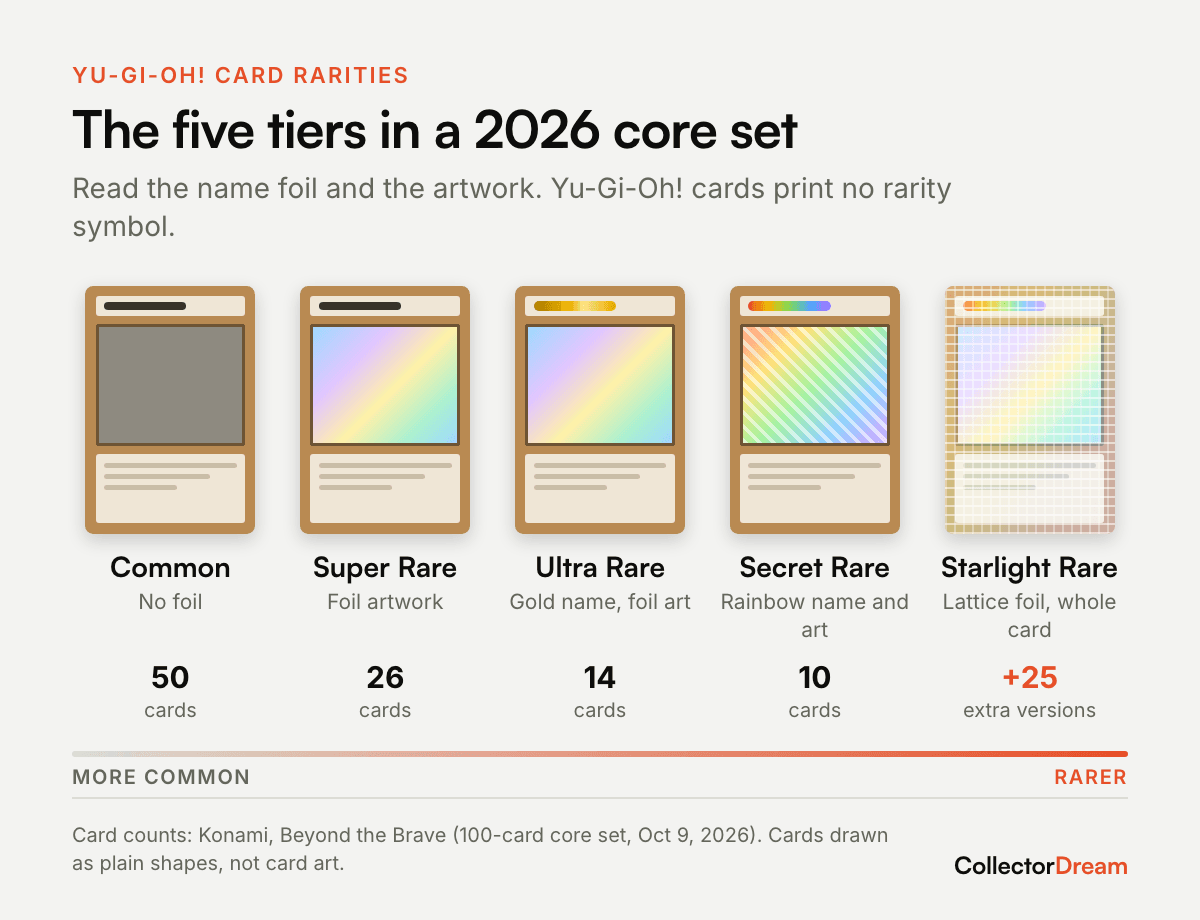
Every English core booster since mid-2025 uses the same five tiers. The counts below are from Konami's page for Beyond the Brave (October 9, 2026), the most recent core set at the time of writing.
Rarity | Card name | Artwork | Cards in Beyond the Brave |
|---|---|---|---|
Common | Black or white, no foil | No foil | 50 |
Super Rare | Black or white, no foil | Holofoil | 26 |
Ultra Rare | Gold foil | Holofoil | 14 |
Secret Rare | Rainbow foil | Rainbow foil in a diagonal pattern | 10 |
Starlight Rare | Rainbow foil | Lattice foil over the whole card, border included | 25 extra versions of cards already in the set (5 with extended art) |
Counts: Konami, Beyond the Brave (100-card set, launched Oct 9, 2026). Descriptions: TCGplayer Seller Blog, Oct 27, 2021. Konami doesn't publish pull rates.
Where is the rarity on a Yu-Gi-Oh! card?
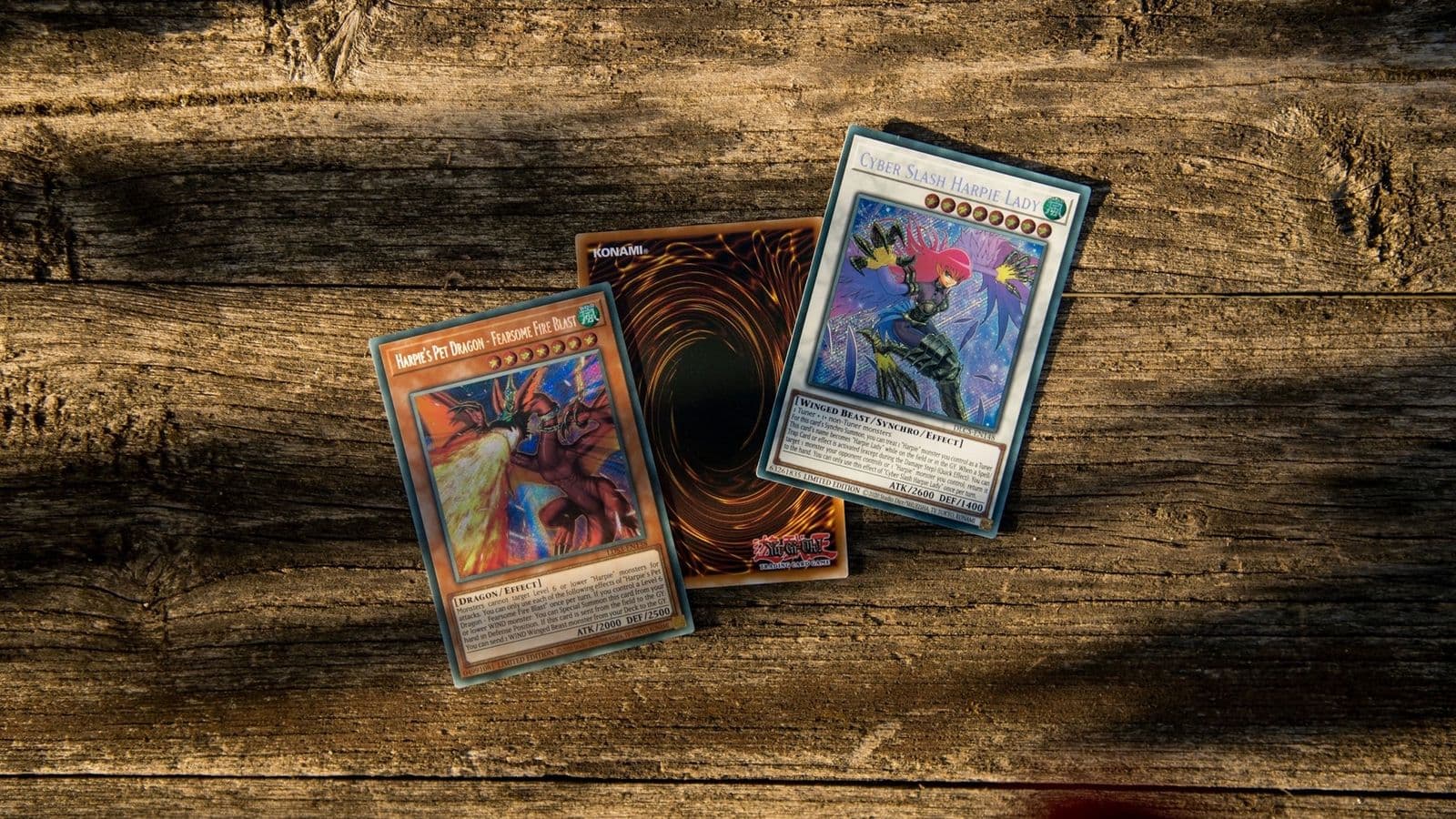
Nowhere, in print. Unlike Pokémon, which puts a symbol next to the card number (our Pokémon rarity guide shows them), a Yu-Gi-Oh! card tells you its rarity only through its foil. Two parts matter:
- The card name at the top: plain ink, silver, gold or rainbow foil.
- The artwork box: plain, holofoil, or a special foil pattern.
What is printed is the set code, under the artwork on the right, such as BETB-EN044. The letters name the set, EN means English, and the number is the card's place in the set. The same code is shared by every rarity of that card, which is why you'll see listings like "BETB-EN044 Starlight Rare": the rarity has to be added by hand.
1st Edition isn't a rarity. The "1st Edition" text below the artwork marks the first print run. A 1st Edition Common is still a Common.
The core booster rarities, one by one
Common
No foil anywhere. Commons fill most of every pack, and you need them for a complete set and for most decks. Konami's core sets have 50 of them.
Super Rare
The artwork is holofoil, but the name is printed normally. That makes Super Rares easy to confuse with Commons from across the room, so tilt the card under a light. Modern Super Rares also have foil Level stars and Attribute icons (TCGplayer).
Ultra Rare
Holofoil artwork plus a gold foil name. Ultra Rares are the most common "hit" in a pack, and many of a set's strongest cards appear at this rarity.
Secret Rare
A rainbow-foil name, and artwork with a finer, diagonal rainbow foil. In a core set there are usually ten, and they're the ones players and collectors look for first in a box.
Starlight Rare
The Starlight Rare is the top tier of today's core sets. It covers almost the whole card, border included, in a horizontal, lattice-like holographic pattern, so it looks different from every other card in the pack at a glance.
Starlight Rares first appeared in Rising Rampage in 2019 (Yugipedia). They came back to core sets with Duelist's Advance (July 4, 2025), where 24 cards got a Starlight version and one card was printed only as a Starlight Rare. Konami said they'd turn up at "about the same rate" collectors had found Quarter Century Secret Rares (Konami). In late 2026 the set Beyond the Brave added extended-art versions, with the artwork spreading over the frame, for five of its cards (Konami).
They're scarce. Konami doesn't publish odds, and community counts are small: one community sample logged four Starlight Rares in 312 Beyond the Brave packs, or 13 boxes (TCGTalk, Oct 2026). Treat that as a rough sense of scale, not a rate.
How do you tell the rarity at a glance?
Ask three questions in order. Is the name foil? If yes, is it gold or rainbow? Then look at the artwork and the border.
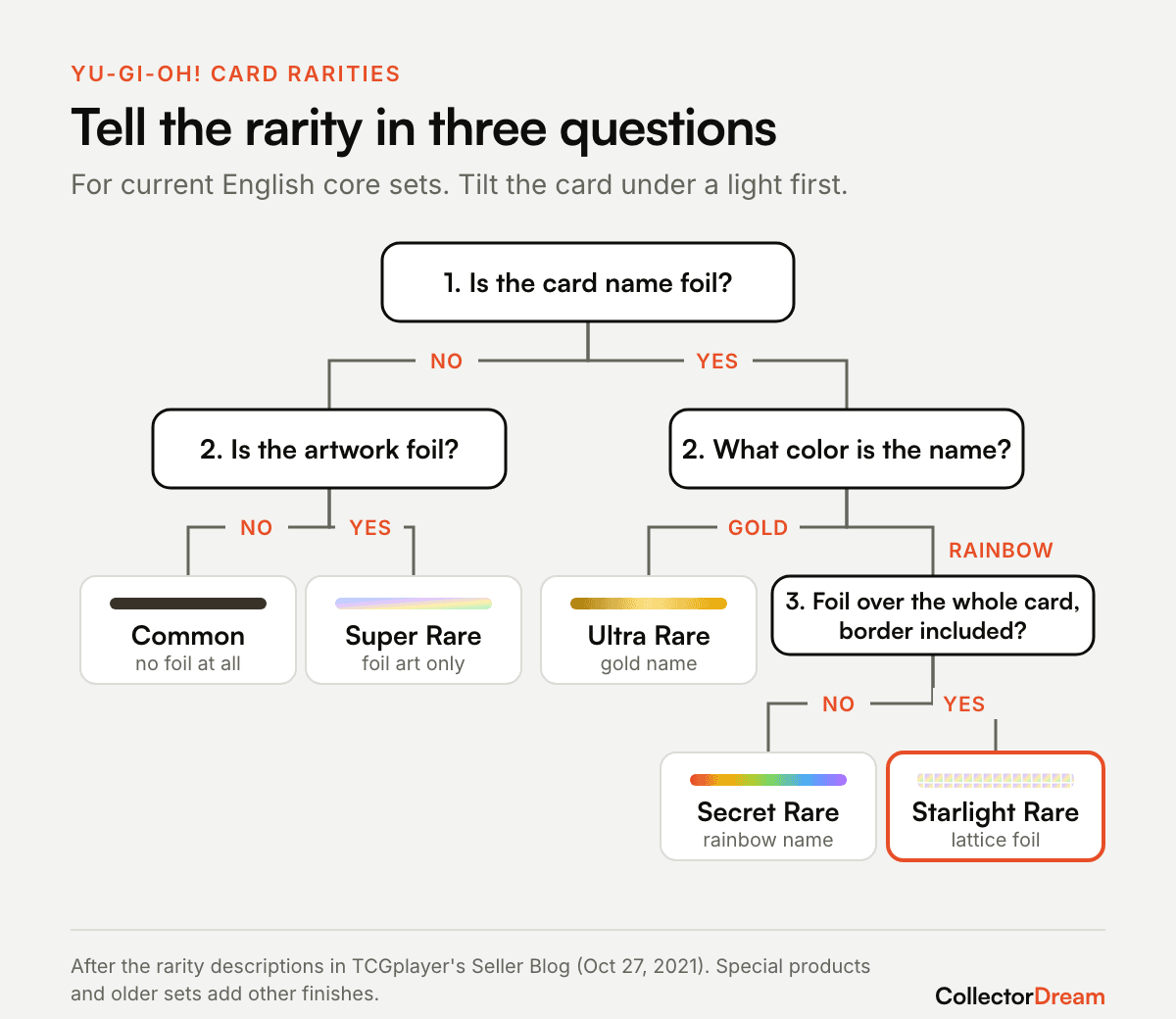
This works for current core boosters. Special products and older cards add other finishes, which is where the next two sections come in.
What happened to Quarter Century Secret Rares?
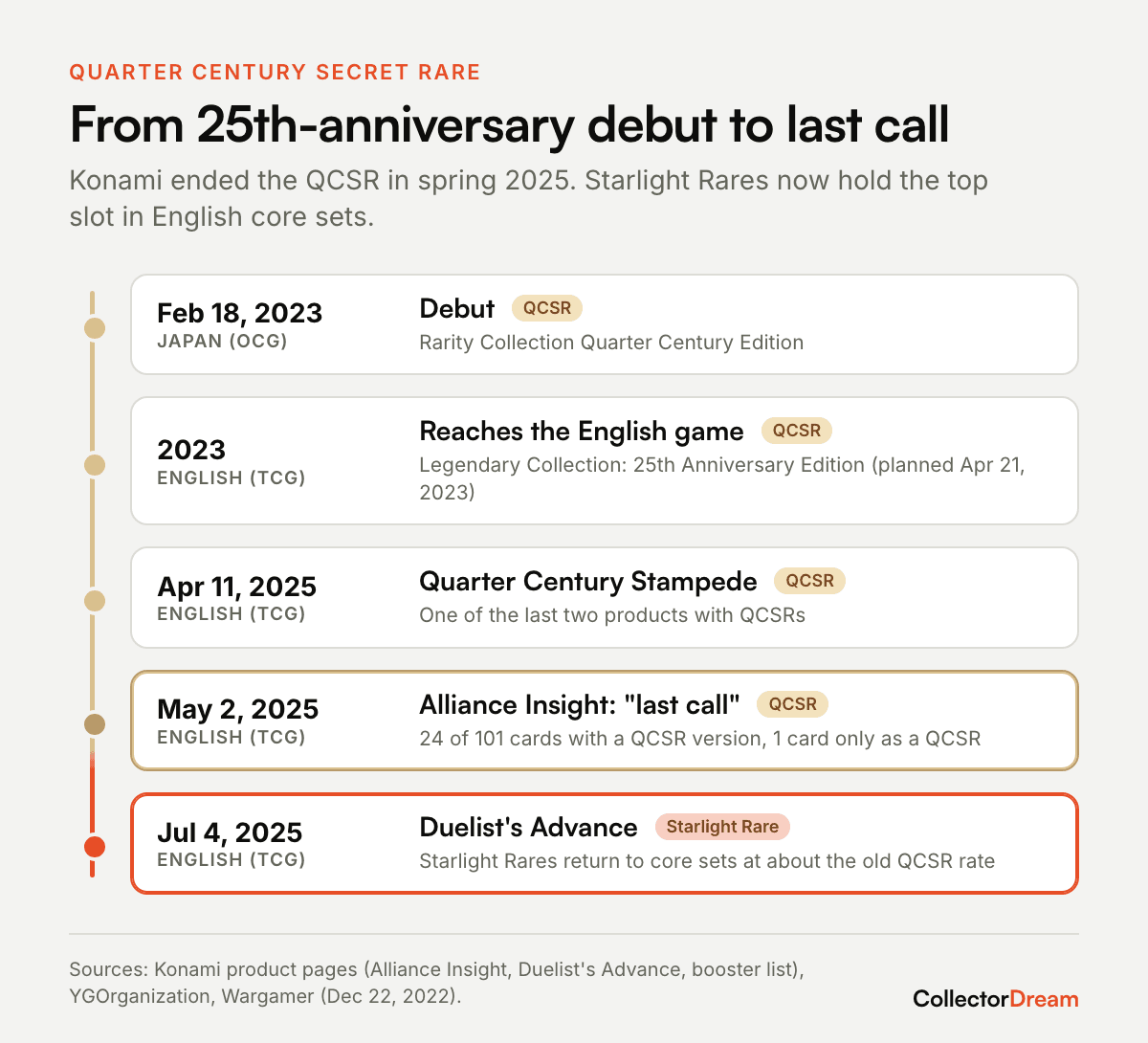
They're retired. The Quarter Century Secret Rare (QCSR) was made for Yu-Gi-Oh!'s 25th anniversary, and Konami ended it in 2025.
- February 18, 2023: QCSR debuts in Japan in Rarity Collection Quarter Century Edition (YGOrganization).
- 2023: it reaches the English game in Legendary Collection: 25th Anniversary Edition, planned for April 21, 2023 (Wargamer, Dec 22, 2022).
- April 11, 2025: Quarter Century Stampede, one of the two last products with QCSRs (Konami).
- May 2, 2025: Alliance Insight, which Konami billed as the "Last call for Quarter Century Secret Rares!" Twenty-four of its 101 cards had a QCSR version, and one card came only as a QCSR (Konami).
- July 4, 2025 onward: Starlight Rares fill the top slot in core sets (Konami).
A QCSR has a speckled, champagne-gold name and a small 25th-anniversary "Quarter Century" mark printed on the card (Samurai Sword Tokyo, Oct 24, 2026). The last Japanese QCSRs came out in April 2025, the same spring as the English ones.
Retired and special-product rarities
You'll meet these in older collections, tins, collector sets and the Rarity Collection line. None of them shows up in a 2026 core booster. The newest is the serial-numbered Grand Master Rare, the scarcest finish Konami has put in an English booster product so far.
Rarity | How to recognize it | Where you'll find it |
|---|---|---|
Rare | Silver foil name, plain artwork | Older English sets; dropped from English core sets, which now go straight from Common to Super Rare |
Ultimate Rare | Gold name, foil artwork, embossed (raised) Level, Attribute and art | Older English core sets; moved to tournament packs from Breakers of Shadow onward (Yugipedia) |
Ghost Rare | Silvery-white name, pale 3D-looking holographic artwork | Introduced in Tactical Evolution (2007); known in Japan as Holographic Rare (Yugipedia) |
Collector's Rare | Muted rainbow foil with a raised texture that some compare to fingerprints | Special products (TCGplayer) |
Platinum Secret Rare | Platinum-colored Secret Rare foil on the art, border, Level and Attribute | Tins and Rarity Collection sets |
Prismatic Ultimate and Prismatic Collector's Rare | Rarity Collection versions of Ultimate and Collector's Rare | Only Rarity Collection sets (Konami, Rarity Collection V) |
Gold Rare, Gold Secret Rare | Gold name, gold borders and holo art | The Gold series products |
Parallel Rares | A normal rarity with a film coating over the whole card (dots, stars, shatterfoil, mosaic) | Promo and special products |
Grand Master Rare | Hieroglyphic border and a serial number from 001 to 100 | Magnificent Monsters (September 4, 2026): 18 cards, 100 copies of each for the Americas plus a separate run marked "E" for markets supplied from Europe (Konami) |
Descriptions: TCGplayer Seller Blog unless noted.
Rarity Collection V (April 17, 2026) is the easiest place to see several of these side by side: alongside Super, Ultra and Secret Rares it has Starlight, Platinum Secret and the Prismatic Ultimate and Collector's Rares, and no Quarter Century Secret Rares (Konami).
OCG vs TCG: how Japanese rarities differ
The OCG (Official Card Game, sold in Japan and Asia) and the TCG (Trading Card Game, sold in English and other Western languages) share the same cards but not the same rarity ladder. If you buy Japanese cards, these differences matter:
| English TCG core sets | Japanese OCG sets |
|---|---|---|
Rare (silver name) | Not used | Still a regular tier |
Ultimate Rare | Tournament packs and special sets only | Still printed in regular sets |
Ghost Rare | Called Ghost Rare | Called Holographic Rare |
Top secret-rare foil now | Starlight Rare | Prismatic Secret Rare (since March 2025) |
Serial-numbered Grand Master Rare | Special products only, starting with Magnificent Monsters (September 4, 2026) | From Limit Over Collection: The Heroes (February 2026) |
Quarter Century Secret Rare | Ended May 2025 | Ended April 2025 |
OCG details: Samurai Sword Tokyo, Oct 24, 2026 and Yugipedia. TCG Grand Master Rare: Konami.
Two traps for new buyers:
- Same name, different look. The OCG's Prismatic Secret Rare looks more like an English Starlight Rare than an English Prismatic Secret Rare (Samurai Sword Tokyo). Always check which version a listing means.
- Set codes tell you the language. Japanese cards carry
JPin the set code, English cardsEN, and the two are priced as separate markets.
Does a higher rarity mean a higher value?
Usually it raises the price, but the card matters more than the foil. A Starlight Rare of a card nobody plays can sell for less than a Secret Rare of a deck staple, and an old Ghost Rare of a famous monster can outsell both. What moves prices:
- The card itself: iconic monsters (Blue-Eyes, Dark Magician) and cards that see heavy competitive play.
- Scarcity of that printing: a card printed only once at a high rarity, or only as a Starlight Rare, has no cheaper version to fall back on.
- Condition: foil Yu-Gi-Oh! cards scratch and curve easily, and grading companies notice.
- Language and edition: English vs Japanese, and 1st Edition vs Unlimited, are separate markets.
We'll cover the cards behind the biggest recent sales in our upcoming guide to the most valuable Yu-Gi-Oh! cards.
What to do with a high-rarity pull
- Sleeve it right away. Yu-Gi-Oh! cards are smaller than Pokémon cards, so use small-size sleeves; our card sleeve size guide has the measurements.
- Toploader or semi-rigid next, especially for Starlight and Secret Rares, whose foil surfaces scuff easily.
- Check centering and the surface before thinking about grading. Our guide to pre-grading at home walks through it, and PSA vs CGC vs TAG vs BGS explains which graders accept Yu-Gi-Oh! cards.
- Look up recent sold prices for the exact set code, rarity and language. Asking prices on a listing aren't proof of value.
Where to go next
- How to Start Collecting Trading Cards in 2026 (the beginner's overview for all five games)
- One Piece Card Rarities Explained (how another Japanese-made game handles rarity)
- How to Spot Fake Cards & Resealed Packs (worth reading before buying a Starlight or Ghost Rare online)
- TCG Release Calendar 2027 (upcoming Yu-Gi-Oh! sets)
Keep track of your foils with CollectorDream
With CollectorDream you can scan a card, confirm its set code and rarity, and see recent sold prices for that exact printing, then log it in your collection. The app is out now on iOS: download CollectorDream on the App Store, and follow Alec's daily openings on YouTube, TikTok and Instagram.
FAQ
What is the rarest Yu-Gi-Oh! card rarity right now?
In current English core sets, the Starlight Rare, which Konami prints at about the rate Quarter Century Secret Rares had. Across all English products, the serial-numbered Grand Master Rare from Magnificent Monsters is scarcer still: 100 numbered copies of each card per distribution region.
Are Quarter Century Secret Rares still being made?
No. Alliance Insight (May 2, 2025) was Konami's "last call" for them in English, and Starlight Rares replaced them in core sets from July 2025.
What's the difference between a Super Rare and an Ultra Rare?
Both have holofoil artwork. An Ultra Rare also has a gold foil name; a Super Rare's name is printed normally.
How can I tell if my Yu-Gi-Oh! card is rare?
Check the name and the artwork. A foil name or foil artwork means it's above Common; gold means Ultra Rare, rainbow means Secret Rare, and foil across the whole card means Starlight Rare.
Is 1st Edition a rarity?
No. "1st Edition" marks the first print run of a set. It's separate from rarity, so a 1st Edition card can be any rarity from Common up.
Alec Nguyen
Founder, CollectorDream
Scan a card, see its rarity and value
The CollectorDream app reads the card for you. Now on the App Store.
Download on iOS (opens the App Store)