On this page · 15 sections
- Every One Piece rarity at a glance
- How to read a One Piece card's rarity
- Base rarities: C, UC, R, SR and SEC
- Leader cards (L)
- What is a parallel card?
- What is a manga rare?
- What does SP mean on a One Piece card?
- Treasure Rares (TR)
- DON!! cards
- Promo cards (P)
- How many of each rarity is in a One Piece set?
- Does a higher rarity mean a higher price?
- Where to go next
- Let CollectorDream read the code for you
- FAQ
Updated: October 29, 2026
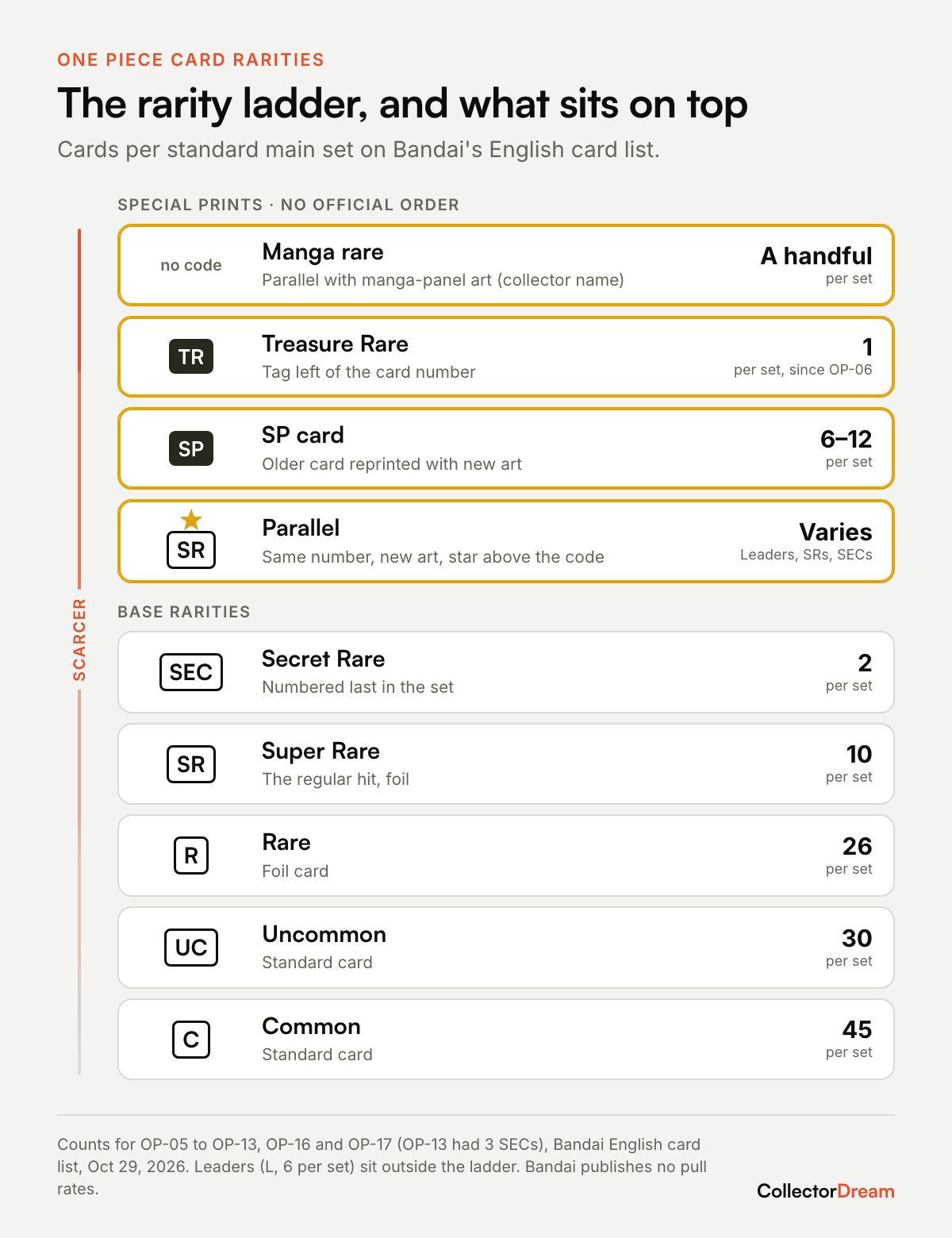
One Piece card rarities are printed as short letter codes, not symbols: C, UC, R, SR, SEC and L, plus a few special prints on top. Once you know where to look and what the little star means, you can sort a fresh pack in seconds. This guide covers every rarity in the English One Piece Card Game, from Common to the manga rare everyone is chasing, and counts how many of each a booster set really has, using Bandai's own card list.
Every One Piece rarity at a glance
Code | Name | What it is | How many in a main set |
|---|---|---|---|
C | Common | Standard card | 45 |
UC | Uncommon | Standard card | 30 |
R | Rare | Foil card | 26 |
SR | Super Rare | Foil card, the regular "hit" | 10 |
SEC | Secret Rare | The top base rarity, numbered last in the set | 2 (OP-13 had 3) |
L | Leader | The card your deck is built around | 6 |
★ over the code | Parallel (alternate art) | Same card number and rarity, new art and finish | Varies, mostly Leaders, SRs and SECs |
SP tag | SP card | An existing card reprinted with new art in a later set | 6–12 |
TR tag | Treasure Rare | One special parallel per set, since OP-06 | 1 |
None | Manga rare | Community name for a parallel with manga-panel art | A handful |
None | DON!! card | Resource card, not part of the rarity system | Varies |
Counts for the standard main booster sets OP-05 to OP-13, OP-16 and OP-17 in the English version, from Bandai's official card list, counted Oct 29, 2026. Bandai doesn't publish pull rates.
How to read a One Piece card's rarity
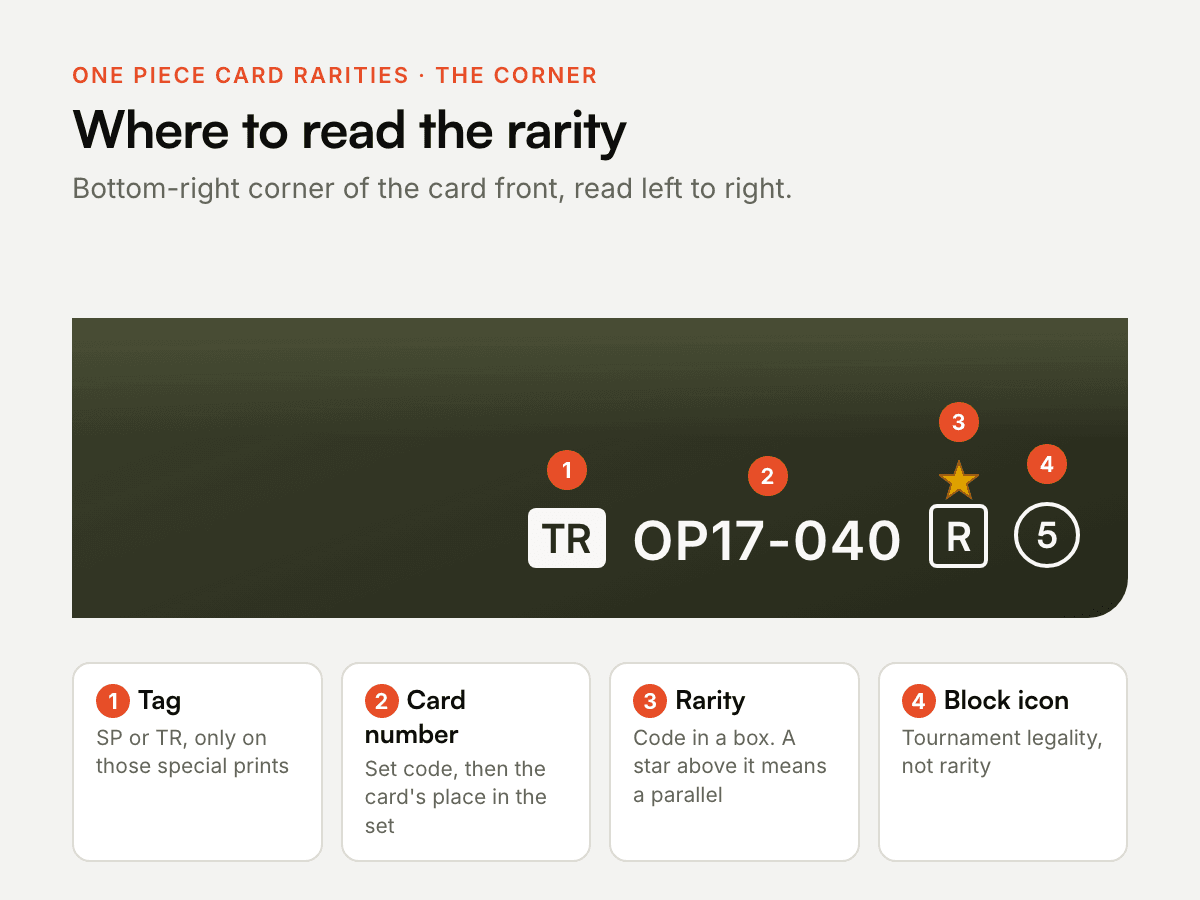
Every One Piece card prints its rarity in the bottom-right corner, in a small box right after the card number. Reading left to right, that corner can show four things:
- An SP or TR tag, only on those special prints.
- The card number, such as
OP17-005. The letters and digits before the dash name the set, and the rest is the card's place in it. - The rarity code in a small box, such as
SR. A star above the box means the card is a parallel. - The block icon, a number in a circle. It decides which tournaments the card is legal in, not how rare it is (Bandai, Jul 23, 2025).
Unlike Pokémon cards, One Piece cards don't print the set size next to the number, so you can't spot a secret rare from a number like 136/103. You read the code in the box instead. If you collect both games, our Pokémon card rarities guide covers the symbol system there.
Base rarities: C, UC, R, SR and SEC
The five base rarities make up the main run of every booster set. In each standard main set on Bandai's English list, the split is nearly identical: 45 Commons, 30 Uncommons, 26 Rares, 10 Super Rares and 2 Secret Rares, with OP-13 the one exception at three Secret Rares (Bandai card list).
- Common (C) and Uncommon (UC) fill most of each pack. They're the cards you'll have doubles of, and you need all of them for a full set.
- Rare (R) cards have a foil finish.
- Super Rare (SR) is the regular hit: ten per set, usually strong characters from the set's story.
- Secret Rare (SEC) is the top base rarity. Most main sets have only two, and they take the last numbers in the set. In OP-17 The World's Strongest Warriors, those are Rocks.D.Xebec (OP17-118) and Loki (OP17-119).
Leader cards (L)
A Leader is the card your deck is built around: it starts the game in play and sets your life total. Leaders carry the code L instead of a rarity, and each main set has six of them. Most Leaders also get a parallel version with new art, so they're collectible as well as playable.
What is a parallel card?
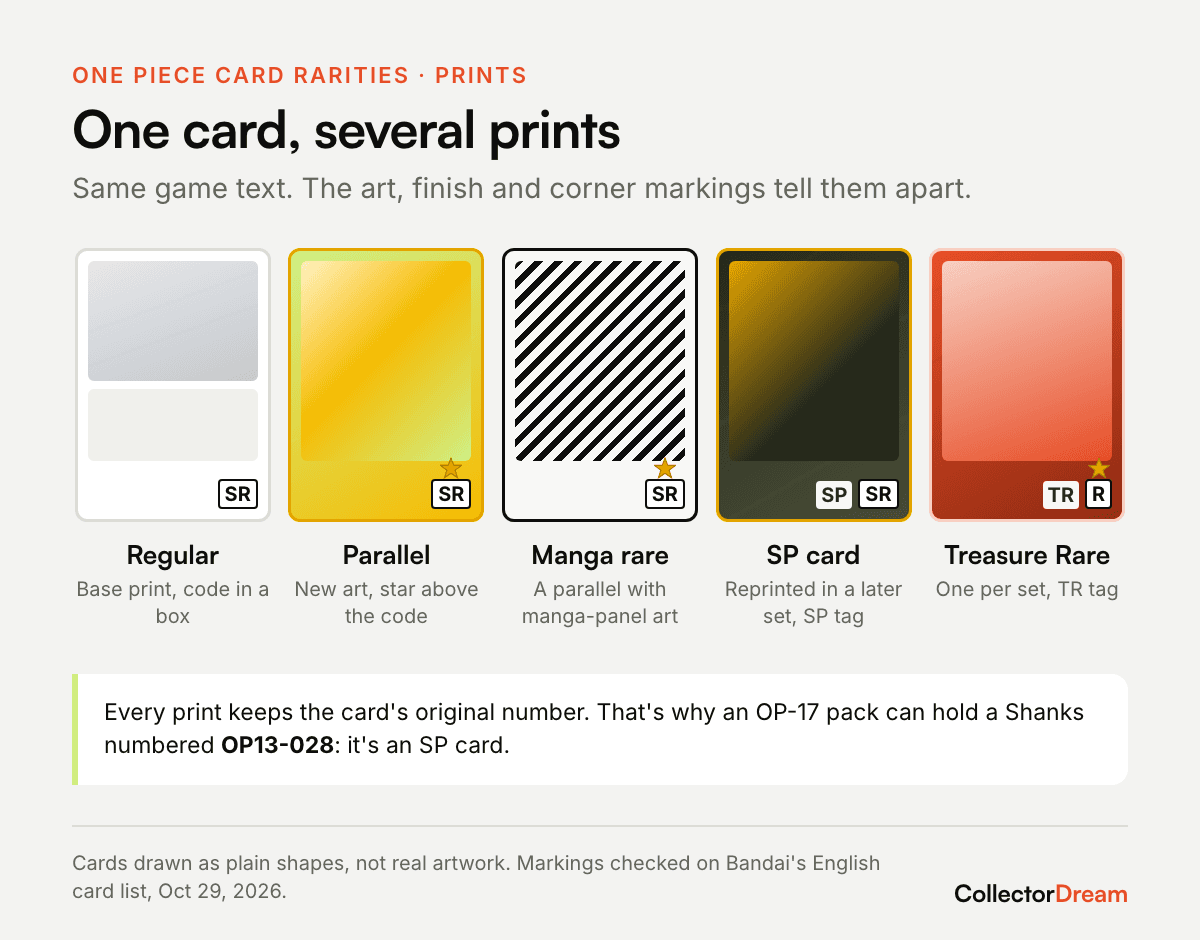
A parallel is an alternate-art print of an existing card. It keeps the same card number, game text and rarity code, but gets new art and a special finish, and a star above the rarity box (Bandai card list). Collectors also call them alt arts.
Parallels are where most of a set's chase cards live. Leaders, Super Rares and Secret Rares get them most often, and some cards get two or three. In OP-17, Edward.Newgate (OP17-005, SR) appears three times on Bandai's list: the regular print and two parallels.
Bandai also uses the name Super Parallel Rare for its scarcest parallel prints. Since April 2026, newly released super parallels, and every card that shares a card number with one, carry the block icon X (Bandai, Jul 23, 2025). So an X on a card tells you that card number has a super parallel. It doesn't tell you that your copy is one.
What is a manga rare?
A manga rare is a parallel card whose art is a panel from the One Piece manga, and it's often the most sought-after card in a set. "Manga rare" is a collector name, not an official rarity: the card still prints its base code (such as SR or SEC) with the parallel star (Samurai Sword Tokyo, Sep 29, 2026). In Japan the same treatment is called a comic parallel.
Bandai's card list files this artwork under the illustration type "Comic". In OP-17, that includes the second parallels of four Super Rares: Edward.Newgate, Shanks, Kaido and Charlotte Linlin. Some regular Event cards use manga panels too, so the art alone doesn't make a card a manga rare; the parallel star does.
Because manga rares sell for so much, fakes are out there. Our guide to spotting fake manga rares, coming next week, walks through what to check.
What does SP mean on a One Piece card?
An SP card is an existing card reprinted in a newer set with new, special art. It keeps its original card number, rarity code and block icon, and adds an SP tag to the left of the number. Bandai's list tags these as "SP CARD" (Bandai card list).
That's why an OP-17 pack can contain a Shanks numbered OP13-028: it's an SP card. Main sets on the English list have had SP cards since OP-03, and 6 to 12 per set since OP-05, and they often come from starter decks and promos as well as earlier boosters.
Treasure Rares (TR)
A Treasure Rare is a single special parallel per set, marked with a TR tag to the left of the card number. Every standard main set from OP-06 to OP-17 has exactly one on Bandai's English list, and the combined OP-14 and OP-15 sets have one each too.
Like SP cards, a Treasure Rare is often a card from an earlier set. The TR in OP-11, for example, is Lucky.Roux numbered OP09-015, and the TR in OP-17 is Edward.Newgate (OP17-040), a Rare with the TR tag and the parallel star (Bandai card list).
DON!! cards
DON!! cards are the game's resource cards: each player has a separate deck of 10 that pays for cards and powers up Leaders and Characters. They don't have a rarity code and aren't on Bandai's card list (Samurai Sword Tokyo, Oct 23, 2026).
They're still collectible. Booster sets add new DON!! designs, and some come in gold or other special versions that collectors look for. Bandai counts them separately: its page for OP-18 The Dominance of God lists "127+1 types" of cards (Bandai).
Promo cards (P)
Promo cards come from events, tournaments and special products rather than booster packs. Their card numbers start with P- (such as P-084), and Bandai's list tags them P. Promos can also come back later as SP cards in booster sets.
How many of each rarity is in a One Piece set?
Standard main sets follow a fixed recipe: 119 base cards, then parallels and special prints on top. Here's what Bandai's English list shows for the three most recent main sets we counted.
Set | Base cards (L / C / UC / R / SR / SEC) | Parallels | SP cards | TR |
|---|---|---|---|---|
OP-13 Carrying On His Will | 6 / 45 / 30 / 26 / 10 / 3 | 43 | 12 | 1 |
OP-16 The Time of Battle | 6 / 45 / 30 / 26 / 10 / 2 | 30 | 6 | 1 |
OP-17 The World's Strongest Warriors | 6 / 45 / 30 / 26 / 10 / 2 | 40 | 10 | 1 |
Counted from Bandai's English card list on Oct 29, 2026. "Parallels" counts every parallel print listed for the set except SP cards, and includes the TR. OP-13 has a third Secret Rare.
Bandai doesn't publish pull rates, so nobody outside the company knows the official odds for any of these. What the counts do tell you: there are far fewer Secret Rares and special prints than Super Rares, and a full "master set" with every parallel is much bigger than the 119-card base set. For what's in the newest set, see our OP-18 chase card guide.
Does a higher rarity mean a higher price?
Usually, but not always. Rarity tells you how scarce a card is in packs; price depends on what collectors want:
- The character. Luffy, Shanks, Zoro and other fan favorites sell for more than less popular characters at the same rarity.
- The art. A striking parallel can be worth far more than the regular print of the same card.
- Condition. Clean corners, edges and centering matter, especially if you're thinking about grading.
- Reprints. An SP or a reprint of a card can change what earlier printings sell for.
For real sold prices, see our list of the most valuable One Piece cards. If you pull a big parallel, sleeve it straight away and check it closely before you decide whether it's worth grading; our pre-grading guide shows you how.
Where to go next
- How to Start Collecting Trading Cards in 2026 (the beginner's guide, all five games)
- Most Valuable One Piece Cards 2026 (which rarities sell for the most)
- Card Sleeve Sizes by Game (the right sleeves for One Piece cards)
Let CollectorDream read the code for you
With CollectorDream you can scan a One Piece card and see its set, number, rarity and print, parallel or not, along with recent sold prices, then add it to your collection. The app is out now on iOS: download CollectorDream on the App Store, and follow Alec's daily pack openings on YouTube, TikTok and Instagram.
FAQ
What is the rarest One Piece card rarity?
Among the printed codes, the Secret Rare (SEC), with only two in most main sets. Above it sit the special prints: parallels of Secret Rares, manga rares, SP cards and the single Treasure Rare per set. Bandai doesn't publish pull rates, so there's no official ranking among those.
What does the star on a One Piece card mean?
A star above the rarity box means the card is a parallel: an alternate-art print of the same card number, with the same game text.
Is a manga rare an official rarity?
No. "Manga rare" is a collector name for a parallel with manga-panel art. The card prints its base code, such as SR or SEC, with the parallel star.
What does SP mean on a One Piece card?
SP marks an existing card reprinted with new art in a later set. It keeps its original card number and rarity code and adds an SP tag next to the number.
What does SEC mean?
Secret Rare, the highest base rarity. Most main sets have two, numbered last in the set.
Are DON!! cards rare?
Regular DON!! cards aren't rare and have no rarity code. Gold and special-art DON!! versions are scarcer, and collectors do chase them.
Alec Nguyen
Founder, CollectorDream
Scan a card, see its rarity and value
The CollectorDream app reads the card for you. Now on the App Store.
Download on iOS (opens the App Store)