On this page · 9 sections
Updated: October 29, 2026
PSA vs CGC vs TAG vs BGS is the first question most collectors ask once a card looks good enough to grade. This guide puts the four side by side: what each one charges and how long it takes, what a 10 actually means at each, which of the five big games they accept, and which grader fits which kind of card.
Grader | Cheapest tier | A middle tier | A fast tier | Scale | Extra detail |
|---|---|---|---|---|---|
PSA | Value: $39.99, max value $500, 90–100 business days | Standard: $59.99, max $1,000, 70–80 days | Express: $199, max $2,500, 20–30 days | 1–10, half grades | Grader Notes from Express up |
CGC | Bulk: $17, max $500, 150 days, 25-card minimum | Economy: $20, max $1,000, 90 days | Standard: $55, max $3,000, 10 days | 1–10, half grades, Pristine 10 and Gem Mint 10 | No subgrade option listed |
TAG | Value: $29.95, covered to $250, 90 days, 10-card minimum | Standard: $59.95, covered to $1,000, 45 days | Express: $149.95, covered to $2,500, 10 days | 1–10 plus a 100–1,000 score | Score from Standard up; defect report on every card |
BGS (reported) | Base: $17.95 with subgrades, 75+ days | Standard: $34.95, 45 days | Express: $79.95, 15 days | 1–10, half grades | Four subgrades |
US prices per card, before shipping, insurance and any membership discount. PSA, CGC and TAG fees from their official pages, checked Oct 29, 2026: PSA pricing and PSA's Value announcement (Oct 28, 2026), CGC services and fees, TAG pricing. Beckett's own pricing page wouldn't load for us, so BGS figures are as reported by PreGradeCards on Sep 16, 2026, citing Beckett's temporary submission form. Turnaround times are each grader's estimate in business days, not a promise.
How do PSA, CGC, TAG and BGS fees compare?
CGC is the cheapest place to start if you can fill a 25-card order, and PSA costs the most at most speeds. The gap is widest at the fast end: CGC Standard takes about 10 business days for $55, while PSA's closest option, Express, is $199 for 20–30 days.
A few things changed in the weeks before this post:
- PSA reopened its Value tier on October 29, 2026, at $39.99 with a $500 maximum value. PSA says new Value orders are processed behind every order already in its building, and its cheaper Value Bulk tier stays closed for now. It also cut 20 days off the Standard and Priority estimates (PSA, Oct 28, 2026).
- BGS paused online Base and Standard orders on August 5, 2026, keeping Express and Priority open, and planned to reopen them on September 15 (ICv2, Aug 6, 2026). Base and Standard were reported open again through a temporary form in mid-September (PreGradeCards). Check beckett.com for the current list before you plan a BGS order.
- TAG's tiers are open but limited. Its pricing page says availability may be limited while it watches volume, and its two cheapest tiers have minimums of 10 and 5 cards (TAG).
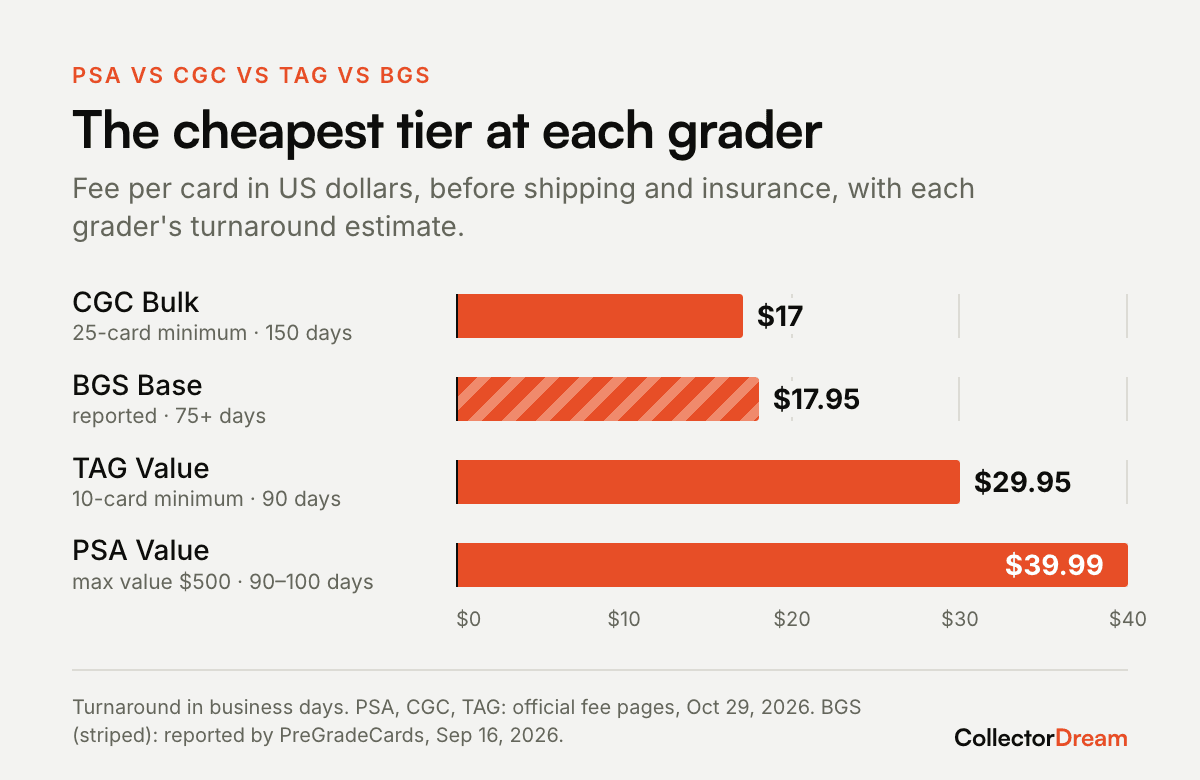
The cheap tiers are cheap because you wait. All four entry tiers sit at 75 business days or more, which works out to roughly three and a half to seven months once weekends are counted.
What does a 10 mean at each grader?
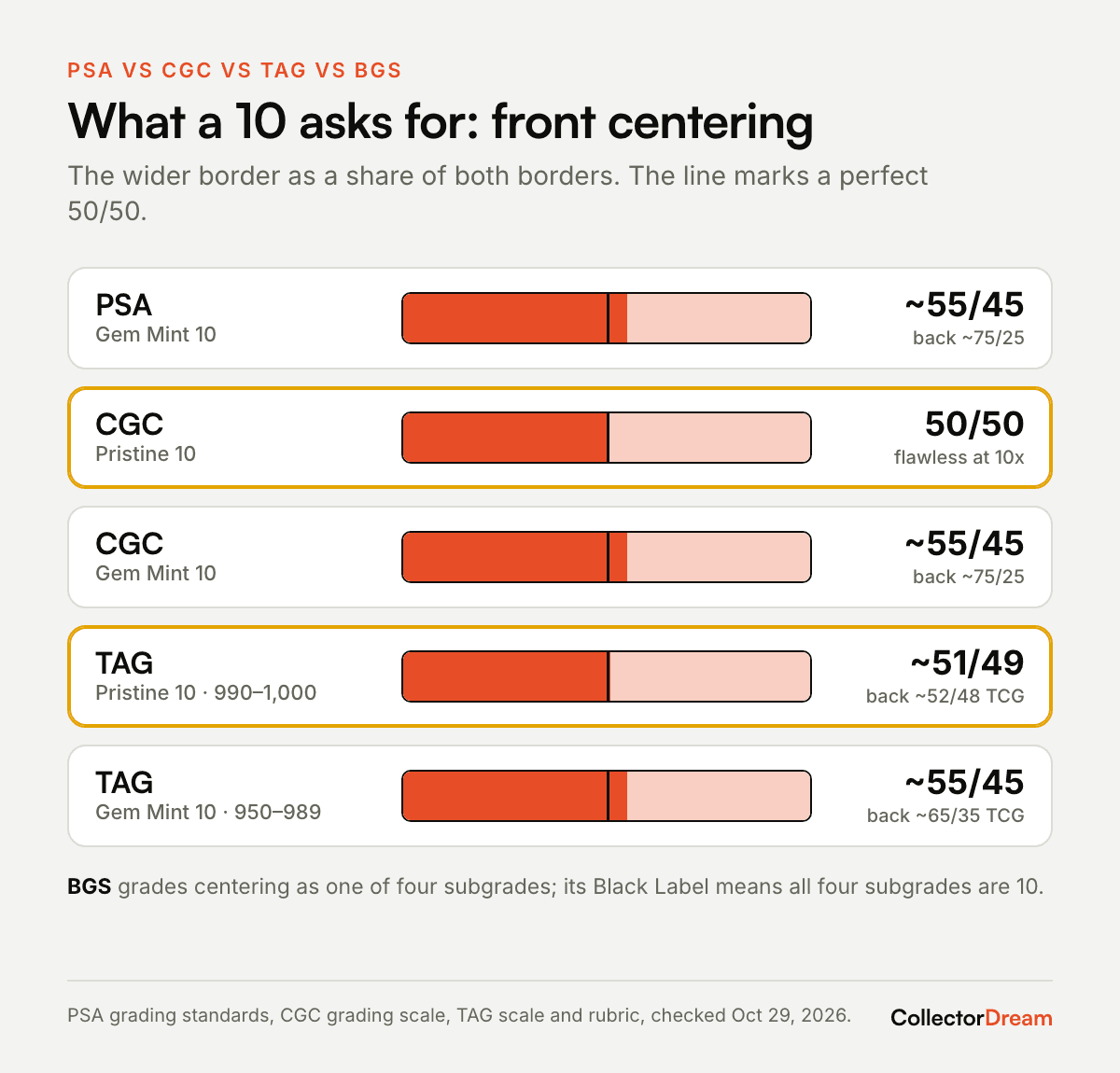
All four use a 1–10 scale, but they draw the top of it differently. PSA has a single Gem Mint 10. CGC and TAG each split the 10 into Pristine and Gem Mint, and BGS is known for its Black Label, given when all four subgrades come back as 10.
Grader | Top grade(s) | Front centering for a 10 | Back centering for a 10 |
|---|---|---|---|
PSA | Gem Mint 10 | about 55/45 | about 75/25 |
CGC | Pristine 10 | 50/50 | — |
CGC | Gem Mint 10 | about 55/45 | about 75/25 |
TAG | Pristine 10 (score 990–1,000) | about 51/49 | about 52/48 for TCG cards |
TAG | Gem Mint 10 (score 950–989) | about 55/45 | about 65/35 for TCG cards |
BGS | Pristine 10 / Black Label | Not checked: Beckett's standards page wouldn't load | — |
Sources: PSA grading standards, CGC grading scale, TAG scale and TAG rubric, checked Oct 29, 2026. Black Label definition: PreGradeCards.
A centering split such as 55/45 means the wider border is 55% of the two borders added together. The closer to 50/50, the better.
What this means in practice:
- PSA gives one number. From Express up, it adds Grader Notes that explain the defects behind the grade (PSA).
- CGC gives one number, and saves the Pristine 10 label for cards that are flawless under 10x magnification, with 50/50 centering (CGC). Its current fee page doesn't list a subgrade option.
- TAG gives a 1–10 grade and, from its Standard tier up, a 1,000-point score ranked against every card it has graded. Every TAG slab comes with a digital report that maps the card's defects (TAG). TAG has no 9.5 (TAG scale).
- BGS prints four subgrades on the label: centering, corners, edges and surface (PreGradeCards).
Which games does each grader accept?
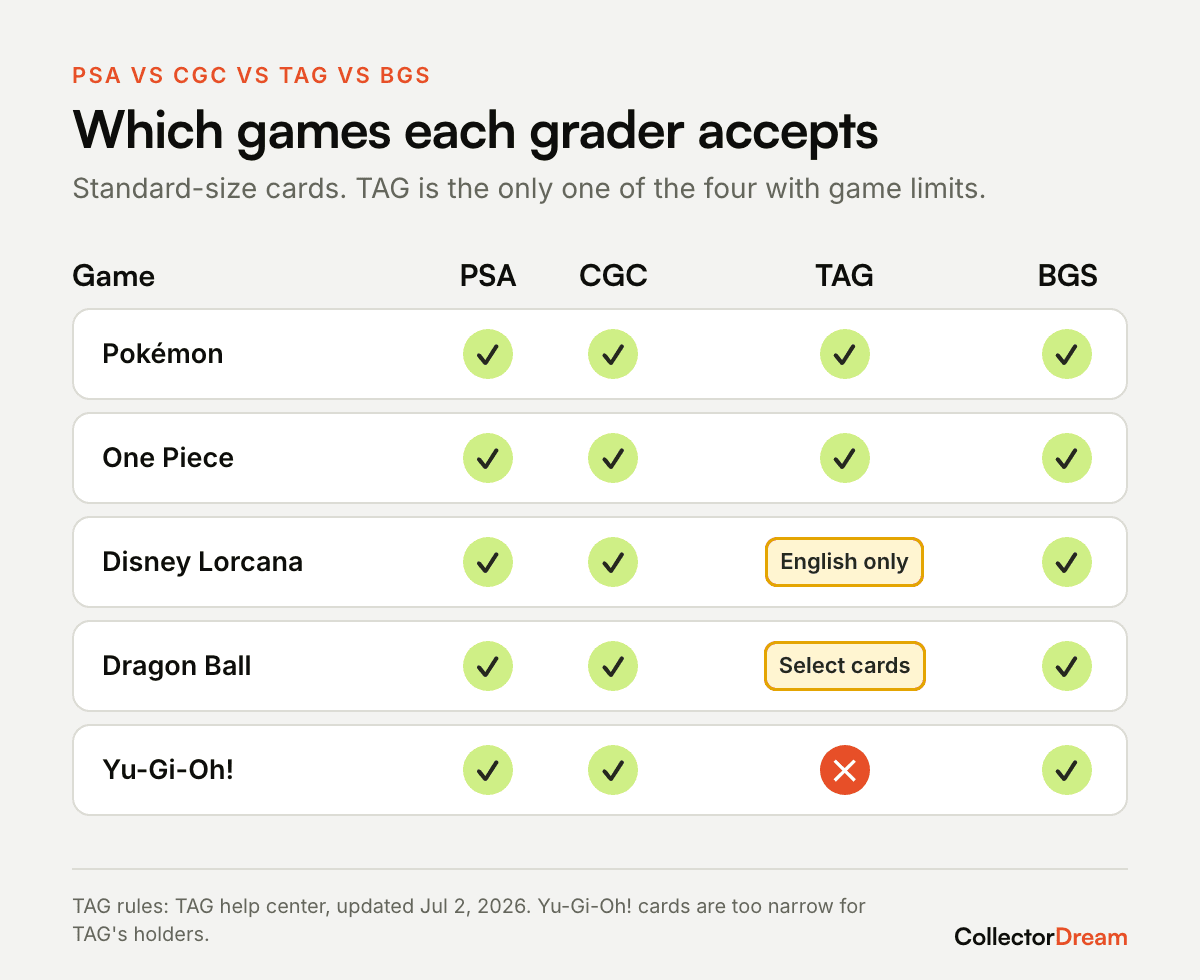
PSA, CGC and BGS grade standard cards from all five games we cover. TAG is the exception: it doesn't take Yu-Gi-Oh! and only some Dragon Ball cards.
Game | PSA | CGC | TAG | BGS |
|---|---|---|---|---|
Pokémon (English and Japanese) | Yes | Yes | Yes | Yes |
One Piece Card Game (English and Japanese) | Yes | Yes | Yes | Yes |
Disney Lorcana | Yes | Yes | Yes (English) | Yes |
Dragon Ball | Yes | Yes | Select cards only; no Dragon Ball Heroes | Yes |
Yu-Gi-Oh! | Yes | Yes | No | Yes |
TAG rules from the TAG help center, updated Jul 2, 2026.
The reason is size. TAG calls Yu-Gi-Oh! cards "bridge" size, 2.25 × 3.5 inches, too narrow for holders built around the 2.5 × 3.5-inch cards most games use. TAG also accepts Japanese cards only for Pokémon, One Piece and some Dragon Ball cards, and it turns down miscuts and test prints (TAG help center). TAG doesn't name which Dragon Ball lines qualify, so ask before you send Fusion World, Masters or Super Divers cards.
Which grader should you use for your card?
Pick the grader by what you want the slab to do. CollectorDream makes its own app, so weigh our take accordingly, but here's how we'd think about it:
- You might sell the card one day: PSA. It's the largest grader by a wide margin (it says it graded 59 million items in the past three years alone), so PSA slabs have the deepest pool of past sales for buyers to compare against (PSA, Oct 28, 2026). The trade-off is the longest queue.
- You want a lot of cards slabbed for your own binder or shelf: CGC Bulk or Economy, or TAG Value. They're the cheapest per card, and CGC lets you mix games in one Bulk order (CGC).
- You want the card back quickly: CGC Standard ($55, about 10 business days) or Express ($100, about 5).
- You want to know exactly why it got its grade: TAG's score and defect report, or BGS subgrades.
- You collect Yu-Gi-Oh!: PSA, CGC or BGS.
- Your card might be close to perfect: CGC and TAG both have a Pristine 10, and BGS has the Black Label. PSA tops out at Gem Mint 10.
For One Piece in particular, our guide to whether grading One Piece cards is worth it runs the break-even math. If you're new to slabs entirely, start with how to start collecting trading cards.
What the fee table leaves out
The per-card fee is only part of what you pay and wait for:
- Declared value sets your tier. Each tier has a maximum card value. CGC says that if it values a card higher than you declared, it moves the card to the right tier and bills you the difference (CGC). TAG says its price doesn't change with a card's value; each tier instead includes protection up to a set amount (TAG).
- Minimums. CGC Bulk needs 25 cards, TAG Value 10 and TAG Base 5.
- Shipping and insurance both ways, plus any membership. CGC's paid memberships start at $39 a year (CGC) and take 10–20% off grading.
- The queue. Turnaround estimates are estimates. PSA says it had a backlog of 7.2 million items on October 28, 2026, and new Value orders go behind it (PSA).
- The grade you actually get. A fee that makes sense for a 10 can make no sense for a 9. Check a card's centering, corners, edges and surface honestly before you pay to find out.
Checking a slab you already own or want to buy
Every one of these graders prints a certification number on the label and lets you look it up on its website. Do it before you buy any slab: the record should match the card's name, set, number and grade.
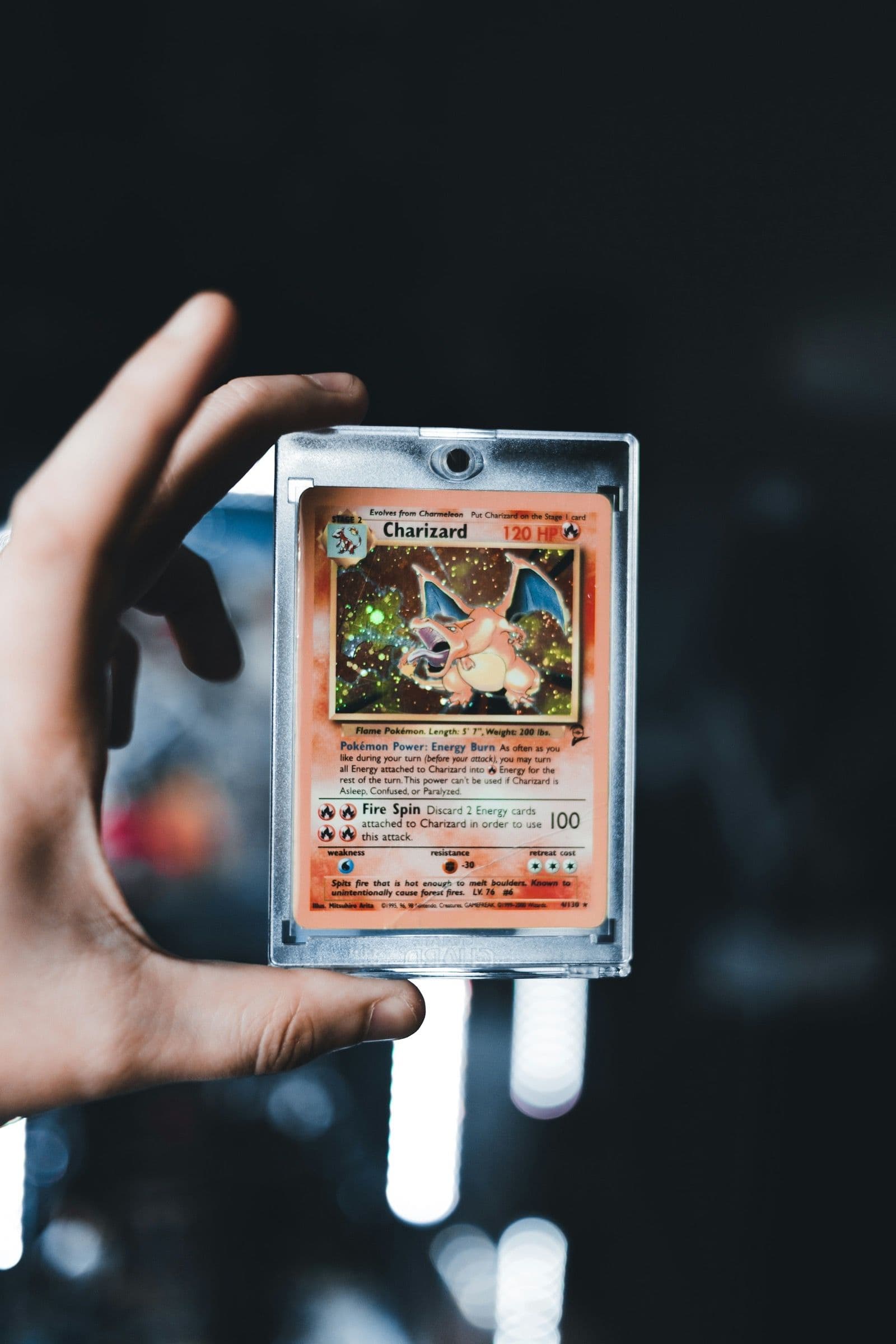
PSA warns that a matching cert number doesn't prove a slab is genuine, because counterfeiters copy real numbers onto fake labels. Its buyer's guide suggests holding the label up to a strong light (you should be able to make out the text on the other side) and checking the holder's edges for cloudy "frosting" or cracks, which show the seal has been broken (PSA). For raw cards and sealed packs, our guide to spotting fake cards and resealed packs covers the warning signs.
Where to go next
- Is It Worth Grading One Piece Cards in 2026? (break-even math for a real game)
- Most Valuable One Piece Cards 2026 (the cards most often sent for grading)
- Pokémon Card Rarities Explained (which pulls are worth a closer look)
- How to Start Collecting Trading Cards in 2026
Know your grade before you pay for one
CollectorDream helps you decide what to send in: scan a card and see its recent sold prices, raw and graded. A pre-grade read on its centering and condition is coming soon. The app is out now on iOS: download CollectorDream on the App Store, and follow my daily openings on YouTube, TikTok and Instagram.
FAQ
Which grading company is best for Pokémon cards?
It depends on the goal. PSA has the largest market for graded Pokémon cards, CGC is cheapest and fastest at mid-range speeds, TAG gives the most detailed report, and BGS gives subgrades. All four accept English and Japanese Pokémon cards.
Is CGC cheaper than PSA?
Yes, at every comparable speed on October 29, 2026. CGC's cheapest tier was $17 (25-card minimum) against PSA's $39.99, and CGC's 10-day Standard tier was $55 against $199 for PSA Express.
Does TAG grade Yu-Gi-Oh! cards?
No. Yu-Gi-Oh! cards are a smaller size than TAG's holders are built for. Send them to PSA, CGC or BGS.
What is the difference between a Pristine 10 and a Gem Mint 10?
At CGC and TAG, Pristine is the top of the 10 grade: near-perfect centering (50/50 at CGC, about 51/49 at TAG) and no flaws visible under magnification. A Gem Mint 10 allows about 55/45 centering and very minor flaws.
Does PSA give subgrades?
No. PSA gives one overall grade. Its Express tier and above add Grader Notes that explain the defects behind it.
Which grader is fastest?
For the money, CGC: Standard in about 10 business days for $55 and Express in about 5 for $100. The very fastest tiers are CGC WalkThrough (about 2 business days, $300), TAG Premier (3–5 days, $299.95) and PSA Premier (7–10 days, $599).
Alec Nguyen
Founder, CollectorDream
Scan a card, see its rarity and value
The CollectorDream app reads the card for you. Now on the App Store.
Download on iOS (opens the App Store)