On this page · 10 sections
Updated: October 29, 2026
Starting a card collection in 2026 can feel like walking into a card show for the first time: five big games, new sets every few weeks and prices that change daily. The good news is you don't need to know all of it. This guide walks you through how to start collecting trading cards one step at a time: picking a game, deciding what kind of collector you are, buying your first cards safely and keeping them in good shape.
I've been opening packs on camera every day, and almost every question in my comments comes back to these same few decisions. Here's how I'd make them.
The five games at a glance
| Pokémon | One Piece Card Game | Yu-Gi-Oh! | Dragon Ball | Disney Lorcana |
|---|---|---|---|---|---|
Publisher | The Pokémon Company | Bandai | Konami | Bandai | Ravensburger |
Collecting since | 1990s | Japan Jul 2022, English Dec 2022 | Late 1990s | Fusion World since Feb 2024 (older lines before that) | Aug 2023 |
Newest English release (early Nov 2026) | Delta Reign (Nov 6) | OP-17 (Aug 28); EB-05 (Oct 30); OP-18 due Nov 20 | Beyond the Brave (Oct 9) | Fusion World FB11 (Oct 16) | Hyperia City (Oct 23) |
Top collector chase | Special Illustration Rares, gold Mega Hyper Rares | Manga-art alt arts, Treasure Rares | Starlight Rares | Alt arts and Secret Rares | Enchanted and Iconic cards |
Official English pack price | No single MSRP; ETB $49.99 for 9 packs | $4.99 | Not listed on Konami's product pages | $4.99 (Fusion World); $5.99 (Masters) | Not listed in Ravensburger's release news |
Card size | Standard | Standard | Smaller | Standard | Standard |
Release dates and pack prices from each publisher's official product pages (checked Oct 28–29, 2026): Pokémon, One Piece, Yu-Gi-Oh!, Fusion World, Masters, Lorcana. ETB retail price: Coded Yellow and Cardrake.
Step 1: Pick a game you actually care about
Price charts change; the characters you grew up with don't. The collectors I see stick around longest are the ones who started with a game they already loved. Here's a quick, honest profile of each.
Pokémon
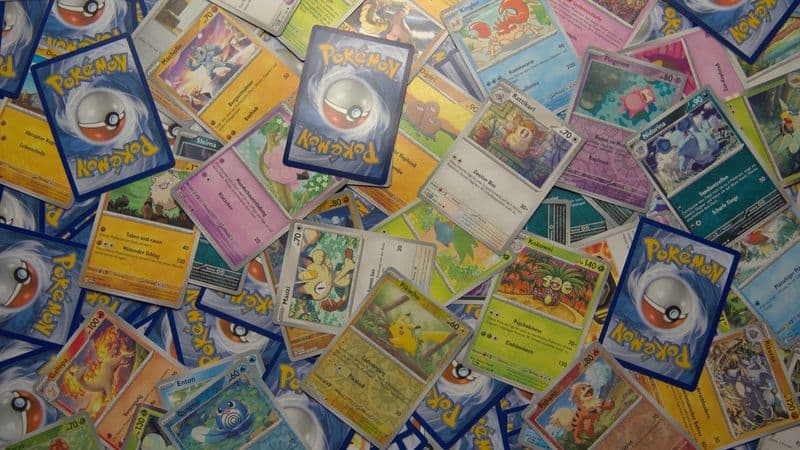
The biggest and most collected card game, celebrating its 30th anniversary this year with the all-foil 30th Celebration set (TCGplayer, Sep 3, 2026). The newest main set, Delta Reign, arrives November 6 with Mega Rayquaza ex as its headline card (our Delta Reign chase card guide covers the odds). There's enormous variety, from cheap commons of your favorite Pokémon to rare full-art cards, and new sets arrive every couple of months.
Good for: nostalgia, art lovers, collecting one favorite Pokémon across 30 years of cards. Watch out for: big releases sell out and get marked up. Avoid paying well above retail in launch week.
Before your first packs, it helps to know what the rarity symbols mean. They're printed next to the card number, and our full Pokémon rarity guide is coming later this month.
One Piece Card Game
Bandai's card game based on Eiichiro Oda's manga launched in Japan in July 2022 and in English that December (Samurai Sword Tokyo set timeline). Its English booster packs are $4.99 each at MSRP (Bandai, OP-17). Collectors chase alternate-art cards, especially the ones drawn in manga panel style that fans call "Manga Rares". That's a community nickname, not an official rarity: the official list runs from Common up to Secret Rare, Special Card (SP) and Treasure Rare.
Good for: anime and manga fans, collectors who like striking alt art. Watch out for: Japanese and English printings are priced very differently, so always check which language a listing is.
Yu-Gi-Oh!
Konami's card game has been around since the late 1990s and has a huge back catalog. The newest booster, Beyond the Brave, came out October 9, and Glorious Victors follows on December 4 (Konami). Collectors today chase Starlight Rares, which Beyond the Brave includes (Konami Europe). Konami billed Alliance Insight (May 2025) as the "last call" for Quarter Century Secret Rares, so those are now a closed rarity.
Good for: players who also collect, fans of the original anime, vintage hunters. Watch out for: Yu-Gi-Oh! cards are smaller than the other four games (about 59 × 86 mm), so they need smaller sleeves (TCG Stacked). Some graders don't take them: TAG, for example, doesn't currently grade Yu-Gi-Oh! (TAG, Jul 2, 2026).
Dragon Ball
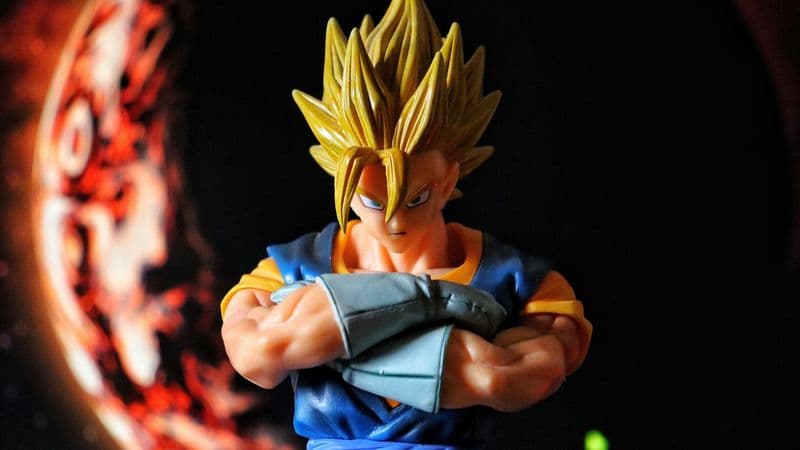
Dragon Ball is really three different collecting worlds, all from Bandai:
- Fusion World, the current main card game, launched in February 2024. Its newest English set, FB11 Brightness of Hope, came out October 16, with FB12 Reach the God due December 18, at $4.99 a pack (Bandai).
- Masters, the original Dragon Ball Super Card Game, is still running, with its own tournaments and sets (Bandai). Its next booster, Chromatic Ascension (DBS-B32), is due November 27, 2026, at $5.99 for a 12-card pack (Bandai).
- Super Divers is a Japan-only arcade card game. It replaced Super Dragon Ball Heroes (Siliconera) and launched on November 7, 2024. Each play at the arcade machine gives you one card (Famitsu). There's no English release, so collectors outside Japan buy the cards secondhand.
Good for: lifelong Dragon Ball fans, collectors who enjoy a smaller, friendlier market. Watch out for: make sure you know which of the three lines a card comes from; they aren't interchangeable.
Disney Lorcana
Ravensburger's Disney card game launched in game stores in August 2023. Its newest set, Hyperia City, came out October 23, and Into the Inkdark arrives in early 2027 (Disney Lorcana, Sep 22, 2026). The collector favorites are Enchanted cards, plus the newer Epic and Iconic rarities added with Fabled in 2025 (Rare Candy). Into the Inkdark introduces collector boosters and the first serialized Illustrious cards: six per set, with only 23 of each printed.
Good for: Disney fans, families, collectors who want a younger game where full sets are still within reach. Watch out for: serialized cards make the very top of the market harder to complete, so decide early whether you're chasing those or not.
If Pokémon is your pick, Phillips Collectibles' beginner roadmap (above) is one of the most-watched starter videos of the year and a good companion to this guide.
Step 2: Choose your collecting lane
You don't have to collect "everything". Most happy collectors pick one or two lanes:
Lane | What it means | Why people like it |
|---|---|---|
Favorite character | Every card of one Pokémon, pirate, Saiyan or Disney hero | Clear goal, spans every set, any budget |
Set collector | One copy of every card in a set (a "master set" adds every variant) | Satisfying checklist, great with packs |
Art collector | Alt arts, illustration rares, a favorite artist | Your binder becomes a gallery |
Sealed collector | Unopened boxes and packs kept as they are | Display value, nostalgia |
Graded collector | Cards in protective slabs with a condition grade | Long-term protection, easier to trade |
Player-collector | Build decks you play, upgrade to fancier versions over time | Your cards get used, and you meet people |
Pick one lane to start. You can always add another later.
Step 3: What to buy first
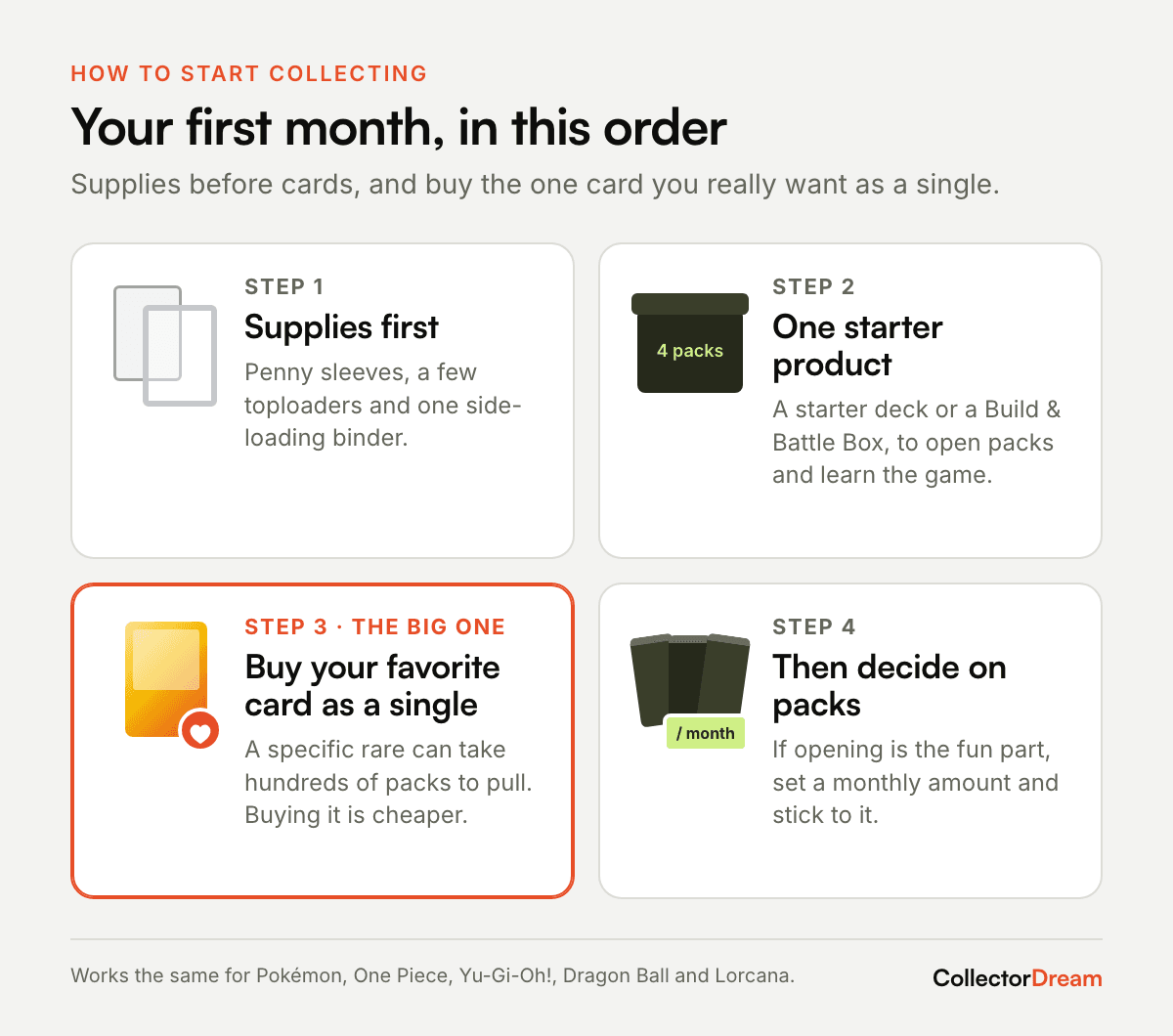
Here's what I'd buy in your first month, in this order:
- Supplies before cards: penny sleeves, a handful of toploaders and one side-loading binder. Cheap, and they protect everything that follows.
- A starter product: a starter deck or a small box with a few packs, for the fun of opening and for a feel of the game. In Pokémon, a Build & Battle Box gives you a deck, four packs and a promo for $21.99 at retail (Cardrake, Oct 27, 2026).
- One card you really want, as a single. This is the most important tip in the guide. A specific rare card can take hundreds of packs to pull. Buying it directly is almost always cheaper, and it's the card you'll actually look at every day.
- Then decide on packs. If opening is what you enjoy, set a monthly amount and stick to it.
Set a budget you won't regret
Pick an amount you'd be comfortable spending on a hobby each month, as you would for games or concerts, and treat it as spent once it's gone. Collecting stays fun when it isn't tied to whether prices go up.
Step 4: Buy from places you can trust
- Local game stores: fair prices, prerelease events and people to trade with. Often the best place to start.
- Official stores and big retailers: the safest place to buy sealed products at retail price.
- Established marketplaces: fine for singles, as long as the seller has a long history of good feedback and the platform offers buyer protection.
- Card shows: great for singles and trades once you know prices. Bring a list and check recent sold prices on your phone.
Red flags: a deal far below every other listing, sealed boxes with loose or uneven wrapping, sellers who want payment outside the platform, and photos that look copied from elsewhere. A full guide to spotting fake cards and resealed packs is coming before the holidays.
Step 5: Protect your cards
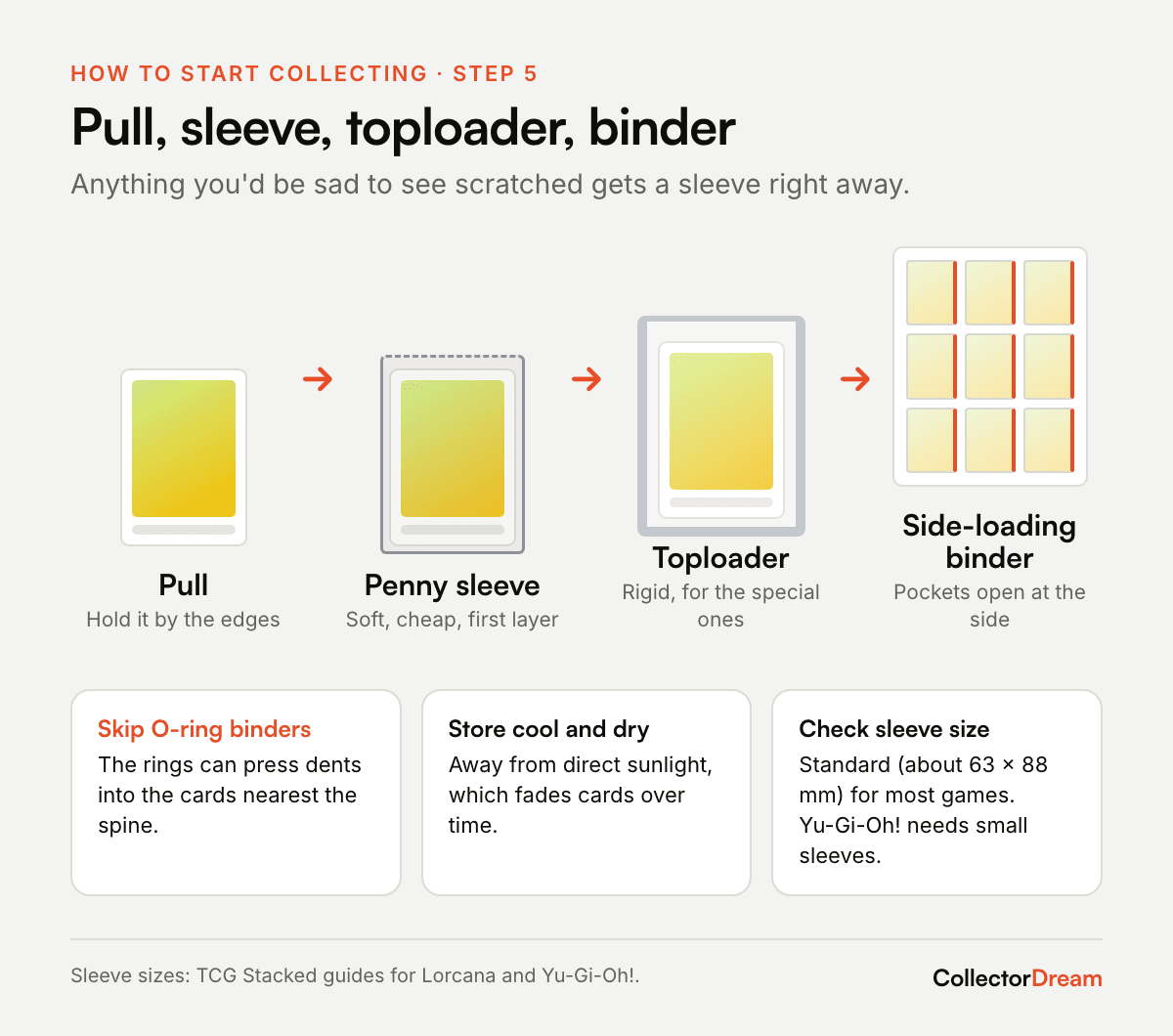
- Pull, sleeve, toploader. Anything you'd be sad to see scratched goes into a penny sleeve right away, and anything special goes into a toploader too.
- Binders: use side-loading pages. Avoid O-ring binders, whose rings can press dents into cards.
- Storage: somewhere cool and dry, out of direct sunlight.
- Sleeve sizes: Pokémon, One Piece, Lorcana and Dragon Ball use the standard size (about 63 × 88 mm), and Yu-Gi-Oh! needs small sleeves (TCG Stacked: Lorcana, Yu-Gi-Oh!).
Step 6: Know what you own
Sooner or later you'll wonder what a card is worth. Two habits will save you a lot of money:
- Look at sold prices, not asking prices. A listing shows what someone hopes to get. Completed sales show what people actually paid.
- Match the exact card: same set, same number, same language, same condition. A Japanese card and its English version can be priced very differently, and so can a raw card and a graded one.
Grading (sending a card to a company like PSA, CGC, BGS or TAG to be authenticated, graded and sealed in a slab) costs real money per card, so save it for cards you love or cards in top condition. We'll cover when grading is worth it in its own guides.
Where to go next
- Delta Reign Chase Cards & Pull Rates: what to chase in the newest Pokémon set, and which product gives you the most packs for your money.
- Coming next on the blog: Pokémon card rarities explained, One Piece chase cards and a guide to grading. We'll link them here as they go live.
Start your collection with CollectorDream
CollectorDream is built for exactly this moment: you can scan cards from all five games, see recent sold prices (raw and graded) and watch your collection grow in one place. The app is out now on iOS: download CollectorDream on the App Store, and follow my daily collecting videos on YouTube, TikTok and Instagram.
FAQ
Which trading card game is best for beginners to collect?
The one whose characters you love. Pokémon has the most variety and the biggest community. One Piece, Dragon Ball Fusion World and Lorcana are younger, so complete sets are easier to reach. Yu-Gi-Oh! suits people who want to play as well as collect.
Is it better to buy packs or singles?
For a specific card, singles are almost always cheaper. Packs are for the fun of opening and for building a set from scratch. Most collectors do both.
How much should I spend when I start collecting?
An amount you'd happily spend on any hobby each month, decided before you shop. Start with supplies, one starter product and one single you really want.
Are Japanese cards worth collecting?
Many collectors love them for their print quality and earlier release dates. They're priced differently from English cards, so compare like with like, and check your grader accepts the language before you submit.
Do I need to grade my cards?
No. Grading protects and authenticates a card, but it costs money per card and takes time. Most cards in a new collection are best kept in sleeves, toploaders and binders.
Alec Nguyen
Founder, CollectorDream
Scan a card, see its rarity and value
The CollectorDream app reads the card for you. Now on the App Store.
Download on iOS (opens the App Store)