On this page · 11 sections
- The modern rarity ladder at a glance
- How to read the bottom of a card
- Each rarity, explained
- Special-set rarities
- Older cards: before 2023
- Japanese rarity codes vs English names
- Does a higher rarity mean a higher price?
- What to do with a big pull
- Where to go next
- Let CollectorDream read the symbol for you
- FAQ
Updated: October 29, 2026
Every modern Pokémon card tells you how rare it is: look for the small symbol next to the card number in the bottom corner. Once you can read it, you'll know in a second whether a pull is a regular rare, a sought-after Special Illustration Rare or the gold card everyone is chasing. This guide covers all the Pokémon card rarities printed in English sets today, what each one looks like, how often it turns up in packs, and how the Japanese codes line up with the English names.
The modern rarity ladder at a glance
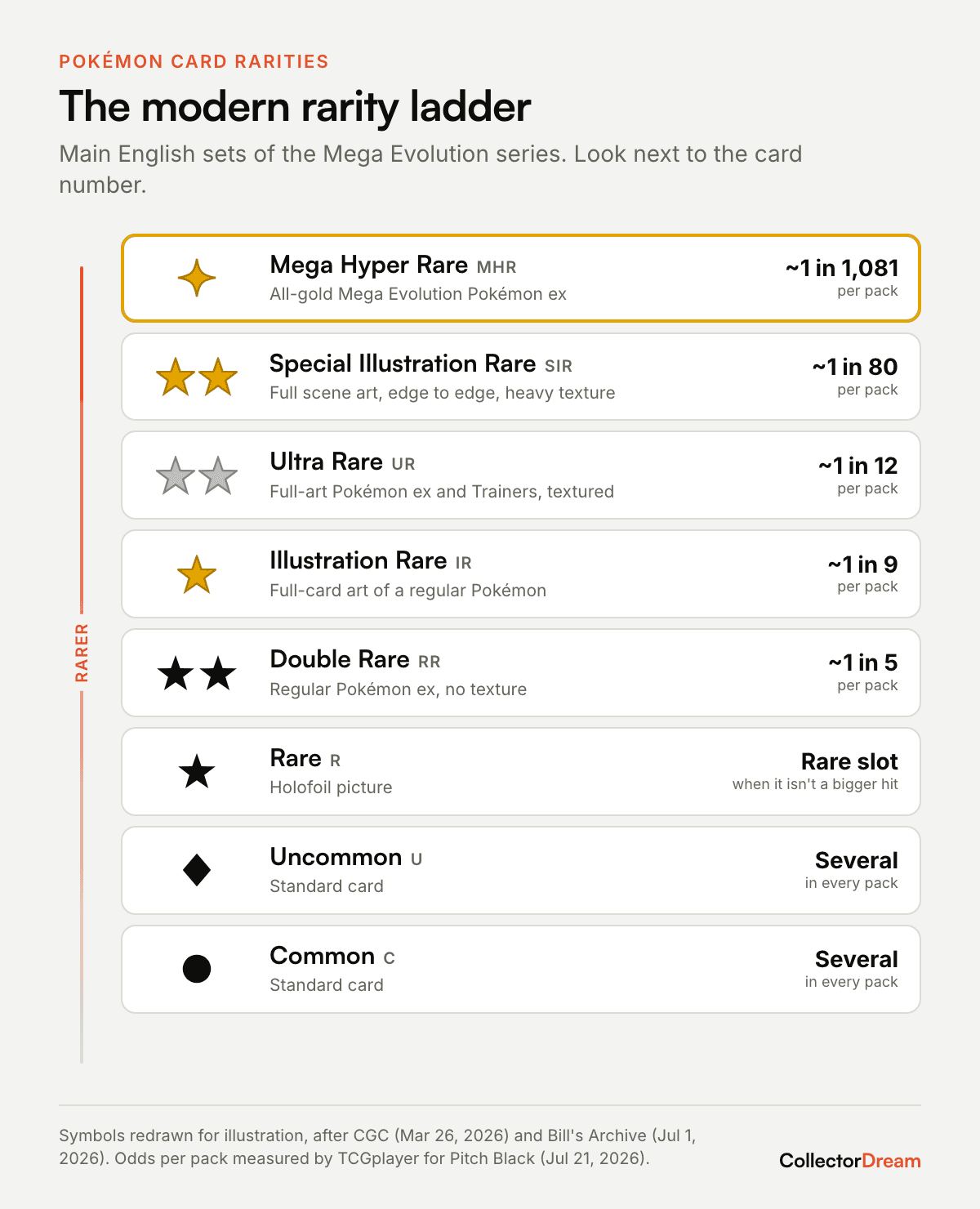
These are the rarities in main English sets of the current Mega Evolution series, which uses the same system as Scarlet & Violet except for the gold cards. Odds are per pack, measured by TCGplayer's Authentication Center for two recent sets.
Symbol | Rarity | What the card looks like | Pull rate per pack (Mega Evolution / Pitch Black) |
|---|---|---|---|
● black circle | Common | Standard card | Several in every pack |
◆ black diamond | Uncommon | Standard card | Several in every pack |
★ black star | Rare | Holofoil artwork | The rare slot, when it isn't a bigger hit |
★★ two black stars | Double Rare | Regular Pokémon ex, no texture | ~1 in 5 |
★ one gold star | Illustration Rare (IR) | Full-card art of a regular (non-ex) Pokémon | ~1 in 9 |
★★ two silver stars | Ultra Rare (UR) | Full-art Pokémon ex and Trainers, textured | ~1 in 12 |
★★ two gold stars | Special Illustration Rare (SIR) | Full-card scene art of a Pokémon ex or Supporter, heavily textured | ~1 in 101 / ~1 in 80 |
✦ gold four-pointed star | Mega Hyper Rare | Gold, front-facing Mega Evolution Pokémon ex | ~1 in 1,260 / ~1 in 1,081 |
Symbols: CGC, updated Mar 26, 2026 and Bill's Archive, updated Jul 1, 2026. Mega Hyper Rare symbol and pull rates: TCGplayer for Mega Evolution (5,000+ packs, Sep 30, 2025) and Pitch Black (4,000+ packs, Jul 21, 2026). The Pokémon Company doesn't publish official pull rates.
How to read the bottom of a card
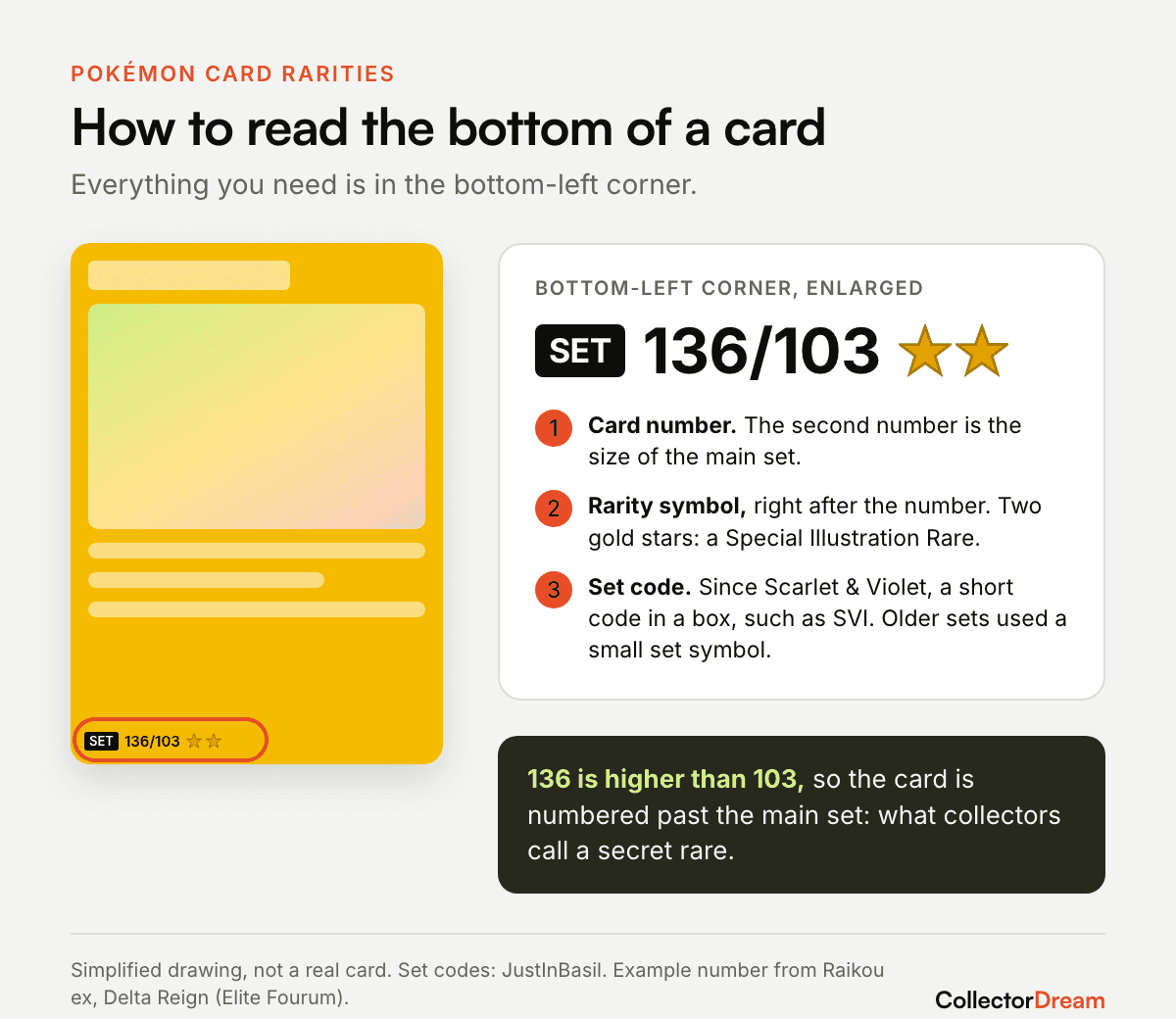
Turn any modern card over to its front and look at the bottom corner. You'll find three things:
- The card number, written like
084/103. The second number is the size of the main set. - The rarity symbol, right next to the number.
- The set code, a short code in a box such as
SVI, which tells you which expansion the card is from. Cards from before Scarlet & Violet show a small set symbol instead (JustInBasil).
If the first number is higher than the second, as in 136/103, the card sits outside the main numbering. That's what collectors call a secret rare (CGC). In today's sets, the Illustration Rares, Ultra Rares, Special Illustration Rares and the gold card are all numbered past the set total. Raikou ex from Delta Reign, for example, is a Special Illustration Rare numbered 136/103 (Elite Fourum).
Promo cards are different: they carry a black star with the word PROMO and a promo number instead of a set number.
Each rarity, explained
Common, Uncommon and Rare
The black circle, diamond and star have marked Common, Uncommon and Rare since the first sets of the 1990s (Bill's Archive). In modern sets every Rare has a holofoil picture. These cards fill most of each pack, and while they're rarely valuable on their own, you need every one of them for a complete set.
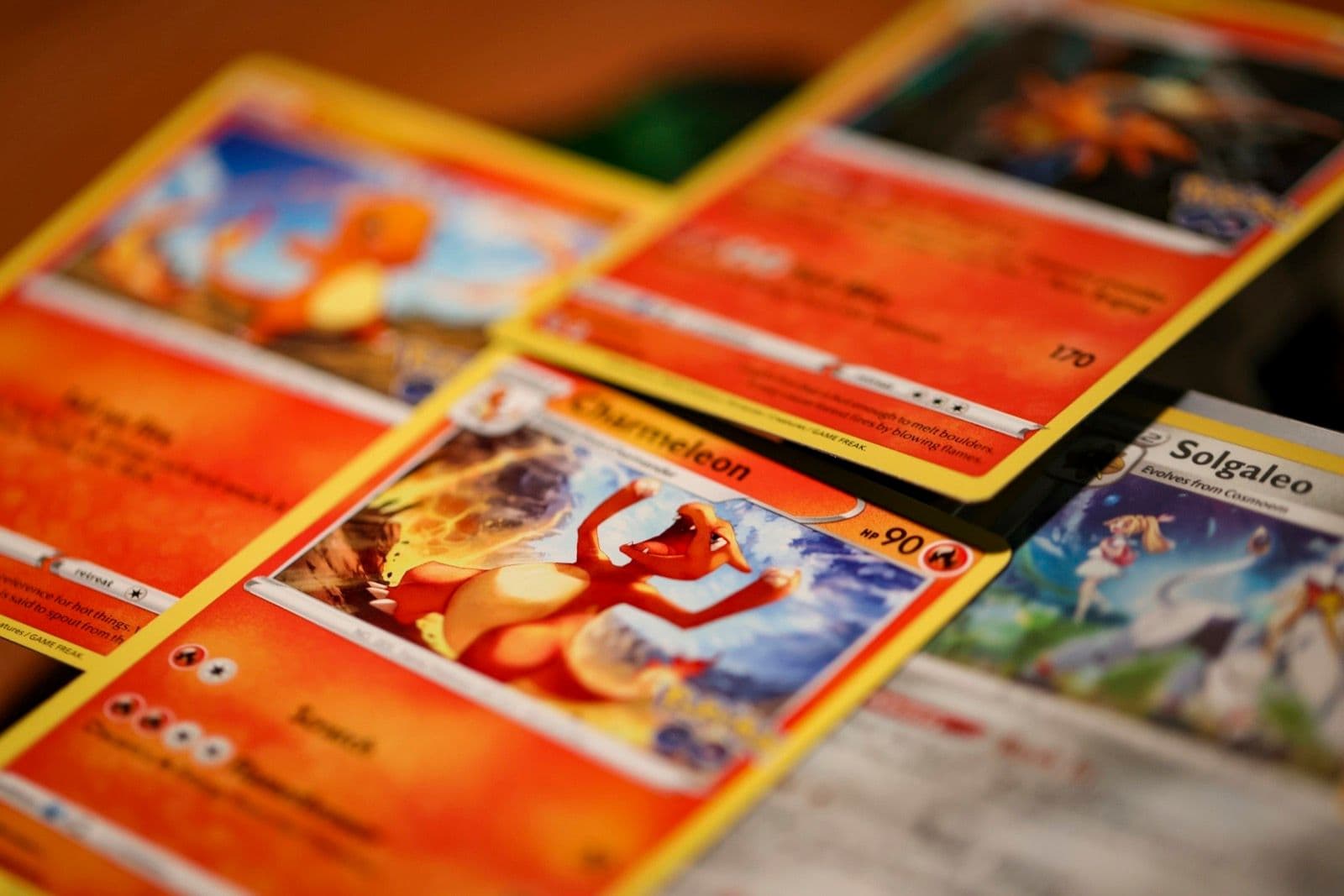
Reverse holos aren't a rarity. A reverse holo is a Common, Uncommon or Rare printed with foil everywhere except the picture. It keeps its original rarity symbol.
Double Rare (two black stars)
Regular Pokémon ex cards, the ones with the standard frame. In the first Mega Evolution set, all ten Double Rares were Mega Evolution Pokémon ex, and about one pack in five had one (TCGplayer). They're the "hit" you'll see most often.
Illustration Rare (one gold star)
A regular, non-ex Pokémon drawn as a full-card illustration, often in a style quite different from the rest of the set. Illustration Rares turn up in roughly one pack in nine, in the second reverse holo slot. They're a favorite of art-focused collectors because there are lots of them, and many are affordable.
Ultra Rare (two silver stars)
Full-art versions of Pokémon ex and Trainer cards (Items, Stadiums and Supporters), with a textured surface you can feel. Roughly one pack in twelve has one.
Special Illustration Rare (two gold stars)
The SIR is the chase tier of most modern sets: a Pokémon ex or a Supporter drawn as a full scene that runs edge to edge, with heavy texture. A typical main set has 6–10 of them, and you'll find one in roughly every 80–100 packs. A specific SIR is much harder: TCGplayer measured about 1 in 480 packs for any one SIR in Pitch Black, and about 1 in 1,008 in the larger first Mega Evolution set.
Hyper Rare and Mega Hyper Rare (gold cards)
In the Scarlet & Violet series, gold cards were Hyper Rares, marked with three gold stars. The Mega Evolution series replaced them with the Mega Hyper Rare, which has its own four-pointed star symbol (TCGplayer, Sep 30, 2025). These are all-gold cards showing a Mega Evolved Pokémon facing you head-on, and they're the rarest cards in today's main sets: about 1 in 1,260 packs in Mega Evolution and 1 in 1,081 in Pitch Black. Most sets have only one or two.
Special-set rarities
Special sets (the ones between the main expansions) often add a rarity of their own. You'll meet these in the wild:
Rarity | Where it appears | How to recognize it |
|---|---|---|
ACE SPEC Rare | Scarlet & Violet era sets from Temporal Forces on | One pink star; the card has a magenta border, an ACE SPEC logo and magenta card-type text (Bulbapedia, DexTCG) |
Shiny Rare and Shiny Ultra Rare | Paldean Fates and other shiny sets | One hollow gold star (Shiny Rare) or two (Shiny Ultra Rare, the full-art version); the Pokémon appears in its shiny colors (Bulbapedia, Bulbapedia) |
Black White Rare | Black Bolt and White Flare (2025), one card each | Two stars, one black and one white. The two cards are Zekrom ex in Black Bolt and Reshiram ex in White Flare, printed in all-black or all-white foil (Bulbapedia, DexTCG) |
Mega Attack Rare | Ascended Heroes (Jan 30, 2026), 7 cards | Two stars, one pink and one green; full-art Mega Pokémon with the kanji of their signature attack (CGC, Bulbapedia) |
Futuristic Rare | 30th Celebration (Sep 16, 2026) | Cards illustrated by Japanese artist YOSHIROTTEN (TCGplayer, Sep 3, 2026). Collector references don't agree yet on its symbol, so go by the artist credit. |
Older cards: before 2023
If you're sorting a childhood collection, you'll find older styles too (Bill's Archive):
- 1996–2016: just the circle, diamond and star. A holo Rare has foil on the picture only.
- Sun & Moon and Sword & Shield (2017–2023): many different treatments all shared the single black star: full arts, Rainbow Rares, gold Secret Rares and alternate arts. The symbol doesn't separate them, so collectors learned to tell them apart by the look of the card and its number.
The extra symbols in Scarlet & Violet were designed to end exactly that confusion.
Japanese rarity codes vs English names
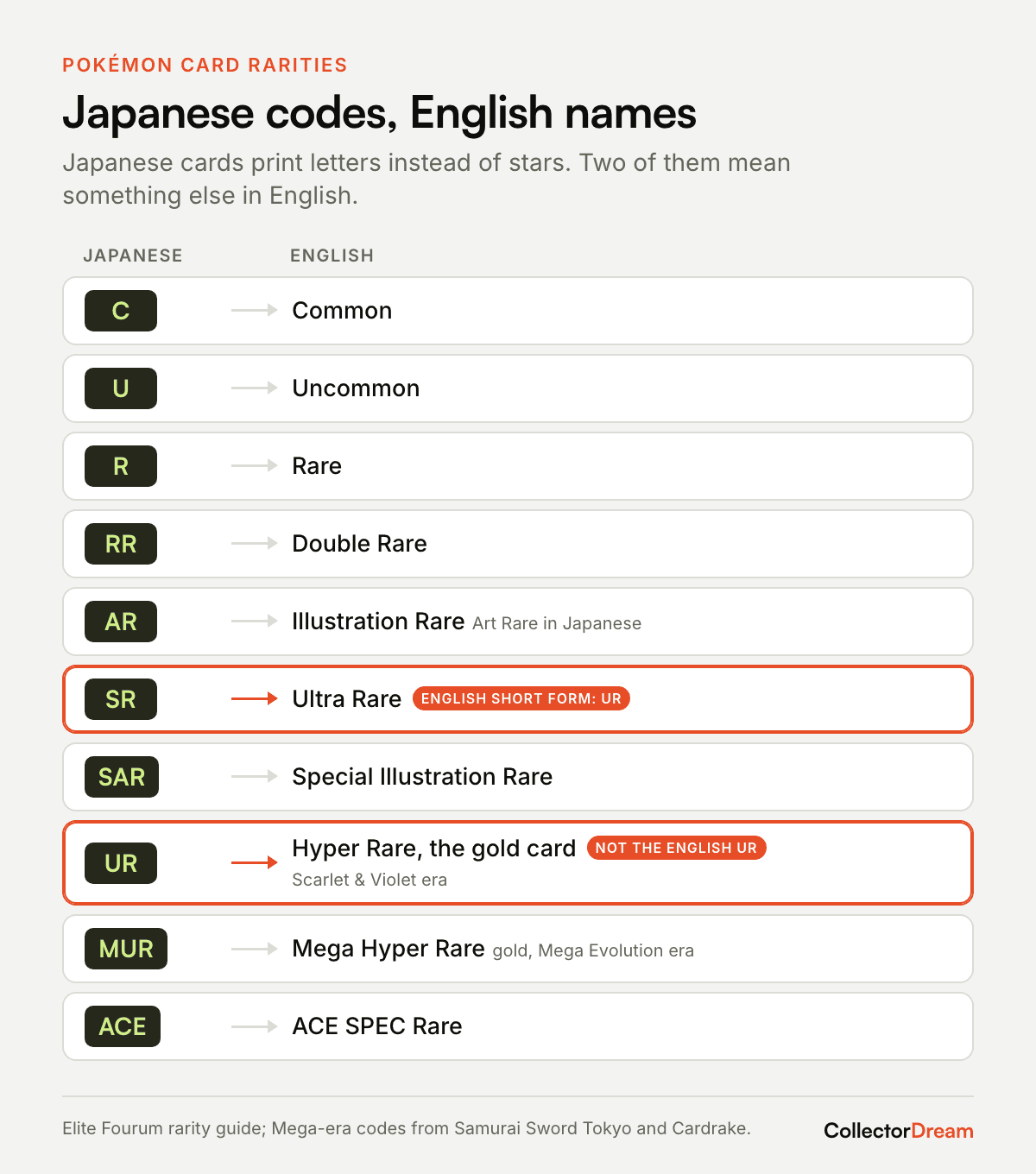
Japanese cards print a letter code instead of stars. If you buy Japanese cards or watch Japanese openings, this is the translation (Elite Fourum; Mega-era codes from Samurai Sword Tokyo and Cardrake):
Japanese code | English name |
|---|---|
C | Common |
U | Uncommon |
R | Rare |
RR | Double Rare |
AR (Art Rare) | Illustration Rare |
SR (Super Rare) | Ultra Rare |
SAR (Special Art Rare) | Special Illustration Rare |
UR (Ultra Rare) | Hyper Rare (gold, Scarlet & Violet era) |
MUR (Mega Ultra Rare) | Mega Hyper Rare (gold, Mega Evolution era) |
ACE | ACE SPEC Rare |
Watch out for "SR" and "UR": they mean different tiers in Japanese and English. A Japanese SR is an English Ultra Rare, and a Japanese UR is a gold card.
Does a higher rarity mean a higher price?
Usually, but not always. Rarity tells you how scarce a card is in packs. Price depends on what collectors want:
- The Pokémon. In Pitch Black, TCGplayer pointed out that the SIR Mega Darkrai ex is exactly as hard to pull as the SIR Mega Charizard X ex from Phantasmal Flames, but sells for less (TCGplayer). Popular Pokémon carry a premium at every rarity.
- The art. Illustration Rares of fan favorites can outsell Ultra Rares from the same set.
- Condition. A centered, clean card is worth more raw and much more if it grades well.
- How much was printed. Sets that get reprinted in several waves often cost less for the same rarity.
So use rarity as a quick sort when you open packs, then check recent sold prices before deciding what to sleeve, grade or trade.
What to do with a big pull
- Sleeve it straight away, then put it in a toploader or semi-rigid holder.
- Check the centering and corners before anything else. Those decide whether it's worth grading.
- Look up recent sold prices, not asking prices, for the exact card number and language.
- Log it. Knowing what you own makes trading, insuring and completing sets much easier.
Where to go next
- Delta Reign Chase Cards & Pull Rates (see the rarity ladder in a real set)
- Coming in December: a full guide to Japanese vs English Pokémon cards, from print quality to pricing.
- How to Start Collecting Trading Cards in 2026
Let CollectorDream read the symbol for you
With CollectorDream you can scan a card and see its set, number, rarity and recent sold prices in one place, then add it to your collection. The app is out now on iOS: download CollectorDream on the App Store, and follow my daily pack openings on YouTube, TikTok and Instagram.
FAQ
What is the rarest Pokémon card rarity right now?
In current main sets, the Mega Hyper Rare: gold, front-facing Mega Evolution cards that TCGplayer measured at about 1 in 1,081 to 1 in 1,260 packs. Special sets sometimes have rarities that are scarcer still.
What do two black stars mean on a Pokémon card?
Double Rare: a regular Pokémon ex card. Two silver stars mean Ultra Rare and two gold stars mean Special Illustration Rare.
What does SIR mean?
Special Illustration Rare, marked with two gold stars. It's a full-card scene illustration of a Pokémon ex or Supporter, and usually the chase tier in a modern set.
What is a secret rare?
Any card numbered higher than the set total, like 136/103. In modern sets that includes the Illustration Rares, Ultra Rares, SIRs and gold cards.
Is a reverse holo rare?
No. A reverse holo is a foil version of a Common, Uncommon or Rare and keeps that card's rarity symbol.
Are Japanese and English rarities the same?
The tiers mostly line up, but the names don't. Japanese AR, SR and SAR correspond to English Illustration Rare, Ultra Rare and Special Illustration Rare. Japanese main-set packs also have fewer cards (five rather than ten), so pull rates aren't directly comparable.
Alec Nguyen
Founder, CollectorDream
Scan a card, see its rarity and value
The CollectorDream app reads the card for you. Now on the App Store.
Download on iOS (opens the App Store)