On this page · 11 sections
- Why fakes are worth checking for this season
- How to spot fake Pokémon cards: 6 checks
- What about fake One Piece cards?
- How to tell if a booster box or ETB has been resealed
- How to tell if a single pack has been resealed or searched
- Scam listings and fake stores: the red flags
- What to do if you already bought a fake
- Buy from a verified source
- Where to go next
- Check your cards with CollectorDream
- FAQ
Updated: October 29, 2026
Fake cards and resealed packs show up most when demand is highest, and the holidays are exactly that. This guide shows you how to spot fake Pokémon cards (and fake One Piece cards) in a few minutes, how to tell whether a booster box or pack has been opened and resealed, and which listings and payment requests are scams before you send any money. No special tools needed, though a phone flashlight and one card you know is real help a lot.
Red flag | What to check | How much it tells you |
|---|---|---|
Price far below retail or recent sales | Compare with the official store and recent sold listings | A lot. Pokémon calls it a near-certain sign for packs |
Card glows through under a flashlight | Hold it next to a common you pulled yourself | Strong when it fails; a pass proves little |
Blurry text, wrong font, bold copyright line | Look with your phone camera zoomed in | Strong |
Flat, smooth holo or no texture on a textured rarity | Tilt it under a lamp next to a real card | Strong |
Back too pale, too bright or purplish | Side by side with a real back | Strong |
Card number or rarity symbol that doesn't exist | Search the card in the official database | Proof, if it isn't there |
Glue, heat marks or extra seams on shrink wrap | Compare with a box you know is sealed | Medium; guides disagree on the details |
Seller wants Friends and Family, gift cards or an off-site chat | Their payment terms | Treat it as a scam |
Sources: Pokémon Support, CGC counterfeit alerts linked below, PayPal and the FTC. Checked Oct 29, 2026.
Why fakes are worth checking for this season
Counterfeits are more common than most people expect. PSA's 2025 Fraud Report, released in May 2026, found that counterfeit Pokémon cards rose more than 125% year over year, and Pokémon was the most counterfeited trading card category it saw (ICv2, May 8, 2026). One Piece ranked 8th among counterfeited card categories (Sports Collectors Digest, May 11, 2026).
Pokémon's own support team says it gets the most reports of counterfeit sales from flea markets, and that a pack priced far below the suggested retail price is a near-certain warning (Pokémon Support). Holiday shoppers, and parents in particular, are exactly who those cheap packs are aimed at. If you're buying for a kid, our Pokémon card gift guide for parents covers where to buy at normal retail prices.
How to spot fake Pokémon cards: 6 checks
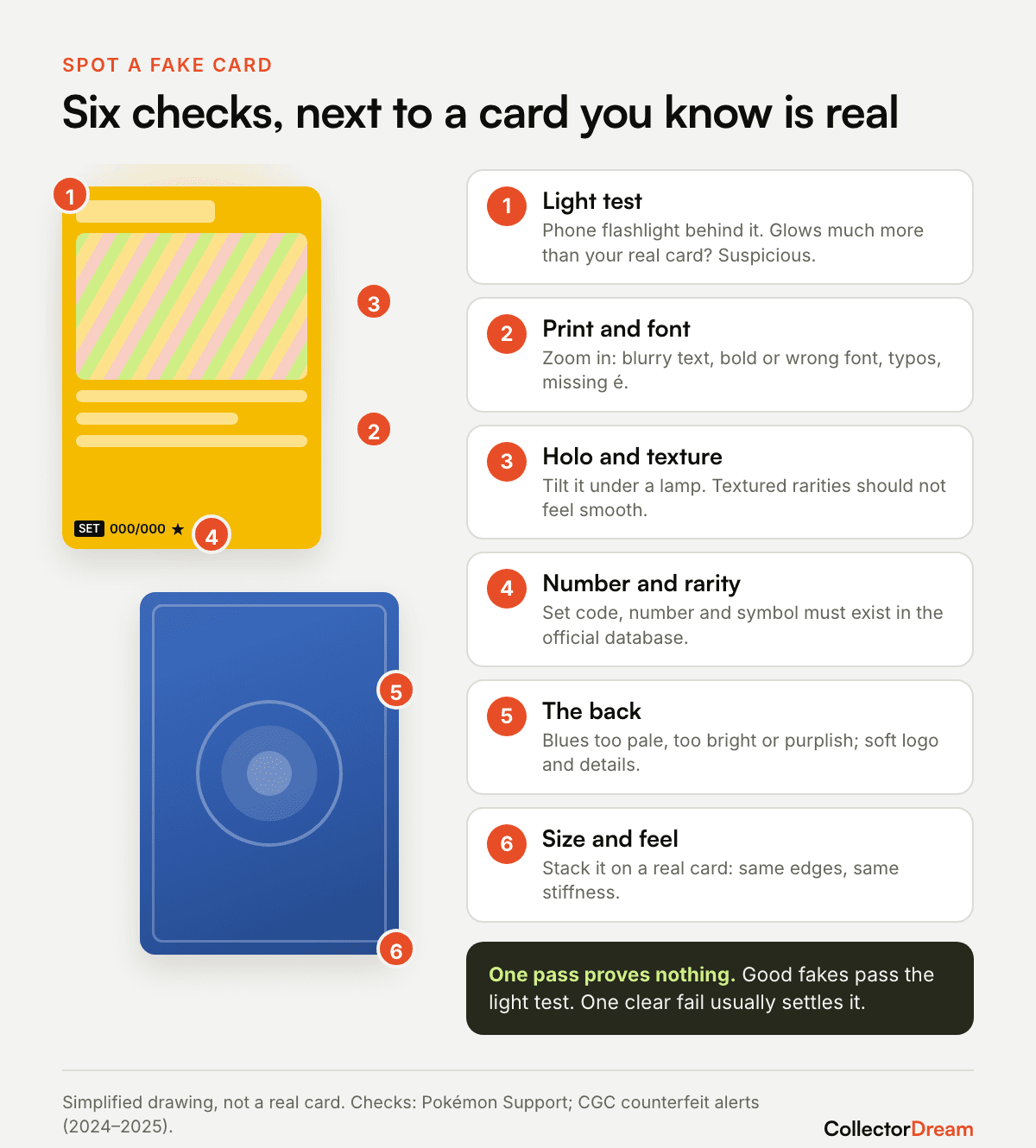
The quickest way to spot a fake Pokémon card is to put it next to a card you know is real and go through the six checks below. Any common or uncommon you pulled from a pack bought at a big retailer works as your reference.
1. The light test
Hold the card in front of a phone flashlight or a bright lamp. Pokémon Support says counterfeit cards "are often easy to see through" this way (Pokémon Support). Do the same with your reference card: if the suspect card glows much brighter, be suspicious.
The catch is that the light test only catches cheap fakes. Some counterfeits are printed on the same kind of offset press as real cards, and CGC needed UV and infrared light to separate a fake Munch Mimikyu promo from a real one (CGC, Jun 11, 2025).
2. Print quality and font
Zoom in with your phone camera. Real cards have crisp black text, and the energy symbols, set code and card number are sharp. On a fake Japanese Omanyte that CGC examined, the black text and set symbols were fuzzy and the artwork was much softer than the real card (CGC, Oct 11, 2024). Also look for spelling: a missing accent on "Pokémon", odd wording in an attack, or a font that looks slightly too bold.
3. Holo and texture
Tilt the card under a lamp. Modern Ultra Rares and Special Illustration Rares have a textured surface you can feel with a fingertip, and the foil moves in a pattern rather than as one flat shine. A textured rarity that feels smooth, or a holo that looks like a glossy sticker, is a strong warning. If you're not sure which cards should be textured, our guide to Pokémon card rarities shows what each tier looks like.
4. Card number and rarity symbol
Look at the bottom corner: the set code, card number and rarity symbol should all exist and match each other. Search the card by name in the official Pokémon TCG card database. A card number that isn't in the set, an attack the real card doesn't have, or a rarity symbol that doesn't fit the card are all signs of a fake. CGC found the rarity symbol on that fake Omanyte differed from the genuine one side by side.
5. The back
Put the backs side by side. Fakes often get the blues wrong, either too pale or too bright, and the details of the Poké Ball and logo come out soft. A fuzzy back can also rule out a trick CGC mentions, where a fake front is glued to a genuine back (CGC).
6. Size, thickness and feel
Stack the suspect card on your reference card. It should match exactly at every edge and feel just as stiff. Fakes are often slightly off in size, thinner and floppier, or glossier and slippery to the touch.
A word on the "rip test": tearing a card open to look at its inner layer is something collectors do with bulk, but it destroys the card. Don't do it to anything you might need to return.
What about fake One Piece cards?
Fake One Piece cards follow the same pattern, and the most-faked ones are the expensive Manga Rares and alternate arts. Bandai has warned that counterfeit cards were being sold on marketplace sites, and says it offers no replacement or support for counterfeits, even ones bought by accident (Bandai, Nov 1, 2024).
CGC's alert on a fake Monkey D. Luffy OP05-119 Manga Rare is a good model of what to check (CGC, Aug 8, 2024):
- The art: the fake's texture was uniform and the fine sketch details were blurred.
- The text: larger and bolder than the genuine card, with a soft copyright line.
- The "ONE PIECE CARD GAME" stamp near the color symbol: almost transparent on the real card, harshly printed on the fake.
- The back: duller and more purple than the strong blue of a real card.
Before buying a high-end One Piece card, check what it usually sells for in our most valuable One Piece cards list. A Manga Rare listed well below that is the classic setup.
How to tell if a booster box or ETB has been resealed
A resealed box is a real box that someone opened, searched or emptied, then wrapped again to sell as new. Reseals are harder to prove than fake cards, so look for several small signs rather than one.
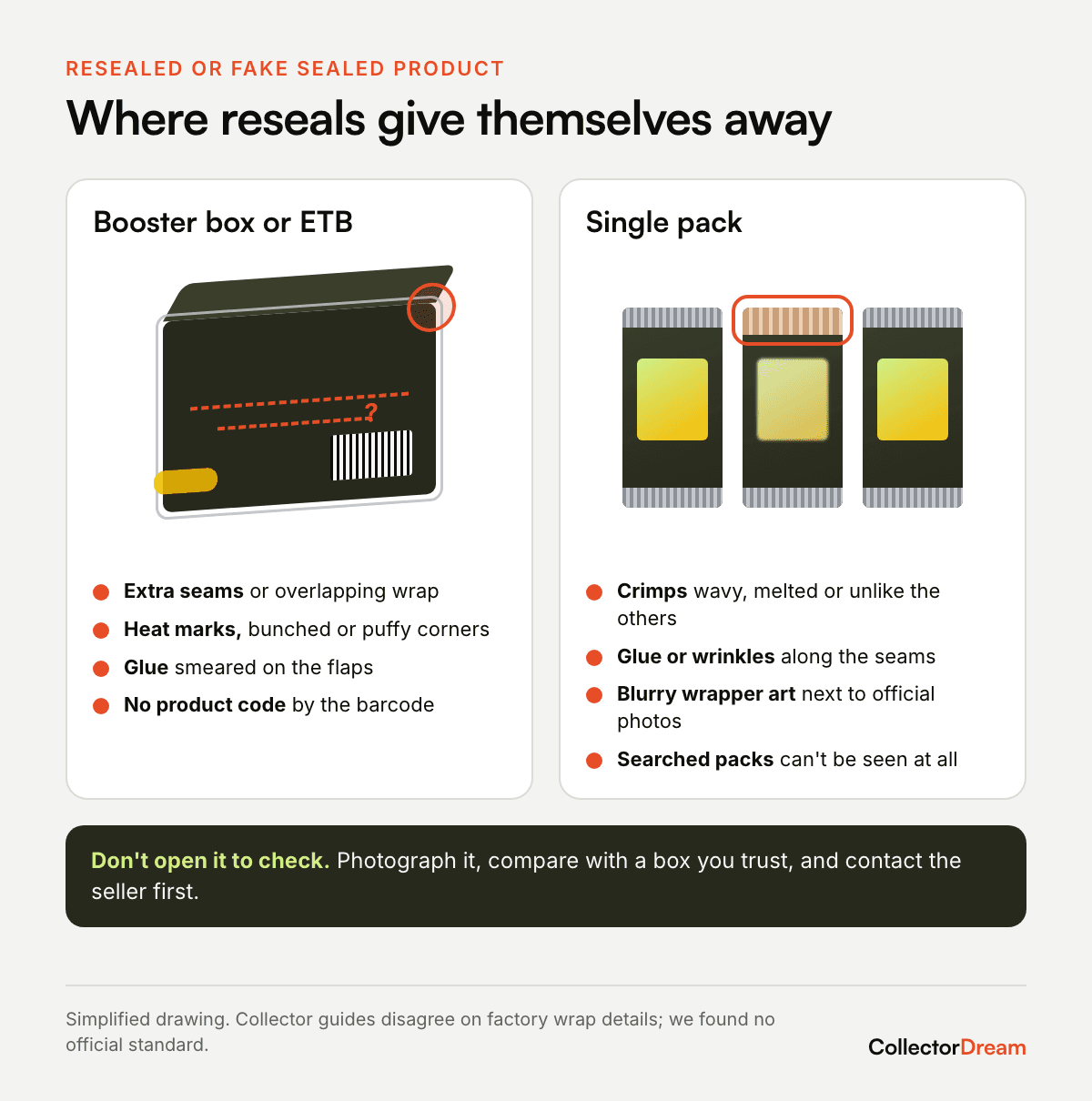
What to check on a box:
- The wrap: heat-gun marks, bunched or puffy corners, and more than one overlapping seam suggest it was wrapped by hand.
- The flaps: glue smeared at the edges, or a flap that doesn't sit flush with the box.
- The printing: a box with no product code near the barcode, or with a set code that doesn't match the product, is a strong sign of a fake (Geeky Domain).
- The contents list: for Elite Trainer Boxes and collections, compare the box and its listed contents with the official Pokémon TCG product gallery.
One honest warning: collector guides disagree on what factory shrink wrap should look like. Some say it's always tight, others say a slightly loose wrap is normal, and we couldn't find an official standard from The Pokémon Company. So compare against a box you know came from a trusted shop, and weigh the seller and price more heavily than any one detail of the wrap.
Don't open it to check. If you suspect a reseal, take photos and contact the seller first. Opening the product usually ends any chance of a return.
How to tell if a single pack has been resealed or searched
Loose packs from unknown sellers carry the most risk, because a pack can be opened at the crimp, emptied of its hit and glued shut again. Check:
- Both crimps (the ridged seals at the top and bottom). They should be even and match other packs from the same set. Wavy, melted or extra-shiny crimps are a warning.
- Glue or wrinkles along the seams, and any small tear at a corner.
- The art and text on the wrapper, compared with the official product photos. Fake packs often use blurry or wrong artwork.
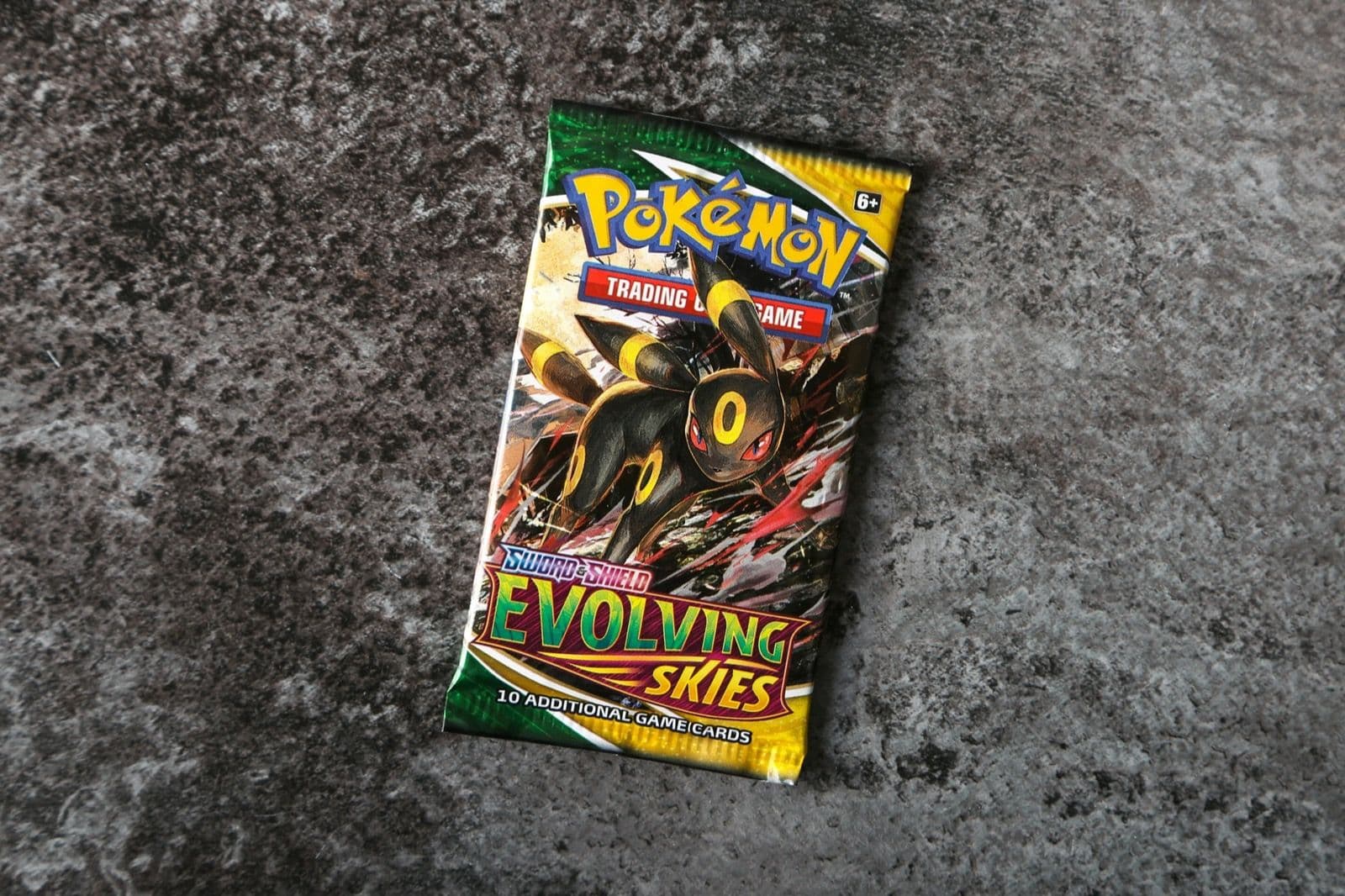
Even an untouched pack can have been "searched": some sellers weigh or feel packs to pick out the ones likely to hold a hit, then sell the rest. You can't detect that from the outside, which is why loose packs from strangers are a poor gift. Pokémon Support puts it simply: fake packs are very hard to spot, so judge the price instead.
Scam listings and fake stores: the red flags
Many holiday losses aren't fake cards at all, but money sent for cards that never arrive. A fake store network found in 2026 used polished Shopify sites, sponsored Google, Instagram and Facebook ads, and preorder and "almost sold out" messages, then shut each site down and opened a new one (Value Added Resource, Jun 29, 2026). Some victims even received a thank-you card in the mail, which may have delayed their disputes.
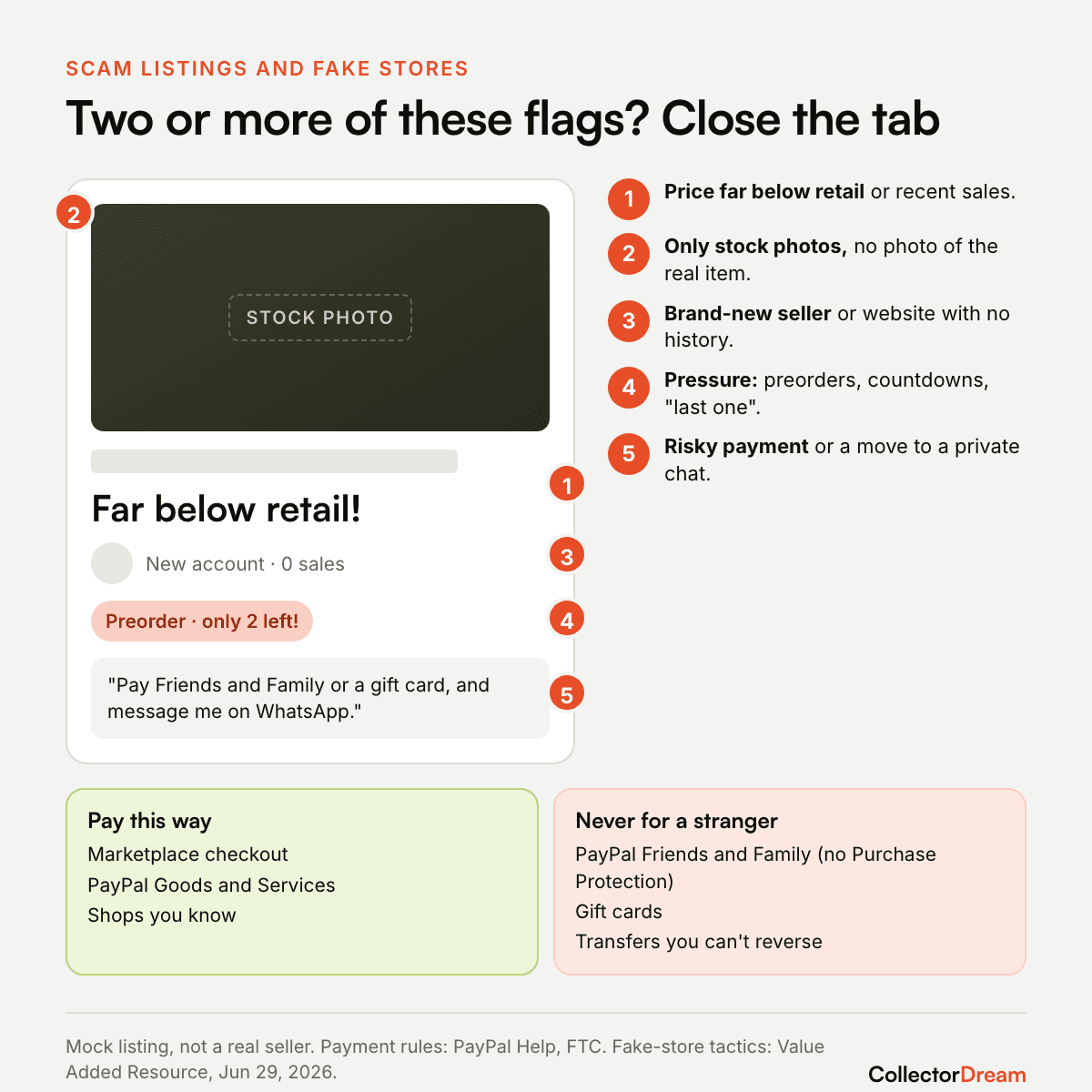
Walk away if a seller or store:
- prices sealed product far below retail or far below recent sales;
- shows only stock photos, not the actual item with today's date or their username on a note;
- is a brand-new account or website with no sales history;
- pushes preorders, countdowns or "last one" messages;
- asks you to move to WhatsApp, Telegram or a private chat;
- wants payment by PayPal Friends and Family, which isn't eligible for PayPal's Purchase Protection (PayPal), by gift cards ("Only scammers will tell you to buy a gift card," says the FTC), or by any bank transfer you can't reverse.
A top spot in search results or a sponsored ad doesn't make a store legitimate. Buy from the official store, big retailers and local game stores you know, or use the marketplace's own checkout so its buyer protection applies.
What to do if you already bought a fake
- Stop using or opening it. Keep the card, the packaging and every message.
- Take clear photos of the front, back and any packaging, next to a genuine example if you have one.
- Contact the seller and the platform where you paid. Open a claim through the marketplace or PayPal Goods and Services within its deadline.
- Call your card issuer if you paid by card and the seller won't help.
- Report it. In the US, report fraud to the FTC and online fraud to the FBI's IC3, as the Value Added Resource report recommends.
Don't expect the publisher to replace it: Bandai says plainly that it doesn't support counterfeit products.
Buy from a verified source
The simplest way to avoid fakes is to change where you buy, not to become an expert. For expensive singles, two routes take most of the risk away:
- eBay's Authenticity Guarantee: in the US, single trading cards selling for $200 or more, raw or graded, go to a PSA facility for inspection before they reach you, and you get a refund if a card fails (eBay). The threshold dropped from $250 in August 2026 (Value Added Resource, Aug 1, 2026). It doesn't cover packs, boxes or lots.
- Already-graded cards: PSA, CGC, BGS and TAG only slab cards they judge to be genuine. Slabs can be faked too, so check the certification number on the grader's website before you pay. Our guide to grading One Piece cards explains how grading works.
For sealed product, buy from the official store, large retailers or a local game store. And if you just want one specific card, buying that single from a trusted seller is usually cheaper than opening packs anyway, as our beginner's guide explains.
Where to go next
- Pokémon Card Gift Guide for Parents (what to buy and where)
- Pokémon Card Rarities Explained (know what a real rarity looks like)
- One Piece OP-18 Chase Cards & Manga Rares (the cards most worth checking twice)
- How to Start Collecting Trading Cards
Check your cards with CollectorDream
With CollectorDream you can scan a card and see its set, number and rarity next to recent sold prices, so a card that doesn't match anything real stands out quickly. The app is out now on iOS: download CollectorDream on the App Store, and follow my daily openings on YouTube, TikTok and Instagram.
FAQ
Does the light test work on every fake?
No. It catches cheap fakes printed on thin or plain card stock, but well-made counterfeits can pass it. Use it alongside the print, texture, back and database checks.
Are Japanese Pokémon cards fake?
No. Japanese cards are official products made for Japan, with Japanese text, a different pack size and their own rarity codes. They can be counterfeited just like English cards, so the same checks apply.
Can a sealed booster box still be fake?
Yes. Boxes can be counterfeit, or genuine boxes can be opened, emptied and rewrapped. Check the wrap, flaps and printing, compare with the official product gallery, and be most careful when the price is well below retail.
Is it safe to buy Pokémon cards on Facebook Marketplace?
It can be, but you get no authentication and often no buyer protection. Meet in person, check the cards before paying, and never pay a stranger by Friends and Family or gift card.
What should I do if I bought fake cards?
Keep everything, take photos, and open a claim with the marketplace or payment service straight away. If the seller won't help, contact your card issuer and report the seller to the FTC.
Alec Nguyen
Founder, CollectorDream
Scan a card, see its rarity and value
The CollectorDream app reads the card for you. Now on the App Store.
Download on iOS (opens the App Store)