On this page · 13 sections
- Every Fusion World rarity at a glance
- How to read a Fusion World card's rarity
- Base rarities: C, UC, R, SR and SCR
- Leader cards (L)
- What do the stars mean? Alt arts and super alt arts
- Commons, Energy Markers and other exceptions
- Promo cards (PR)
- How many of each rarity is in a Fusion World set?
- How rare are alt arts and super alt arts?
- Does a higher rarity mean a higher price?
- Where to go next
- Let CollectorDream read the badge for you
- FAQ
Updated: October 31, 2026
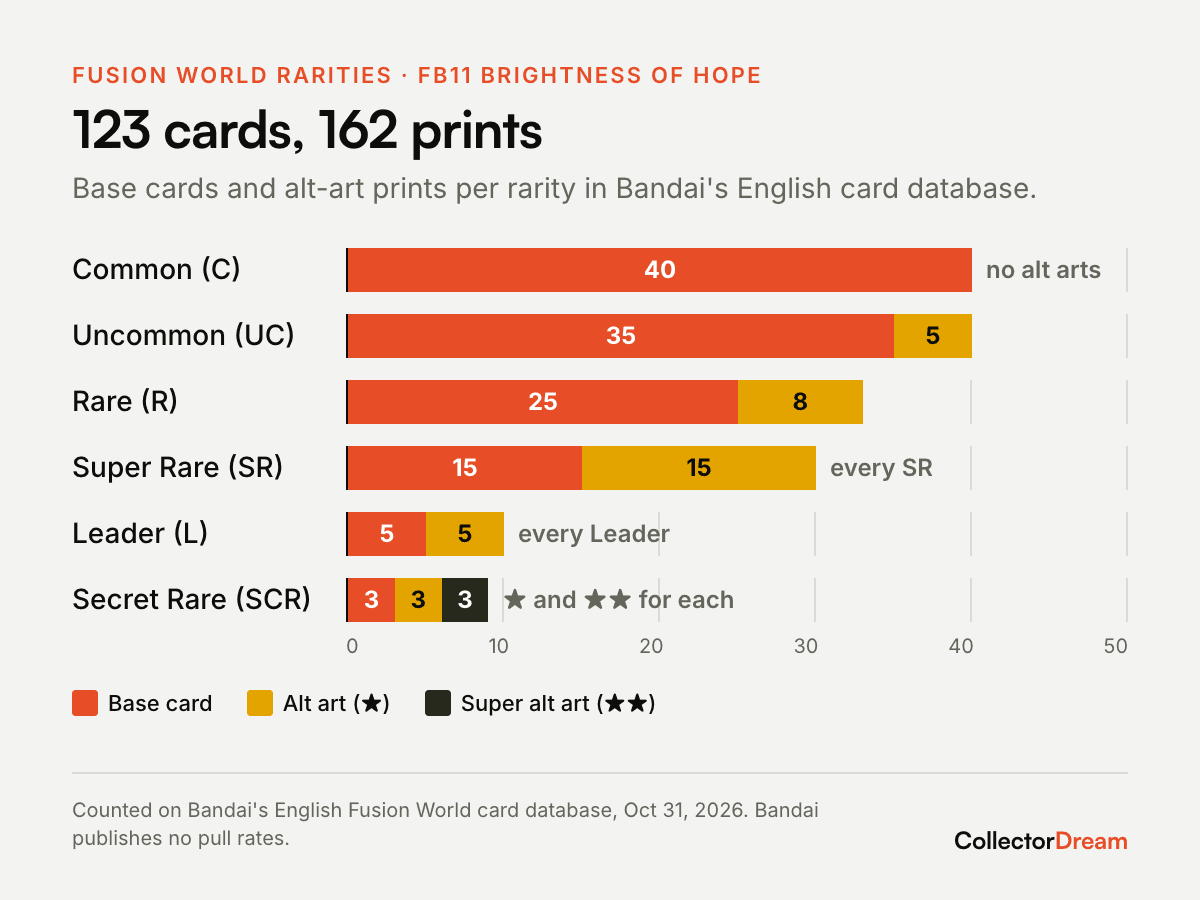
Fusion World card rarities come down to six printed codes and up to two little stars. Learn where the badge sits and what the stars add, and you can sort a pack of Dragon Ball Super Card Game Fusion World cards in seconds. This guide covers every rarity, from Common to the two-star super alt arts, and counts how many of each a booster set really has, using Bandai's own English card database.
Every Fusion World rarity at a glance
Code | Name | What it is | How many in FB11 |
|---|---|---|---|
C | Common | Standard card | 40 |
UC | Uncommon | Standard card | 35 |
R | Rare | Foil card | 25 |
SR | Super Rare | Foil card, the regular hit | 15 |
SCR | Secret Rare | The top base rarity, numbered last in the set | 3 |
L | Leader | The card your deck is built around | 5 |
★ in the badge | Alt art | Same card number and rarity code, new art | 36 (5 L, 5 UC, 8 R, 15 SR, 3 SCR) |
★★ in the badge | Super alt art | A second, scarcer alt art | 3 (1 per SCR) |
PR | Promo | Event and promotional cards | Not in boosters |
Counts for FB11 Brightness of Hope *from Bandai's English card database, counted Oct 31, 2026. FB09 and FB10 have the same base split. Bandai doesn't publish pull rates.*
How to read a Fusion World card's rarity
Every Fusion World card prints its rarity in the bottom-right corner of the front. Bandai's rule manual labels three things there:
- The card number, such as
FB11-121. The letters and digits before the dash name the set, and the rest is the card's place in it. - The block icon, a number in a circle. It has nothing to do with rarity.
- The rarity badge, a small rounded label such as
SRorSCR. On the alt-art prints we checked, the stars sit inside this badge, right after the letters.
The badge's color follows the card's color (red, blue, green, yellow or black), not its rarity, as Japanese guide Torecamap points out. On Bandai's image of the super alt-art Son Goku (FB11-121), the badge reads SCR★★ in red, on a red card.
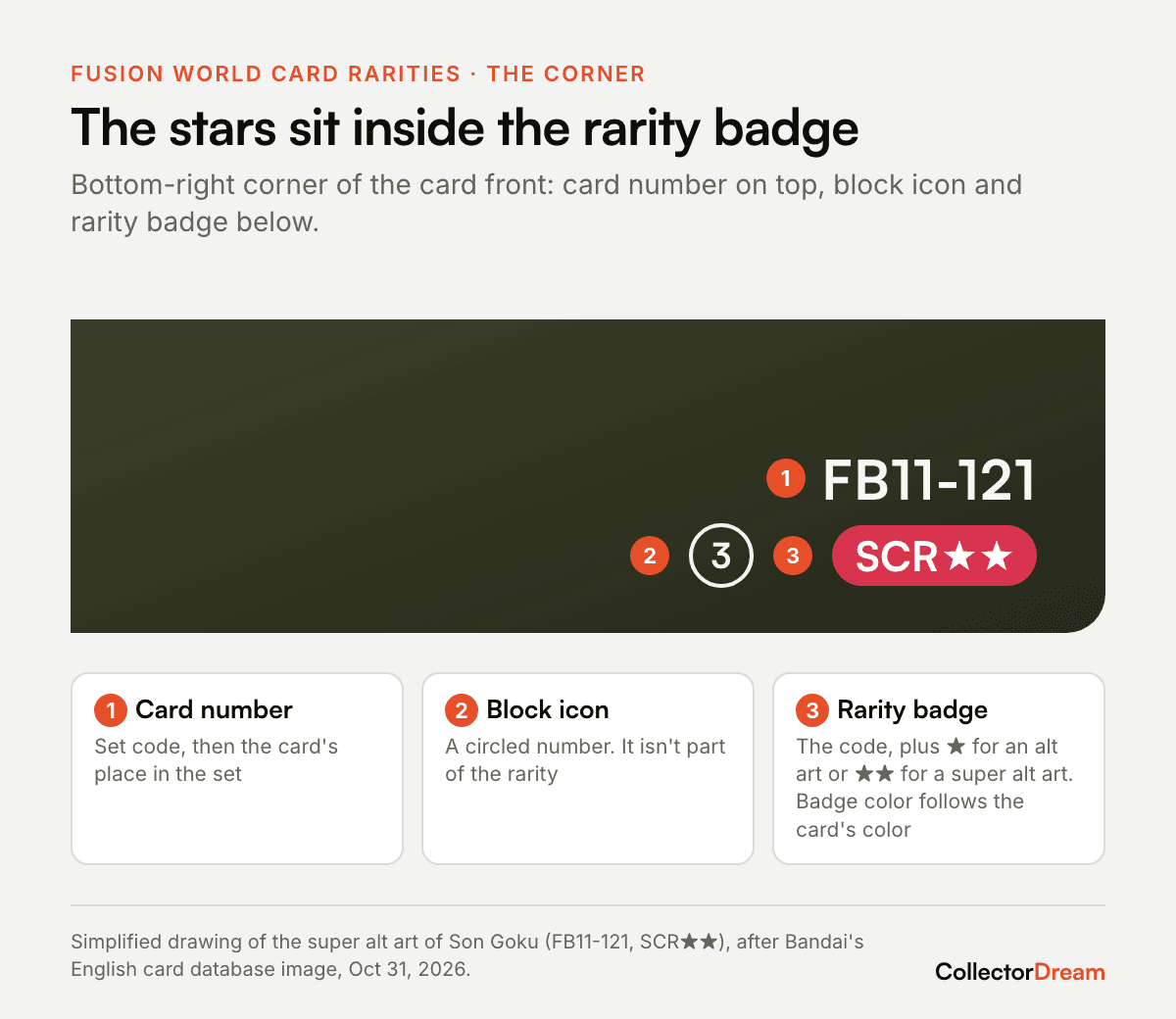
If you also collect One Piece, note the difference: One Piece puts its parallel star above the rarity box, while Fusion World puts the stars inside the badge. Our One Piece card rarities guide shows that layout.
Base rarities: C, UC, R, SR and SCR
The five base rarities make up the main run of every booster set. Bandai's General Rules (version 1.08, updated September 12, 2026) say only that a card's rarity "does not affect gameplay", so these codes are about collecting, not power.
- Common (C) and Uncommon (UC) fill most of each pack. FB09, FB10 and FB11 each have 40 Commons and 35 Uncommons on Bandai's list.
- Rare (R) cards are foil. Each of those three sets has 25.
- Super Rare (SR) is the regular hit: 15 per set since FB07, up from 12 in the early sets, according to Samurai Sword Tokyo's set list.
- Secret Rare (SCR) is the top base rarity, numbered last in the set. Sets from FB09 on have three (FB11-121 to FB11-123 in Brightness of Hope); earlier sets had two.
Fusion World has no God Rare. That name belongs to the original Dragon Ball Super Card Game, now called Masters, and to the Super Divers arcade game. Our Super Divers collector's guide explains that ladder.
Leader cards (L)
A Leader is the card your deck is built around. Each player starts with one Leader in play, and it turns over to a stronger side when its awaken condition is met. Leaders carry the code L in place of a rarity, and each main set from FB09 to FB11 has five of them.
Every FB11 Leader also has an alt-art version (L★) on Bandai's list, and Leaders are where some of a set's most-wanted cards sit, since every deck needs one. FB09 Dual Evolution went a step further: two of its Leaders also got a super alt art (L★★).
What do the stars mean? Alt arts and super alt arts
An alt art is a second print of an existing card with new art and a special finish. It keeps the same card number, game text and rarity code, and adds one star to the badge: SR★, L★, SCR★. Bandai's card database lists it under the same number as the regular card, and its detail page still shows the base rarity (SCR, not "SCR★"), so you can't filter for alt arts there. Japanese collectors call them parallels.
A super alt art adds a second star (SCR★★). It's the scarcest print in a booster set. In FB11, Bandai gave each of the three Secret Rares one regular alt art and one super alt art (Bandai, FB11).
Alt arts play exactly like the regular card, so they're legal in any deck that could run the regular one. Deck rules count cards by number: up to four copies with the same card number, alt art or not (Bandai rules page).
Commons, Energy Markers and other exceptions
A few prints don't follow the one-star, two-star rule. Torecamap's guide lists them, and Bandai's database backs up the counts:
- Common parallels have no star. Story Booster 01 (ST01) gives all 36 of its Commons a second print, but the badge still reads plain C. You tell them apart by the special foil finish, not the code.
- Energy Markers are a separate card type, used to pay costs. They have no rarity badge; a parallel marker gets a star after its number instead (Torecamap's example: E-156★).
- Manga Boosters (SB01, SB02) use their own two-star prints, which Japanese collectors call "ultra parallels".
- Leaders can have two stars (L★★), as in FB09.
Below Super Rare, alt arts are picked card by card. The FB11 product page mentions "Visual Alt-Art" cards and alt arts for Super Combo cards (Bandai, FB11), and the Uncommon alt art we checked, Great Saiyaman 2 (FB11-004), is one of those Super Combo cards.
Promo cards (PR)
Promo cards come from events, tournaments and special products, not booster packs. Bandai's database tags them PR, and the Release Event Packs (FB01–FB05, FB06–FB09, FB10–FB11 and SB01/SB02) have their own entries on the list.
How many of each rarity is in a Fusion World set?
Recent main sets follow a fixed recipe: 123 base cards, then alt arts on top. Here's what Bandai's English database shows.
Set | Base cards (L / C / UC / R / SR / SCR) | Alt arts (★) | Super alt arts (★★) | Prints in total |
|---|---|---|---|---|
FB09 Dual Evolution | 5 / 40 / 35 / 25 / 15 / 3 | 36 | 5 (3 SCR, 2 Leaders) | 164 |
FB10 Cross Force | 5 / 40 / 35 / 25 / 15 / 3 | 36 | 3 (SCR) | 162 |
FB11 Brightness of Hope | 5 / 40 / 35 / 25 / 15 / 3 | 36 | 3 (SCR) | 162 |
ST01 Story Booster 01 | 3 / 36 / 0 / 20 / 10 / 2 | 74 | 3 (2 SCR, 1 Leader) | 148 |
Counted on Bandai's English card database, Oct 31, 2026. "Alt arts" counts every one-star print, plus ST01's 36 starless Common parallels.
Bandai counts only the base cards when it describes a set ("123 types" for FB11 and for the upcoming FB12), so a full master set with every alt art is around 160 cards. For what's coming next, see our FB12 Reach the God chase card guide.
How rare are alt arts and super alt arts?
Nobody outside Bandai knows the official odds: Bandai publishes no pull rates for Fusion World. The best public numbers are rough estimates for Japanese boxes from Torecamap, compiled from trading-card media box openings (published September 7, 2026):
Estimated rate (Japanese boxes) | |
|---|---|
Super Rare (SR) | 3–4 per box |
SR alt art (SR★) | about 1 in 2 boxes |
Secret Rare (SCR) | about 1 in 3–4 boxes |
SCR alt art (SCR★) | about 1 in 8 boxes |
Leader alt art (L★) | about 1 per 12-box carton |
SCR super alt art (SCR★★) | about 1 in 60 boxes (about 1.7% of boxes) |
Source: Torecamap, approximate, not official, and not a measured sample we could check.
Don't carry these numbers straight over to English product. A Japanese pack has 6 cards (Bandai JP, FB12) while an English pack has 12 (Bandai, FB11), so boxes aren't the same size. What the estimates do tell you: a super alt art is a once-in-many-boxes card in either language, and buying the single is the reliable way to own one.
Does a higher rarity mean a higher price?
Usually, but not always. Rarity tells you how scarce a print is; price depends on what collectors want.
- The character. Goku, Vegeta, Gogeta and Vegito cards sell for more than less popular characters at the same rarity.
- The print. A super alt art of a Secret Rare almost always tops its set, and Leader alt arts often sit next in line.
- Condition. Corners, edges and centering matter, especially if you're thinking about grading.
For dated sold prices, see our list of the most valuable Fusion World cards. If you pull a two-star card, sleeve it straight away (Fusion World uses standard-size sleeves) and check it closely with our pre-grading guide before you decide whether to grade it.
Where to go next
- How to Start Collecting Trading Cards in 2026 (the beginner's guide, all five games)
- Most Valuable Dragon Ball Fusion World Cards (which prints sell for the most)
- Chromatic Ascension (B32) Chase Cards (the Masters rarity ladder, with God Rares)
- Pokémon Card Rarities Explained (if you collect more than one game)
Let CollectorDream read the badge for you
With CollectorDream you can scan a Fusion World card and see its set, number, rarity and print, alt art or not, along with recent sold prices, then add it to your collection. The app is out now on iOS: download CollectorDream on the App Store, and follow Alec's daily pack openings on YouTube, TikTok and Instagram.
FAQ
What is the rarest Fusion World rarity?
The super alt art of a Secret Rare (SCR★★). A main set has three, one per Secret Rare, and Japanese estimates put one at roughly one per 60 Japanese boxes. Bandai publishes no official odds.
What do the stars on a Fusion World card mean?
One star in the rarity badge marks an alt art; two stars mark a super alt art. Both keep the regular card's number, text and rarity code.
Is there a God Rare in Fusion World?
No. God Rares (GDR) belong to Dragon Ball Super Card Game Masters and to Super Divers. Fusion World tops out at SCR★★.
What does SCR mean?
Secret Rare, the highest base rarity in Fusion World. Recent main sets have three, numbered last in the set.
Can I play alt-art cards in a deck?
Yes. An alt art has the same game text and card number as the regular print, and the four-copy limit counts both together.
Does Bandai publish Fusion World pull rates?
No. The only public numbers are estimates from Japanese box openings, and Japanese packs have half as many cards as English ones.
Alec Nguyen
Founder, CollectorDream
Scan a card, see its rarity and value
The CollectorDream app reads the card for you. Now on the App Store.
Download on iOS (opens the App Store)