On this page · 9 sections
- What are the standard card sleeve sizes?
- Card sleeve sizes for each game
- "Japanese size" doesn't mean Japanese cards
- How to double sleeve a card
- Which sleeve for binders, toploaders and grading?
- How to check fit before you buy a box of 100
- Where to go next
- Keep your collection organized with CollectorDream
- FAQ
Updated: October 29, 2026
Buying the wrong sleeves is one of the most common first mistakes in the hobby, and it usually happens with a box of 100. This guide lists the card sleeve sizes for each of the five games we cover, in millimeters, and explains when you need an inner sleeve, a deck sleeve, a penny sleeve or a toploader. By the end you'll know exactly which size to buy for every card in your collection.
Game | Card size (about) | Deck sleeve | Inner (perfect fit) sleeve | Note |
|---|---|---|---|---|
Pokémon (English and Japanese) | 63 × 88 mm | Standard, 66 × 91 mm | 64 × 89 mm | Same size in every language |
One Piece Card Game | 63 × 88 mm | Standard, 66 × 91 mm | 64 × 89 mm | Bandai's own sleeves run about 67 × 92 mm |
Dragon Ball Fusion World and Masters | 63 × 88 mm | Standard, 66 × 91 mm | 64 × 89 mm | Ultra PRO lists Dragon Ball Super as standard size |
Dragon Ball Super Divers | Not published | Bandai's official Super Divers sleeves | Measure first | Japan-only arcade cards |
Disney Lorcana | 63 × 88 mm | Standard, 66 × 91 mm | 64 × 89 mm | Ravensburger's official sleeves are standard size |
Yu-Gi-Oh! | 59 × 86 mm | Small / "Japanese", 62 × 89 mm | About 60 × 87 mm | Too loose in standard sleeves |
Sleeve sizes: Ultra PRO (standard and small). Card sizes and One Piece sleeves: Toreca Map, Aug 26, 2026 and TCG Stacked's Yu-Gi-Oh! and Lorcana guides. Inner sizes: Folio's maker roundup (specs checked Sep 24, 2026). All checked Oct 29, 2026.
What are the standard card sleeve sizes?
There are really only two card sizes to worry about across these five games: standard (about 63 × 88 mm, or 2.5 × 3.5 in) and small (about 59 × 86 mm). Every sleeve you'll see is built around one of the two, in a few layers:
- Deck sleeve, standard: 66 × 91 mm. The thick, often colored or matte-backed sleeve players shuffle with. Ultra PRO gives this as its standard size (Ultra PRO). Some brands, Bandai's One Piece sleeves among them, run a millimeter bigger at about 67 × 92 mm (Toreca Map).
- Deck sleeve, small: 62 × 89 mm. The same thing for Yu-Gi-Oh!-sized cards. Ultra PRO calls it "Small"; most other brands call it "Japanese size".
- Inner or "perfect fit" sleeve: about 64 × 89 mm for standard cards and about 60 × 87 mm for small ones. A thin, clear sleeve that hugs the card and goes inside a deck sleeve (Folio).
- Outer sleeve: about 69 × 94 mm. A clear third layer that goes over a deck sleeve (Toreca Map).
- Penny sleeve: about 67 × 92 mm (2⅝ × 3⅝ in). The cheap, thin, clear sleeve collectors use for binders and toploaders (Folio).
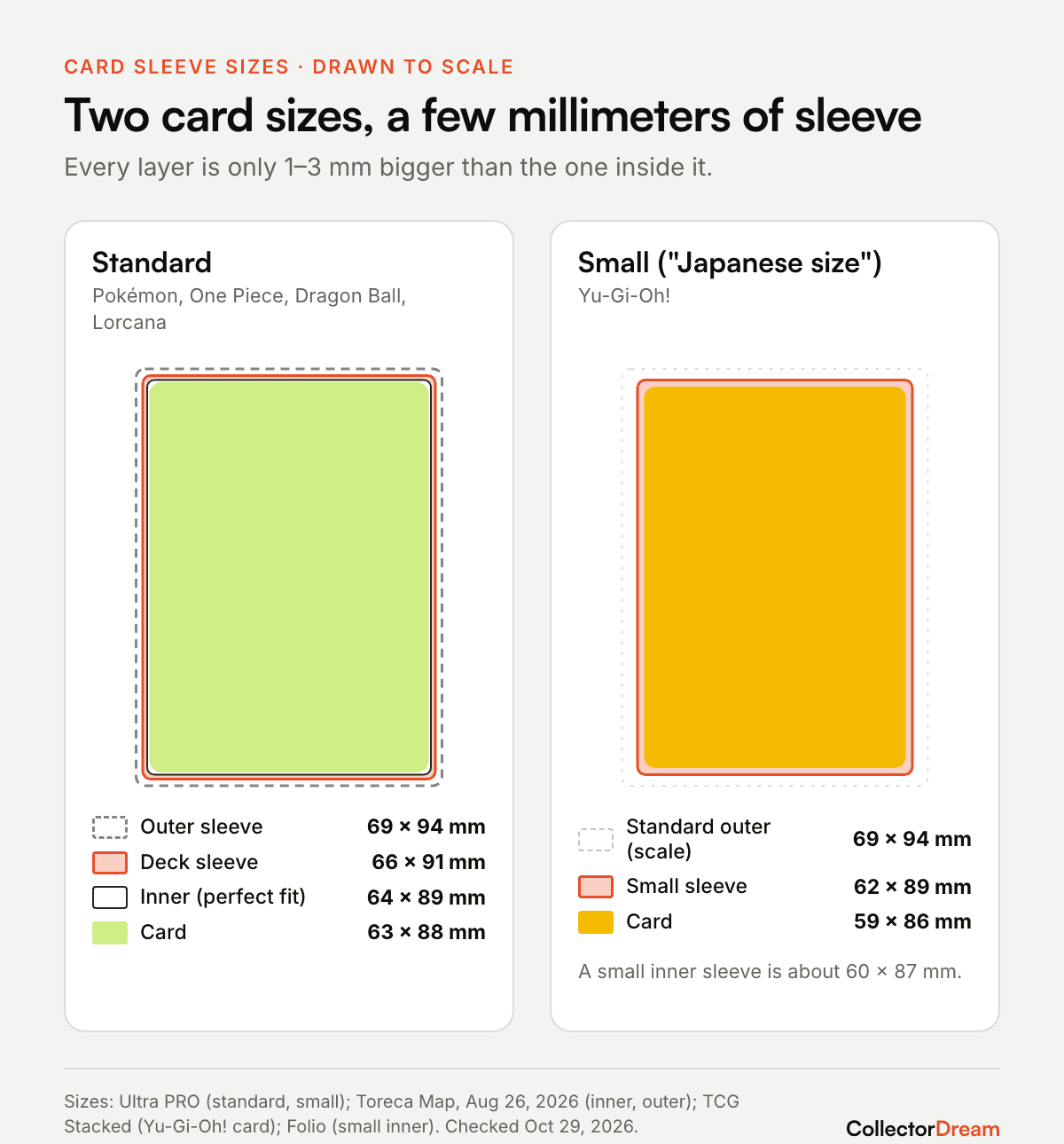
Brands round a little differently, so a "66 × 92" box and a "66 × 91" box are the same class of sleeve. What matters is which family you're in: standard or small.
Card sleeve sizes for each game
Four of our five games use standard sleeves; Yu-Gi-Oh! is the odd one out. Here's the detail per game.
Pokémon
Pokémon cards are standard size, about 63 × 88 mm, and take 66 × 91 mm sleeves (Ultra PRO). That includes Japanese Pokémon cards, which use the same card size as English ones (Delightful TCG). If you collect both languages, one sleeve size covers everything; for how the two printings differ in other ways, see Japanese vs English Pokémon cards.
One Piece Card Game
One Piece cards measure 63 × 88 mm, so standard sleeves fit. Bandai's official character sleeves are a touch larger, at 67 × 92 mm, and a typical double-sleeve stack uses a 64 × 89 mm inner under a 66 × 91 mm deck sleeve (Toreca Map, Aug 26, 2026). Japanese and English One Piece cards are the same size. If you're sleeving a Manga Rare to send off, our guide on whether it's worth grading One Piece cards covers what happens next.
Dragon Ball
Dragon Ball is three lines, and they don't all behave the same:
- Fusion World and Masters cards are standard size. Ultra PRO lists Dragon Ball Super among the games its standard sleeves fit (Ultra PRO).
- Super Divers cards come out of arcade machines in Japan. Bandai sells official Super Divers sleeves there (Joshin), but we couldn't find a published card size. Measure one card, or buy the official sleeves, before you order a box of anything else. Our Super Divers collector's guide explains how the cards are made and sold.
Disney Lorcana
Lorcana cards are standard size and take standard sleeves (TCG Stacked). Ravensburger's own Lorcana sleeves are sold as "standard-sized", 65 to a pack (Ravensburger UK). Small "Japanese size" sleeves won't close over a Lorcana card.
Yu-Gi-Oh!
Yu-Gi-Oh! cards are about 59 × 86 mm, a few millimeters narrower and shorter than the other four games (TCG Stacked). They need small sleeves, 62 × 89 mm (Ultra PRO). A Yu-Gi-Oh! card will go into a standard sleeve, but it slides around, and the extra room lets corners knock against the sleeve edge.
"Japanese size" doesn't mean Japanese cards
"Japanese size" is just the sleeve industry's name for the small 62 × 89 mm sleeve. It has nothing to do with the language printed on your card.
That trips up a lot of new collectors. Japanese Pokémon and One Piece cards are standard size, so a pack of "Japanese size" sleeves bought for them won't fit. The rule is simple: sleeve by game, not by language. Only Yu-Gi-Oh! (and a few games we don't cover, like Cardfight!! Vanguard) needs the small size (Ultra PRO).
How to double sleeve a card
Double sleeving means putting a card in a snug inner sleeve first, then into a deck sleeve. The inner sleeve keeps dust and moisture off the card, and the deck sleeve takes the wear.
- Inner sleeve, top first. Slide the card into a perfect-fit inner (about 64 × 89 mm for standard cards) with the open end at the top.
- Turn it over. Turn the sleeved card upside down, so the inner's open end points down.
- Into the deck sleeve. Slide it into the 66 × 91 mm deck sleeve, open end first. The deck sleeve's closed bottom now covers the inner's opening, so nothing gets in from either end.
- Optional outer sleeve. Some players add a clear outer sleeve (about 69 × 94 mm) on top. For a binder card it's rarely worth the extra bulk.
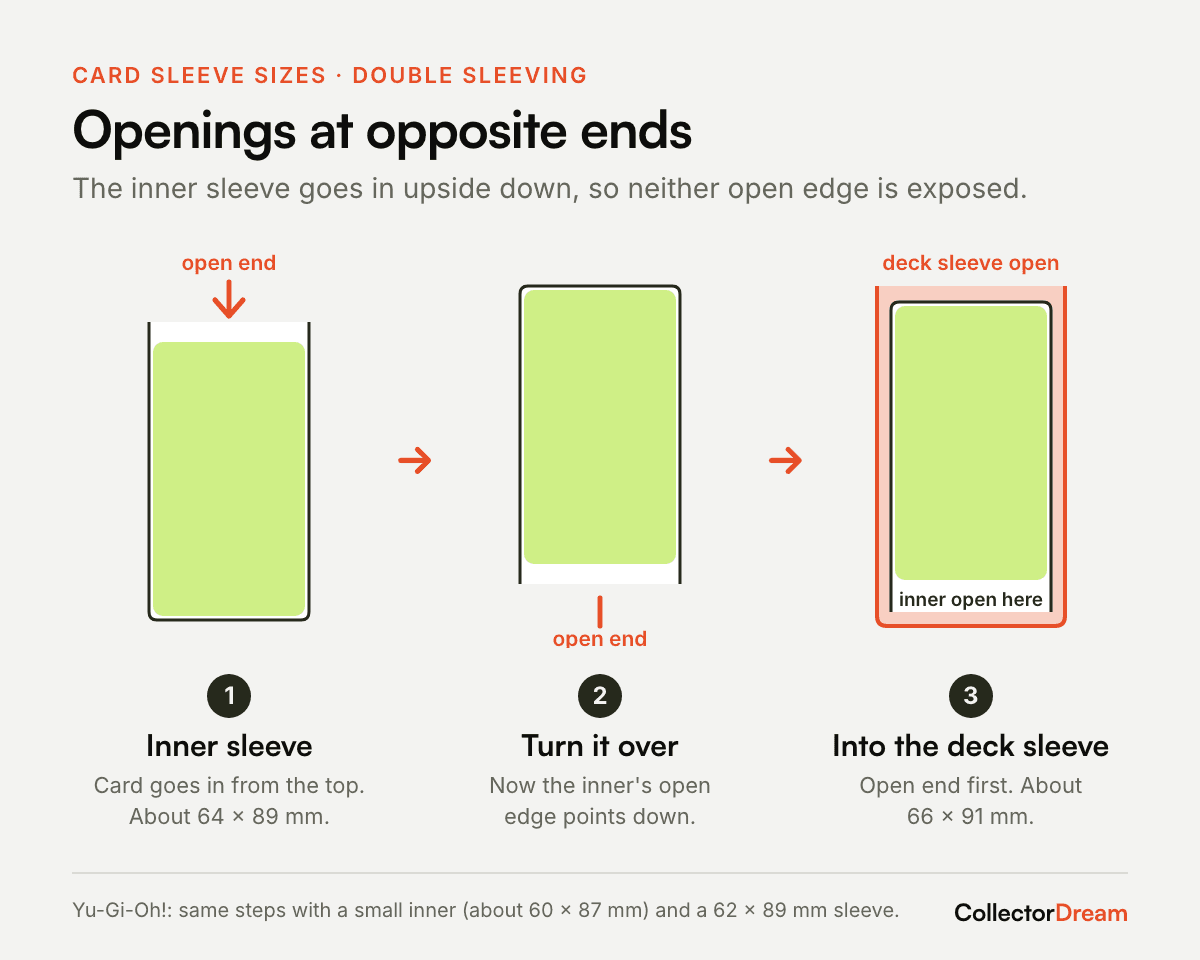
For Yu-Gi-Oh!, do the same with a small inner (about 60 × 87 mm) and a 62 × 89 mm small sleeve.
Which sleeve for binders, toploaders and grading?
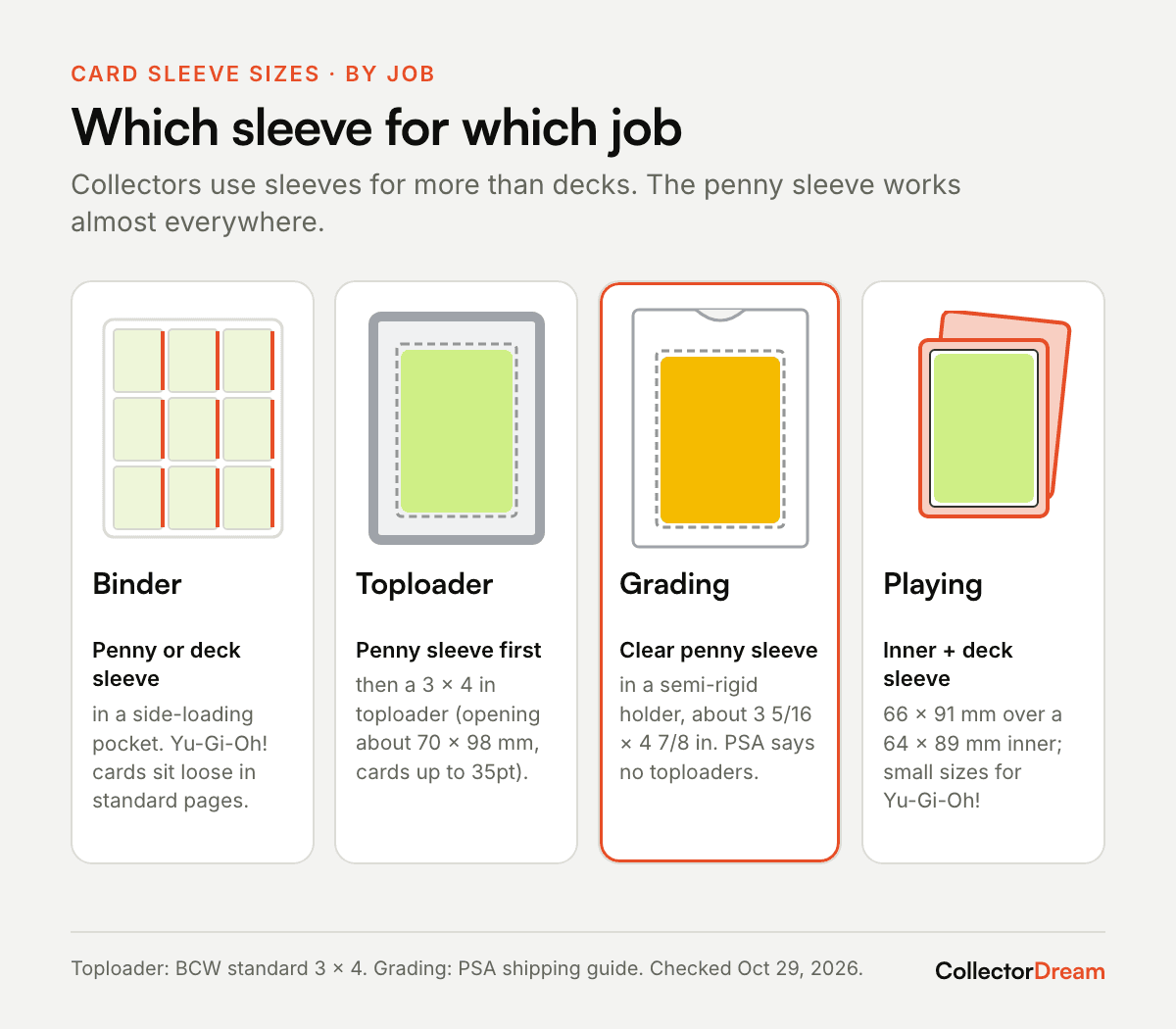
Collectors use sleeves for more than decks, and each job has a size that works best:
- Binder: a penny sleeve or a deck sleeve, then a side-loading pocket. Standard nine-pocket pages are made for sleeved standard cards; Yu-Gi-Oh! cards fit but sit loose.
- Toploader: a penny sleeve first, then a 3 × 4 in toploader. BCW's standard 3 × 4 holder has an opening of 2¾ × 3⅞ in (about 70 × 98 mm) and takes cards up to 35pt thick (BCW), so a penny-sleeved card slides in easily. A thick deck sleeve or a double-sleeved card can be a tight squeeze.
- Sending to a grader: PSA asks for each card in a clear penny sleeve, then a semi-rigid holder about 3 5/16 × 4 7/8 in, and tells you not to use toploaders (PSA shipping guide). Opaque or colored sleeves can cause delays. Other graders have their own rules; our PSA vs CGC vs TAG vs BGS comparison covers who takes what.
- Playing: a deck sleeve, often over an inner sleeve. Players who also collect usually keep their best copies out of the deck altogether.
How to check fit before you buy a box of 100
A quick check saves a drawer of sleeves you can't use:
- Read the size on the pack, not the name. "Standard", "Japanese", "small" and "mini" mean different things at different brands. Look for the millimeter size: 66 × 91 (or 66 × 92) for standard, 62 × 89 for small.
- Measure one card. A ruler is enough. About 63 mm wide means standard; about 59 mm means small.
- Buy a small pack first. Many brands sell packs of 50 to 65. Test the fit with an inner sleeve if you plan to double sleeve, because a stiff inner can make a deck sleeve tight.
- Keep oversized cards separate. Jumbo promo cards and other oversized cards don't fit any of these sizes.
If you're putting together a starter kit for a young collector, our Pokémon card gift guide for parents has the basics in one place, and How to Start Collecting Trading Cards covers sleeves alongside everything else you'll want in your first month.
Where to go next
- How to Start Collecting Trading Cards in 2026
- Japanese vs English Pokémon Cards
- PSA vs CGC vs TAG vs BGS
Keep your collection organized with CollectorDream
Once your cards are sleeved, the next question is what you've actually got. CollectorDream lets you scan cards from all five games, log them by set and condition, and see recent sold prices in one place. The app is out now on iOS: download CollectorDream on the App Store, and follow Alec's daily openings on YouTube, TikTok and Instagram.
FAQ
Are Japanese Pokémon cards a different size?
No. Japanese and English Pokémon cards are both standard size, about 63 × 88 mm, and take the same 66 × 91 mm sleeves. "Japanese size" sleeves are too small for them.
Do Yu-Gi-Oh! cards fit in Pokémon sleeves?
They go in, but they slide around because the card is about 4 mm narrower. Small 62 × 89 mm sleeves fit Yu-Gi-Oh! cards properly.
What size sleeves do One Piece cards use?
Standard sleeves, 66 × 91 mm. Bandai's official One Piece sleeves measure about 67 × 92 mm, and a 64 × 89 mm inner fits underneath for double sleeving.
What are perfect fit sleeves?
Thin, clear inner sleeves cut close to the card, about 64 × 89 mm for standard cards. They go on first, and a deck sleeve goes over them.
Will a sleeved card fit in a toploader?
A card in a penny sleeve fits a standard 3 × 4 in toploader easily. A thick deck sleeve, or a double-sleeved card, can be a tight fit, so test one before you load a stack.
Alec Nguyen
Founder, CollectorDream
Scan a card, see its rarity and value
The CollectorDream app reads the card for you. Now on the App Store.
Download on iOS (opens the App Store)