

On this page · 9 sections
Updated: October 29, 2026
If you've decided one set is your set and you want every card in it, you'll soon hit the question: what is a master set, and what actually counts? This guide explains the difference between a master set, a complete set and a living dex, which reverse holos, promos and stamped cards collectors include, how many cards that adds up to, and a simple way to track your progress without losing your mind.
Collection type | What it includes | Example: Mega Evolution (2025) |
|---|---|---|
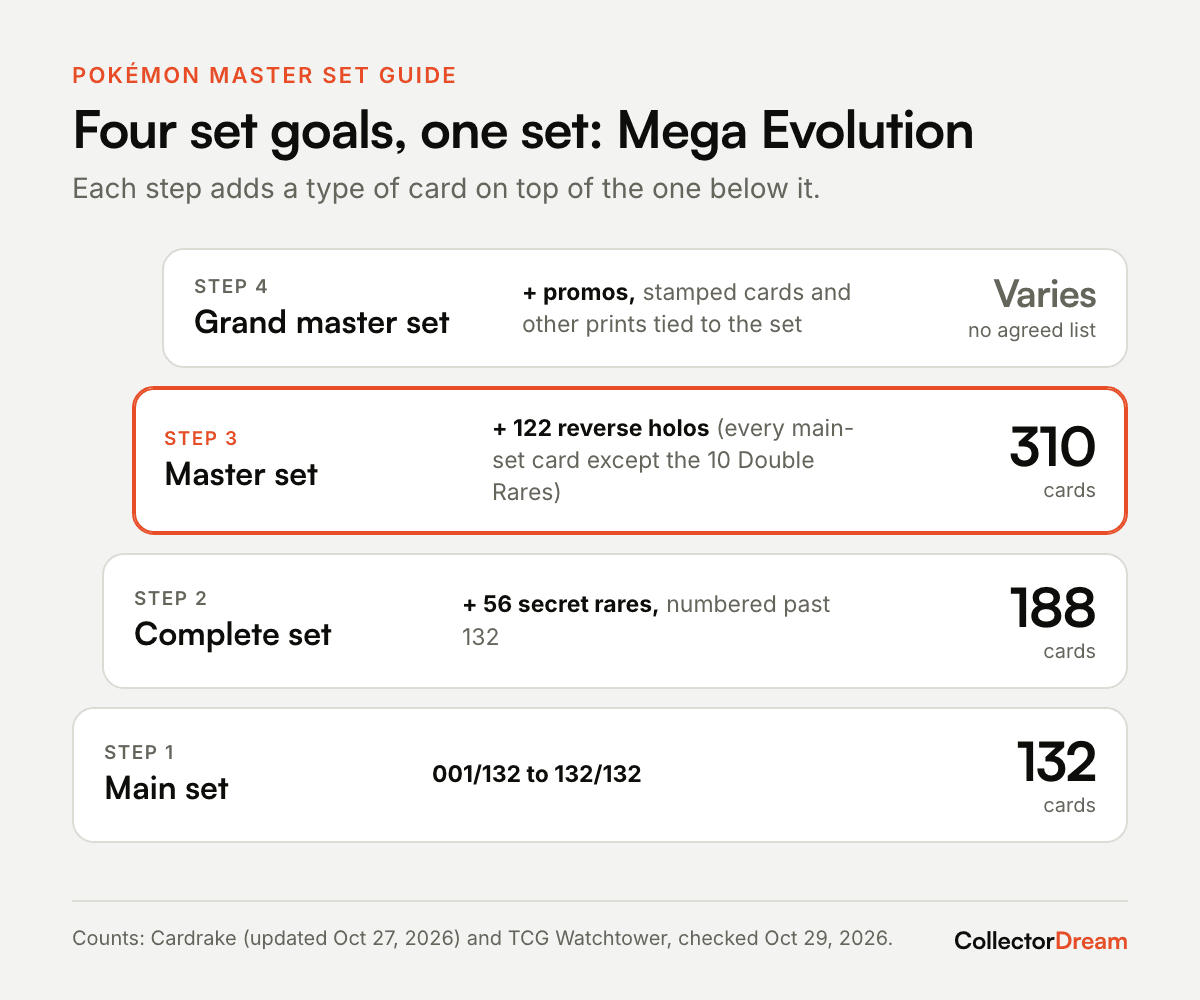
Main set | Every card numbered up to the printed total | 132 cards (001/132 to 132/132) |
Complete set | The main set plus every secret rare | 188 cards |
Master set | The complete set plus every reverse holo | 310 cards |
Grand master set | The master set plus promos, stamped cards and other prints tied to the set | Varies; no agreed list |
Living dex | One card of every Pokémon species, from any set | More than 1,000 cards |
Mega Evolution counts: Cardrake (updated Oct 27, 2026) and TCG Watchtower, checked Oct 29, 2026. Definitions: Cardrake's master set guide and the Elite Fourum.
What is a master set?
A master set is one copy of every card and every printed version of that card in a single expansion. In a modern Pokémon set that means the regular cards, every secret rare (the cards numbered past the set total) and every reverse holo.
The idea is simple: if the set has a card in it, in any finish, a master set has it too. Where collectors disagree is on the edges, such as promos, stamped cards and errors. There's no official definition from The Pokémon Company. As one long-running Elite Fourum thread puts it, there simply isn't a clear definition, and collectors set their own rules (Elite Fourum).
Master set vs complete set vs living dex
These terms describe different goals, from the most contained to the most open-ended.
- Main set: every card from 001 up to the number printed after the slash. On a card numbered 084/132, that's the 132.
- Complete set: the main set plus the secret rares. In today's sets, those include the Illustration Rares, Ultra Rares, Special Illustration Rares and the gold cards. If those terms are new, our guide to Pokémon card rarities explains each one.
- Master set: the complete set plus every reverse holo, and in some sets more than one reverse holo per card.
- Grand master set: the master set plus the promos, stamped cards and retailer versions printed alongside the set (Cardrake). This is where it gets hard, because some promos were only handed out at events.
- Living dex: a different kind of goal. Instead of finishing a set, you collect one card of every Pokémon species, usually in National Pokédex order, from whatever sets you like. With more than 1,000 Pokémon, it never really ends, which is part of the appeal.
What counts in a master set?
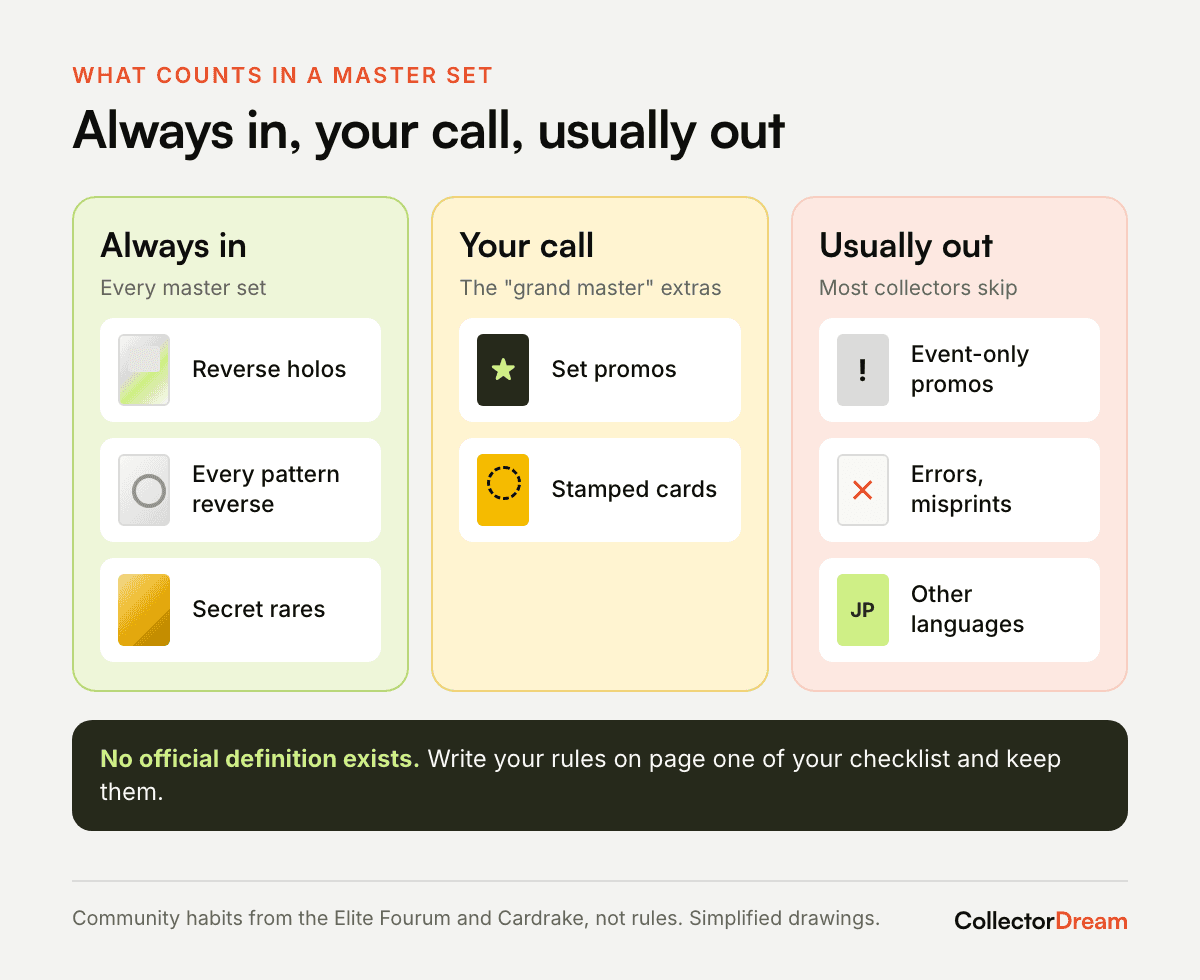
Reverse holos and secret rares always count. Everything else is a choice you make once and stick to.
Reverse holos
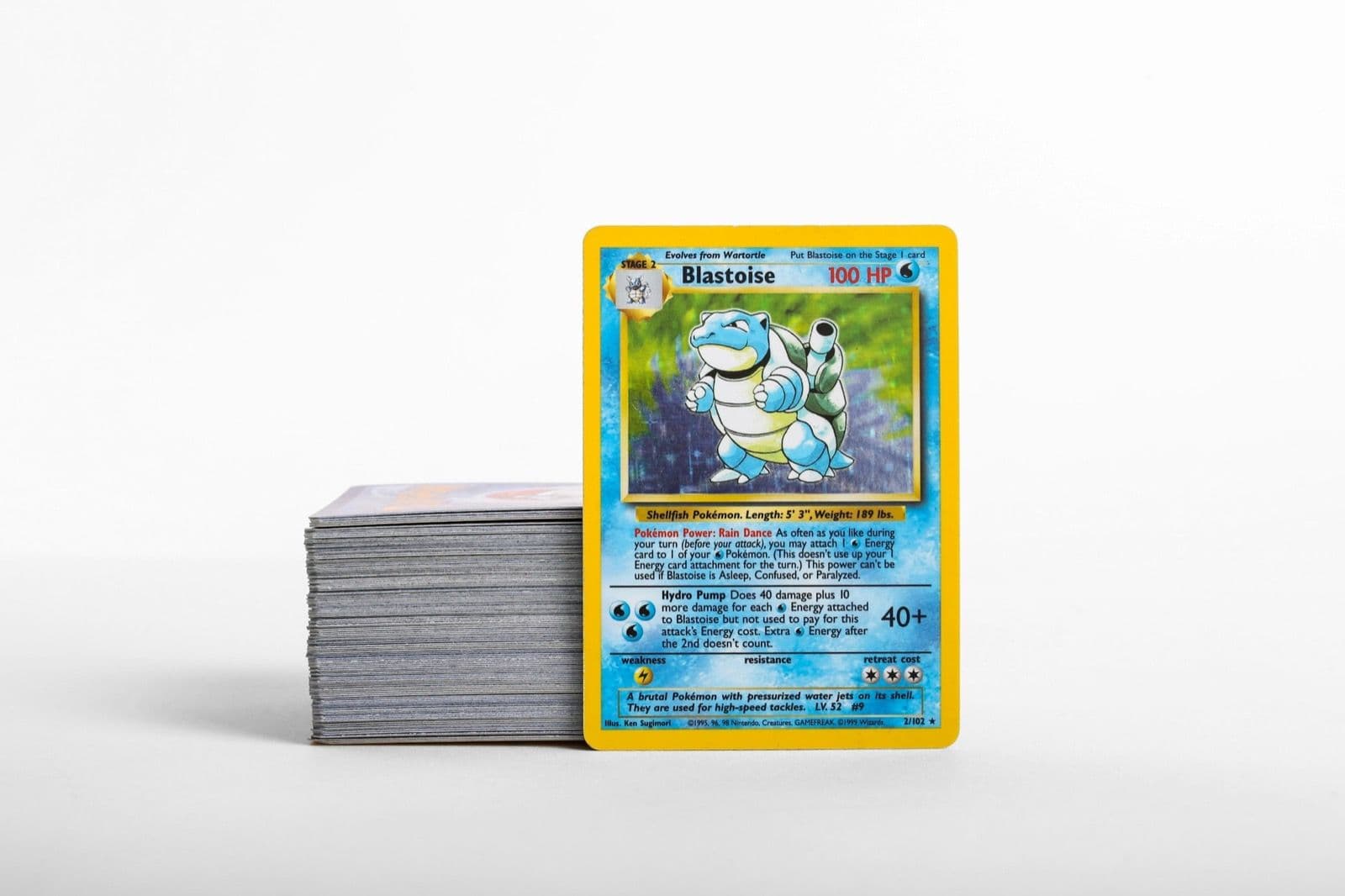
A reverse holo is a Common, Uncommon or Rare printed with foil everywhere except the picture. In the first Mega Evolution set, every main-set card except the ten Double Rares has a reverse holo version, which is where 122 of the master set's 310 cards come from (TCG Watchtower). Secret rares don't get reverse holos.
Pattern reverse holos
Some special sets print a card in more than one reverse holo pattern, and a master set needs each one. Prismatic Evolutions and Black Bolt / White Flare added Poké Ball and Master Ball pattern reverse holos, and Ascended Heroes gave regular Pokémon two reverse holos each: one with an Energy symbol pattern and one with a ball or Team Rocket pattern (Coded Yellow). Check your set's list before you start, because this can add a lot of cards.
The edge cases
Card type | Most collectors | How to decide |
|---|---|---|
Reverse holos, every pattern | Count | Always included in a master set |
Secret rares | Count | Always included |
Black Star promos tied to the set (ETB, blister and collection promos) | Often count | Include them if you want the "grand master" version |
Prerelease and other stamped cards | Split | Common in grand master sets; many skip them |
Event-only and staff promos | Usually skip | Some had tiny print runs, so they can block a set for years |
Errors and misprints | Usually skip | Some count only errors the publisher acknowledged |
Other languages | Skip | A Japanese set is its own master set |
Based on the Elite Fourum discussion and Cardrake. These are community habits, not rules.
If you collect Japanese cards too, keep the two languages as separate sets. Japanese sets are numbered and built differently, as our guide to Japanese vs English Pokémon cards explains.
How many cards is a master set?
Count it as main set + secret rares + reverse holos (+ any extra pattern versions). For the first Mega Evolution set, that's 132 + 56 + 122 = 310 cards, and two trackers agree on that number (Cardrake, TCG Watchtower).
Smaller special sets can come in well under that, while big sets with pattern reverse holos run far higher. Cardrake's guide lists master sets from under 200 cards to more than 400, depending on the set (Cardrake). If two checklists give different totals for the same set, it's usually because one counts the pattern reverse holos or promos and the other doesn't. Pick one list and stay with it.
How to track a master set, step by step
The best tracking system is the one you'll actually keep up. Here's a simple routine that works with paper, a spreadsheet or an app.
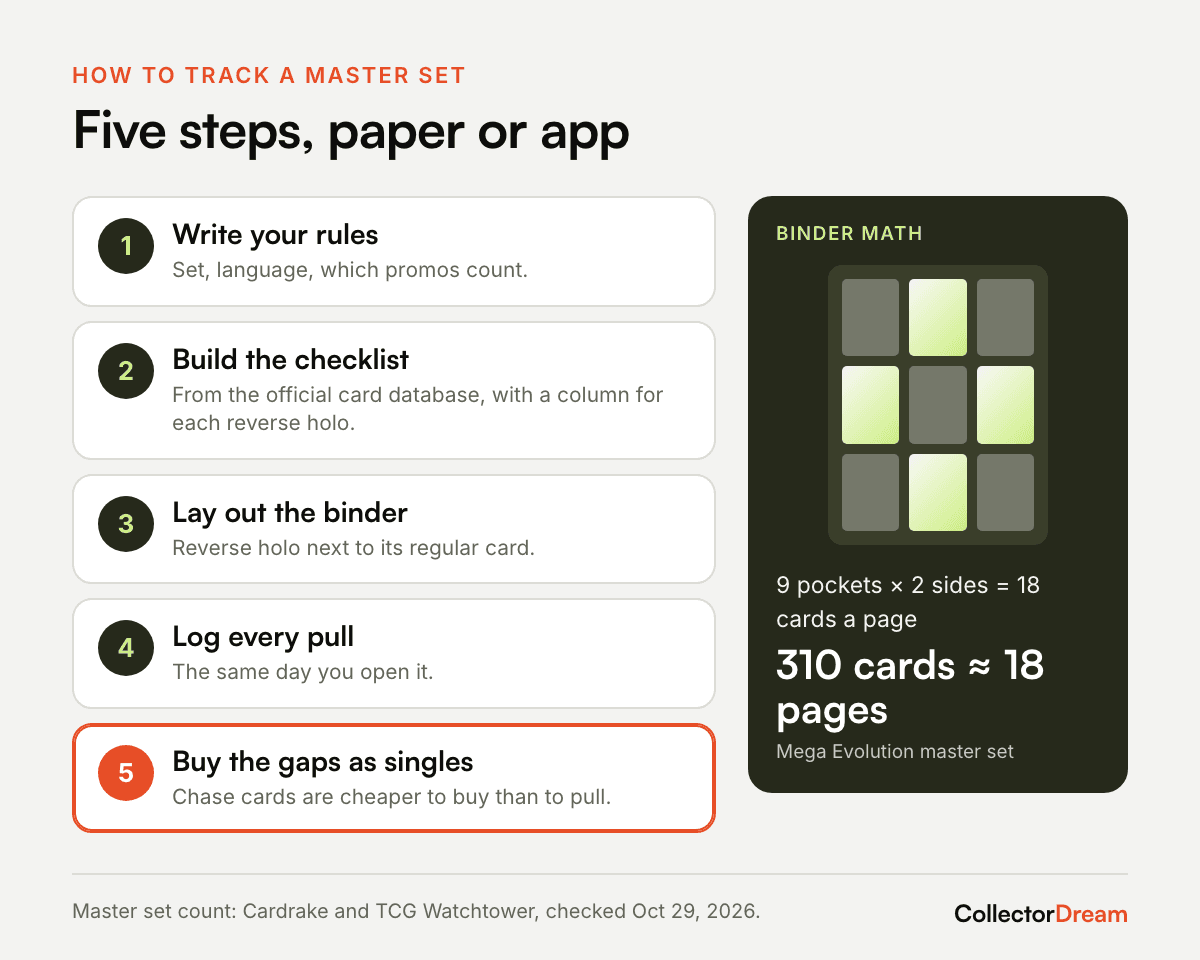
- Write your rules. One line: "Mega Evolution, English, all reverse holos, no stamped promos." It saves arguments with yourself later.
- Build the checklist. Start from the official Pokémon TCG card database, which lists every card in an expansion, then add a second column for the reverse holo of each card that has one. A spreadsheet with columns for number, name, rarity, regular and reverse is enough.
- Lay out the binder. A 9-pocket page holds 18 cards when you use both sides, so a 310-card master set fills 18 pages. Many collectors put each reverse holo right next to its regular version. Use a side-loading binder, and check our guide to card sleeve sizes if you double-sleeve.
- Log every pull the day you open it. Tick it off, then file it in its pocket. Empty pockets show you what's missing at a glance.
- Buy the gaps as singles. Once you're down to the last chase cards, stop opening packs and buy them (see below).
Tracking apps can do steps 2 and 4 for you, and several already exist. CollectorDream makes one of them, so weigh our take on apps accordingly: whatever you use, make sure it lets you mark reverse holos separately, or you'll have to track them by hand anyway.
How to finish a master set without opening forever
The commons, uncommons and most reverse holos come quickly from packs. The last handful of cards is where the money goes, because the chase cards are so rare.
TCGplayer measured about 1 in 480 packs for any one specific Special Illustration Rare in Pitch Black (4,000+ English packs, Jul 21, 2026) (TCGplayer). Hoping to pull every SIR in a set is a plan to open thousands of packs. Buying those cards as singles is almost always cheaper, and it's how most master-set collectors finish.
A few more habits that help:
- Trade your duplicates for reverse holos you're missing. Other set collectors have exactly the opposite problem.
- Check condition before you file a card, especially secret rares. If one might be worth grading someday, see our guide on how to pre-grade cards at home.
- Buy singles from sellers you trust. Expensive chase cards are the ones most often faked, so run the checks in our guide on how to spot fake cards and resealed packs.
- Pick a set you love. A master set takes months. Choose one whose art makes you happy to open the binder.
Where to go next
- Pokémon Card Rarities Explained (what every tier in your checklist means)
- TCG Release Calendar 2027 (pick your next set before it lands)
- How to Start Collecting Trading Cards
Track your master set with CollectorDream
With CollectorDream you can scan cards into a set checklist, mark regular and reverse holo versions separately, and see at a glance which pockets are still empty. The app is out now on iOS: download CollectorDream on the App Store, and follow my daily openings on YouTube, TikTok and Instagram.
FAQ
Do reverse holos count in a master set?
Yes. Reverse holos are what separate a master set from a complete set. In sets with Poké Ball, Master Ball or other pattern reverse holos, each pattern counts as its own card.
Do promos count in a master set?
It depends on your rules. Many collectors leave promos out of a standard master set and add them in a "grand master set," because some promos were event-only and very hard to find.
Is a master set the same as a complete set?
No. A complete set is one of every numbered card, including secret rares. A master set adds every reverse holo and other printed version.
How many cards are in a Pokémon master set?
It depends on the set. The first Mega Evolution set has 188 numbered cards and a 310-card master set; other sets range from under 200 to more than 400.
What is a living dex in Pokémon cards?
A collection with one card of every Pokémon species, usually kept in National Pokédex order. It isn't tied to any one set, and with more than 1,000 species it's a long-term project.
Alec Nguyen
Founder, CollectorDream
Scan a card, see its rarity and value
The CollectorDream app reads the card for you. Now on the App Store.
Download on iOS (opens the App Store)