On this page · 12 sections
- Japanese vs English Pokémon cards at a glance
- Which comes out first, Japanese or English?
- What's in a Japanese pack and box?
- How do Japanese rarity codes compare?
- Are Japanese cards better quality?
- Prices: the same card in two languages
- Can you play with Japanese Pokémon cards?
- How to buy Japanese Pokémon cards safely
- Which should you collect?
- Where to go next
- Track both languages with CollectorDream
- FAQ
Updated: October 29, 2026
Japanese vs English Pokémon cards is one of the first big choices a collector runs into: the same Pokémon, often the same artwork, but different packs, different rarity codes and sometimes very different prices. This guide compares the two side by side with official release dates, pack contents, real market prices for the same cards, and a short checklist for buying Japanese cards safely.
Japanese vs English Pokémon cards at a glance
| Japanese | English |
|---|---|---|
Release | First, often by two to three months | Later; sets are often based on one or two Japanese sets |
Cards per main-set pack | 5 | 10 (plus a Basic Energy and a code card) |
Packs per booster box | Typically 30 | 36 |
Retail pack price | ¥200 for recent main sets (~$1.27) | About $4.49 at the Pokémon Center |
Rarity marking | Letter codes (AR, SR, SAR, MUR) | Symbols (stars) |
Card numbers | Japanese set numbering | Different numbering for the same card |
Tournament play outside Japan | Not legal in Championship Series events | Legal |
Where to buy in the US | Importers, TCGplayer's "Pokemon Japan" line | Any Pokémon retailer |
Japanese prices and pack contents: Pokémon Card Game official site (checked Oct 29, 2026). English pack contents and prices: Pokémon Center Booster Bundle ($26.94 for 6 packs) and Elite Trainer Box listings (Oct 29, 2026). Box sizes: Samurai Sword Tokyo (Oct 19, 2026). Yen converted at ¥158/$ (ECB reference rate, Oct 28, 2026).
Which comes out first, Japanese or English?
Japanese sets almost always come out first. In the current Mega Evolution series, the English version of a set has followed its Japanese source by 7 to 14 weeks:
Japanese set (release) | English set (release) | Gap |
|---|---|---|
Mega Brave + Mega Symphonia (Aug 1, 2025) | Mega Evolution (Sep 26, 2025) | 8 weeks |
Inferno X (Sep 26, 2025) | Phantasmal Flames (Nov 14, 2025) | 7 weeks |
Ninja Spinner (Mar 13, 2026) | Chaos Rising (May 22, 2026) | 10 weeks |
Abyss Eye (May 22, 2026) | Pitch Black (Jul 17, 2026) | 8 weeks |
Storm Emeralda (Jul 31, 2026) | Delta Reign (Nov 6, 2026) | 14 weeks |
30th CELEBRATION (Sep 16, 2026) | 30th Celebration (Sep 16, 2026) | Same day |
Japanese dates: Pokémon Card Game official site. English dates: GoNintendo (Mega Evolution; EMEA got it on Oct 10, 2025), Elite Fourum (Phantasmal Flames), iCv2 (Chaos Rising, Pitch Black, 30th Celebration), Pokémon (Delta Reign). Set pairings: Bulbapedia, Elite Fourum, Samurai Sword Tokyo, Samurai Sword Tokyo card list, TCGplayer. Gaps are our own count.
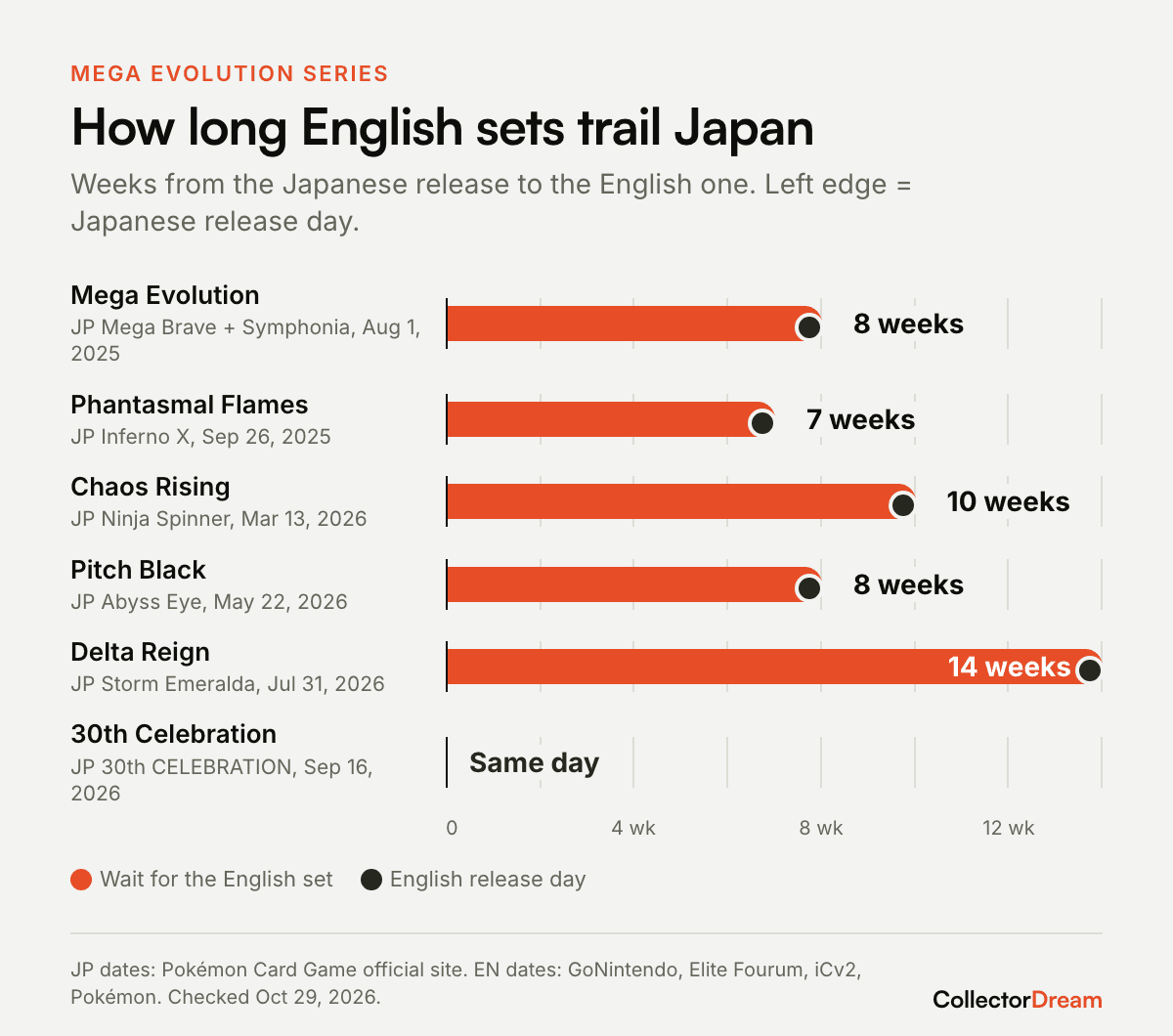
That head start is why Japanese openings spoil the English chase cards months in advance. When we wrote our Delta Reign guide, most of its chase list was "expected" from Storm Emeralda because the English list wasn't out yet.
English sets aren't always a straight translation. They can combine two Japanese sets, add cards from other products, and they always renumber cards. TCGplayer's help center puts it plainly: Japanese and English sets "are not a 1:1 match" (TCGplayer Help Center).
What's in a Japanese pack and box?
A Japanese main-set pack has 5 cards; an English pack has 10. The official Japanese listing for Storm Emeralda gives a list price of ¥200 for five cards (Pokémon Card Game). An English pack holds 10 cards plus a Basic Energy and a Pokémon TCG Live code card (Pokémon Center).
At retail, that works out to:
- Japanese: ¥200 per pack, or ¥40 (~$0.25) per card. Japanese packs were ¥180 until Abyss Eye in May 2026.
- English: the Pokémon Center sells a 6-pack Booster Bundle for $26.94, so about $4.49 per pack, or about $0.45 per card.
Japanese booster boxes have typically held 30 packs (150 cards), against 36 packs (360 cards) in English (Samurai Sword Tokyo, Oct 19, 2026). Outside Japan you won't pay the Japanese list price: importers add shipping, their margin and, in many countries, import duties collected on delivery.
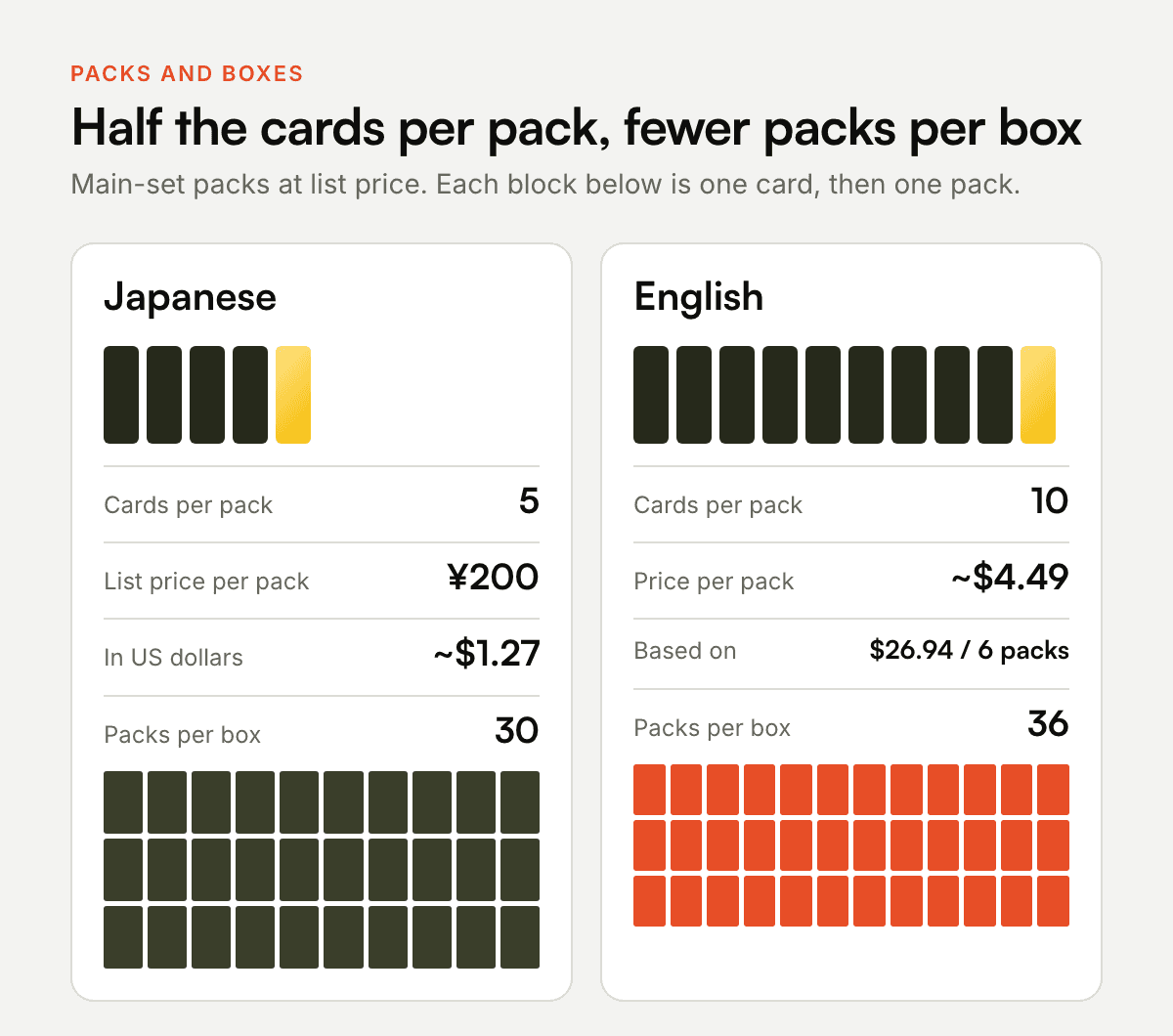
Because Japanese packs have half as many cards, pull rates per pack aren't directly comparable between the two languages.
How do Japanese rarity codes compare?
The tiers line up, but Japanese cards print a letter code instead of stars. Here are the codes you'll meet in current sets:
Japanese code | English name |
|---|---|
RR | Double Rare |
AR (Art Rare) | Illustration Rare |
SR (Super Rare) | Ultra Rare |
SAR (Special Art Rare) | Special Illustration Rare |
UR (Ultra Rare) | Hyper Rare (gold, Scarlet & Violet era) |
MUR (Mega Ultra Rare) | Mega Hyper Rare (gold, Mega Evolution era) |
Watch out for SR and UR: a Japanese SR is an English Ultra Rare, and a Japanese UR is a gold card. Our Pokémon card rarities guide explains every symbol and code in more detail.
Japan also has a few things English sets don't. TCGplayer notes that Japanese High Class packs can include mirror holofoils, parallel foil cards that don't exist in English sets, and that many Japanese promos have no English counterpart (TCGplayer Help Center).
Are Japanese cards better quality?
Many collectors think so, but there's no official data either way. The usual claims are that Japanese cards have finer holo texture, cleaner cuts and more consistent centering, and that the gap shows most at Double Rare and above (Samurai Sword Tokyo, Oct 19, 2026). The same source notes that the silver borders English cards have used since Scarlet & Violet narrow the difference on lower-rarity cards.
Treat print quality as a tendency, not a rule. Check every card you care about yourself, especially before paying to have it graded. Our comparison of PSA, CGC, TAG and BGS covers what graders look at.
Prices: the same card in two languages
Japanese and English versions of the same card can be priced very differently, and not always in the same direction. Here are two of the Mega Evolution era's best-known Pokémon, at three rarity tiers each, using TCGplayer's own Market Price for raw (ungraded) copies on the same day:
Card and tier | English (number) | Japanese (number) |
|---|---|---|
Mega Charizard X ex, full-art scene (SIR / SAR) | $585.57 (125/094) | $707.67 (110/080) |
Mega Charizard X ex, gold (Mega Hyper Rare / MUR) | $185.35 (130/094) | $661.69 (116/080) |
Mega Charizard X ex, full art (Ultra Rare / SR) | $22.24 (109/094) | $22.38 (094/080) |
Mega Darkrai ex, full-art scene (SIR / SAR) | $141.61 (116/084) | $162.23 (114/081) |
Mega Darkrai ex, gold (Mega Hyper Rare / MUR) | $125.12 (120/084) | $381.26 (118/081) |
Mega Darkrai ex, full art (Ultra Rare / SR) | $6.04 (101/084) | $8.19 (099/081) |
TCGplayer Market Price, raw, checked Oct 29, 2026, from TCGplayer's Mega Charizard X ex and Mega Darkrai ex listings. English cards are from Phantasmal Flames and Pitch Black; Japanese cards from Inferno X and Abyss Eye. Japanese prices are for imported Japanese cards sold on TCGplayer in USD.
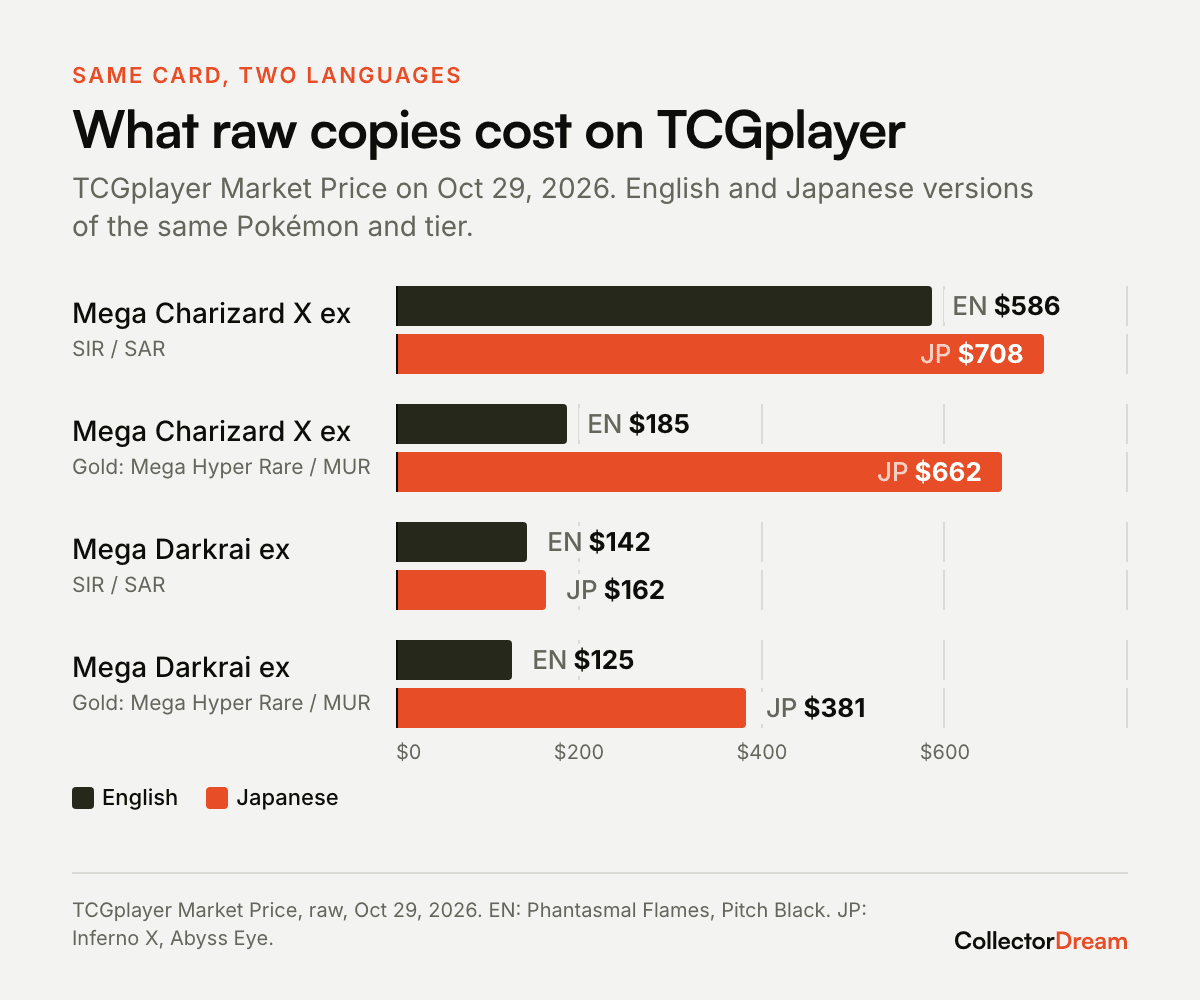
What this snapshot shows:
- At the full-art scene tier (SIR/SAR), the Japanese cards were about 15–21% higher.
- For the gold Mega cards, the Japanese versions were roughly three to three and a half times the English price.
- At the Ultra Rare / SR tier, the two languages were almost level.
Price data alone can't tell you why. Pull rates, print runs, demand in each country and import costs all differ, and one day's prices for six cards don't make a rule for every set. Before you buy, look up recent sold prices for the exact language, number and condition you want.
Can you play with Japanese Pokémon cards?
Not in official tournaments outside Japan. TCGplayer's help center, citing the Play! Pokémon Tournament Rules Handbook, says Japanese cards aren't legal in Play! Pokémon Championship Series events (TCGplayer Help Center). At a casual game night, ask the organizer.
If your kid or a friend wants to battle with their cards, English is the practical choice. Our gift guide for parents covers the English decks that are easiest to start with.
How to buy Japanese Pokémon cards safely
Buy from sellers you can check, and know the extra costs before you pay. A short checklist:
- Use a seller with a track record: an established import shop, or a marketplace that offers buyer protection. On TCGplayer, Japanese cards live under a separate "Pokemon Japan" product line (TCGplayer Help Center).
- Match the exact card: Japanese numbers differ from English ones (Mega Charizard X ex SAR is 110/080 in Japanese, 125/094 in English). Search by set and number, not just the Pokémon.
- For sealed boxes, check the shrink wrap. Samurai Sword Tokyo advises that every sealed box should have its original wrap intact, and some shops sell "no shrink" boxes as a separate, cheaper option (Samurai Sword Tokyo). Know which one you're buying.
- Add the hidden costs: international shipping and, depending on your country, import duties and taxes paid on delivery.
- Know the fakes. Counterfeits exist in both languages. Our guide on how to spot fake cards and resealed packs walks through the checks.
Which should you collect?
Collect the language you enjoy looking at, and stick with it for a set. A few rules of thumb:
- You want to play, or you're buying for a kid: English.
- You love the art and want it first: Japanese gets you the set months earlier, and packs cost less per pack at list price.
- You want a master set: pick one language. The card numbers and set contents don't match, so mixing languages makes a set hard to track.
- You're chasing one specific card: compare both versions' recent sold prices on the day. As the table shows, the cheaper language changes from card to card.
New to collecting? Start with our beginner's guide to collecting trading cards.
Where to go next
- Pokémon Card Rarities Explained (every symbol and Japanese code)
- How to Spot Fake Cards & Resealed Packs (before you import)
- PSA vs CGC vs TAG vs BGS (grading Japanese and English cards)
Track both languages with CollectorDream
With CollectorDream you can scan Japanese and English cards, see each version's set, number and recent sold prices side by side, and keep them in one collection. The app is out now on iOS: download CollectorDream on the App Store, and follow Alec's daily openings on YouTube, TikTok and Instagram.
FAQ
Are Japanese Pokémon cards worth more than English?
It depends on the card. On October 29, 2026, Japanese versions of two Mega Evolution chase cards cost about 15–21% more at the SAR tier and around three times as much for the gold cards, while Ultra Rare / SR prices were nearly level (TCGplayer Market Price, raw).
Are Japanese Pokémon cards better quality?
Many collectors find Japanese cards better cut and centered, with finer holo texture, but no official data confirms it. Check each card yourself.
Why are Japanese Pokémon packs cheaper?
A Japanese main-set pack has 5 cards for ¥200 (about $1.27), half the cards of an English pack. Per card, Japanese packs still cost less at list price, but importing adds shipping, the seller's margin and sometimes duties.
Can you use Japanese Pokémon cards in tournaments?
Not in Play! Pokémon Championship Series events, according to TCGplayer's summary of the official rules handbook. Casual events are up to the organizer.
Do Japanese and English sets have the same cards?
Mostly, but not exactly. English sets can combine Japanese sets or add cards, and every card gets a new number. Some Japanese promos and mirror holofoils have no English version.
How long after Japan do English sets come out?
In the Mega Evolution series, 7 to 14 weeks. The 30th Celebration set was released in both languages on the same day, September 16, 2026.
Alec Nguyen
Founder, CollectorDream
Scan a card, see its rarity and value
The CollectorDream app reads the card for you. Now on the App Store.
Download on iOS (opens the App Store)