On this page · 10 sections
- Step 1: Identify the exact card
- Step 2: Judge the condition honestly
- Step 3: Look up sold prices, not asking prices
- Step 4: Sanity-check the number
- Step 5: Decide whether grading changes the answer
- Which details change a Pokémon card's value?
- Common mistakes when pricing a Pokémon card
- Where to go next
- Price your cards with CollectorDream
- FAQ
Updated: October 29, 2026
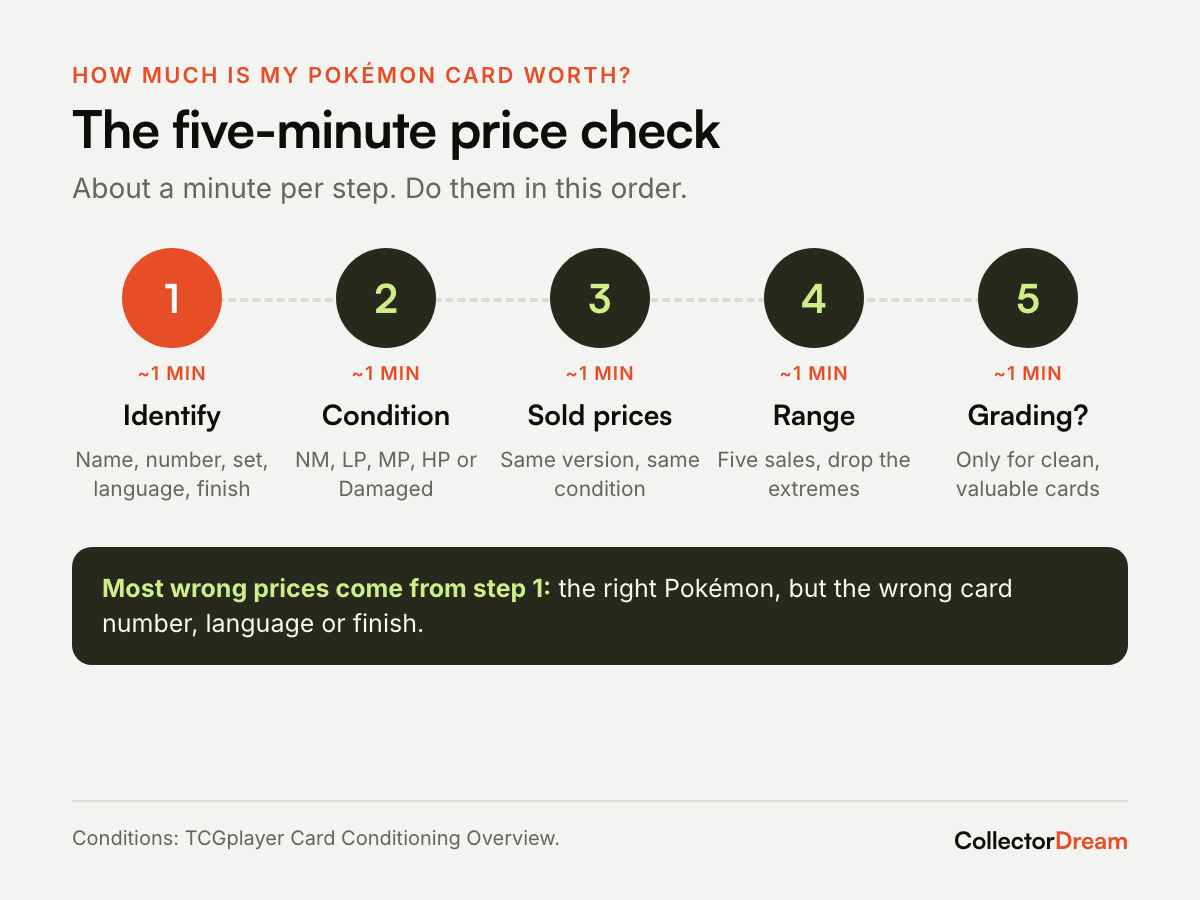
If you've just found a binder of old cards or pulled something shiny, you'll want to know: how much is my Pokémon card worth? You can get a solid answer in about five minutes, without an app or an appraiser. This guide walks through the five checks in order: identify the exact card, judge its condition, look up what it has actually sold for, sanity-check the number, and decide whether grading changes the answer.
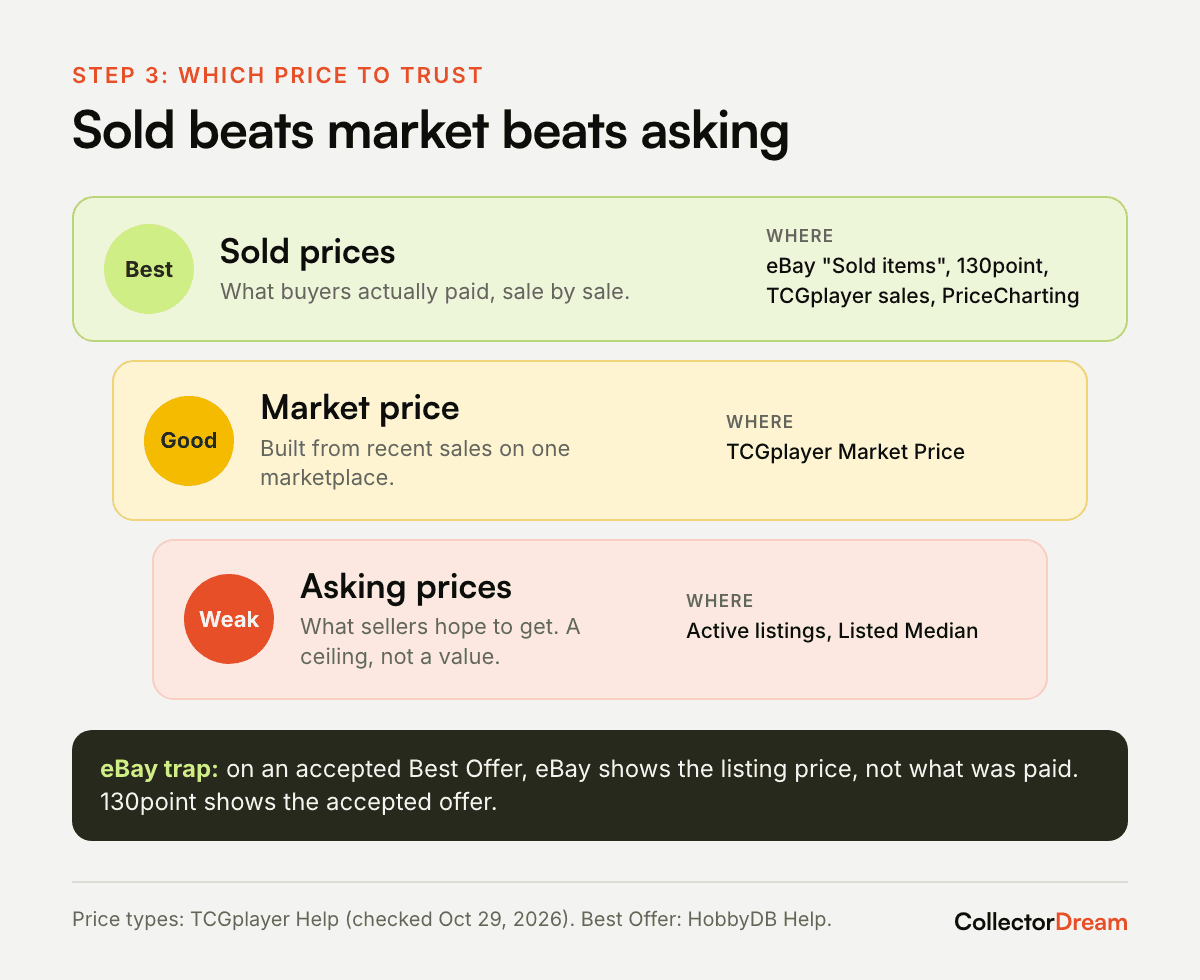
Price type | What it is | Where to find it | How much to trust it |
|---|---|---|---|
Sold | A completed sale, what a buyer actually paid | eBay with the "Sold items" filter, TCGplayer sales history, 130point, PriceCharting | The most. Use several recent sales |
Market price | A marketplace's own figure built from recent sales | TCGplayer Market Price | Good for common, frequently sold cards |
Asking | What sellers hope to get | Active listings anywhere, TCGplayer Listed Median | Least. Shows the ceiling, not the value |
Price types follow TCGplayer's own definitions, checked Oct 29, 2026.
Step 1: Identify the exact card
The first step to finding what your Pokémon card is worth is to pin down exactly which version you have. Many Pokémon have dozens of cards, and the same card can come in several versions, so "Charizard" isn't enough to look up. Note these five things, all printed on the card:
- The name at the top, including any suffix such as ex, V, VMAX or GX.
- The card number, at the bottom, like
215/203. If the first number is higher than the second, it's a secret rare. - The set. Cards since Scarlet & Violet print a short set code in a box (for example
SVI); older cards show a small set symbol instead (JustInBasil). - The rarity symbol next to the number. Our guide to Pokémon card rarities explains every symbol.
- The language and finish. Is it English or Japanese? Is the whole card shiny, only the picture (holo), or everything except the picture (reverse holo)?
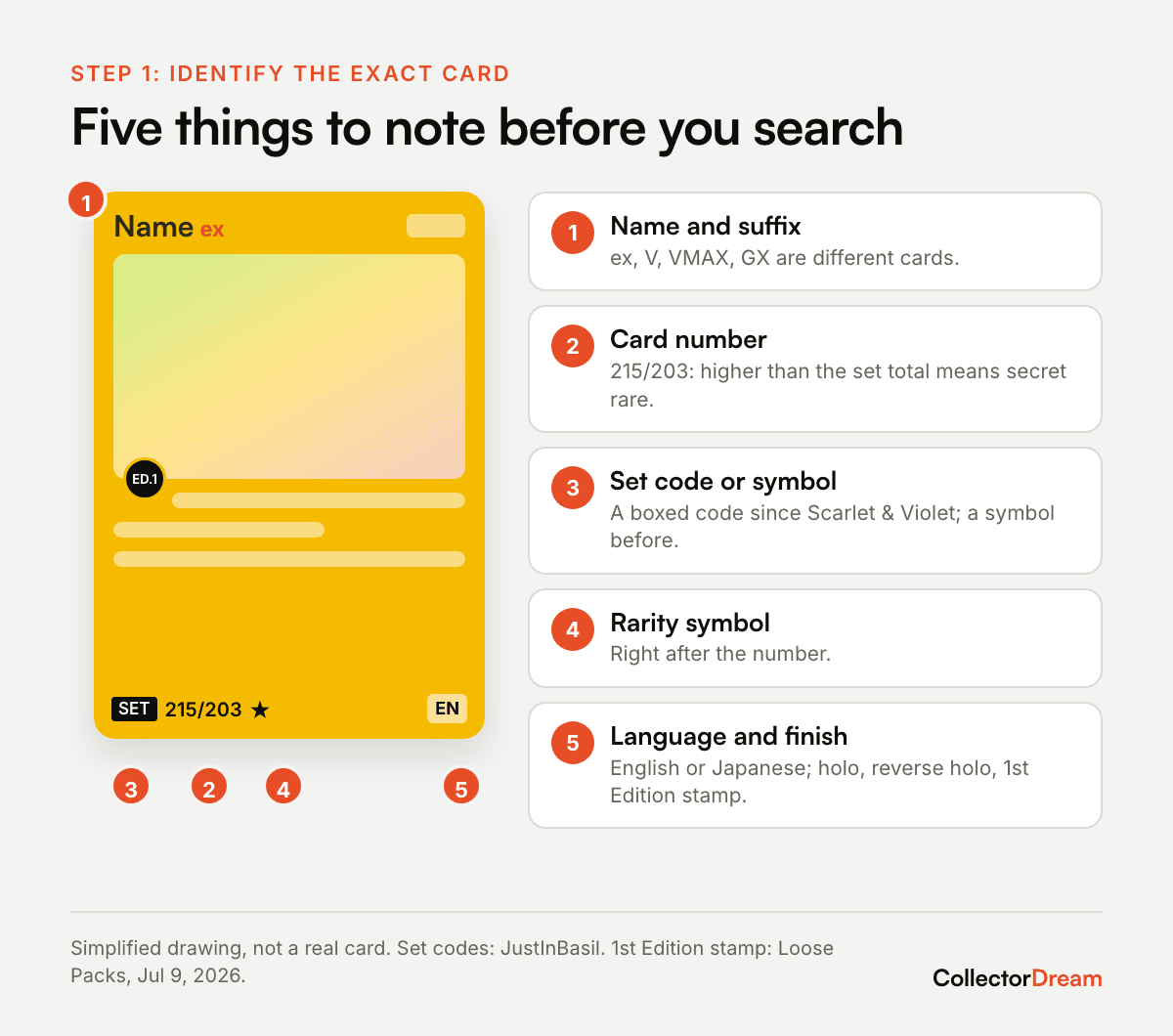
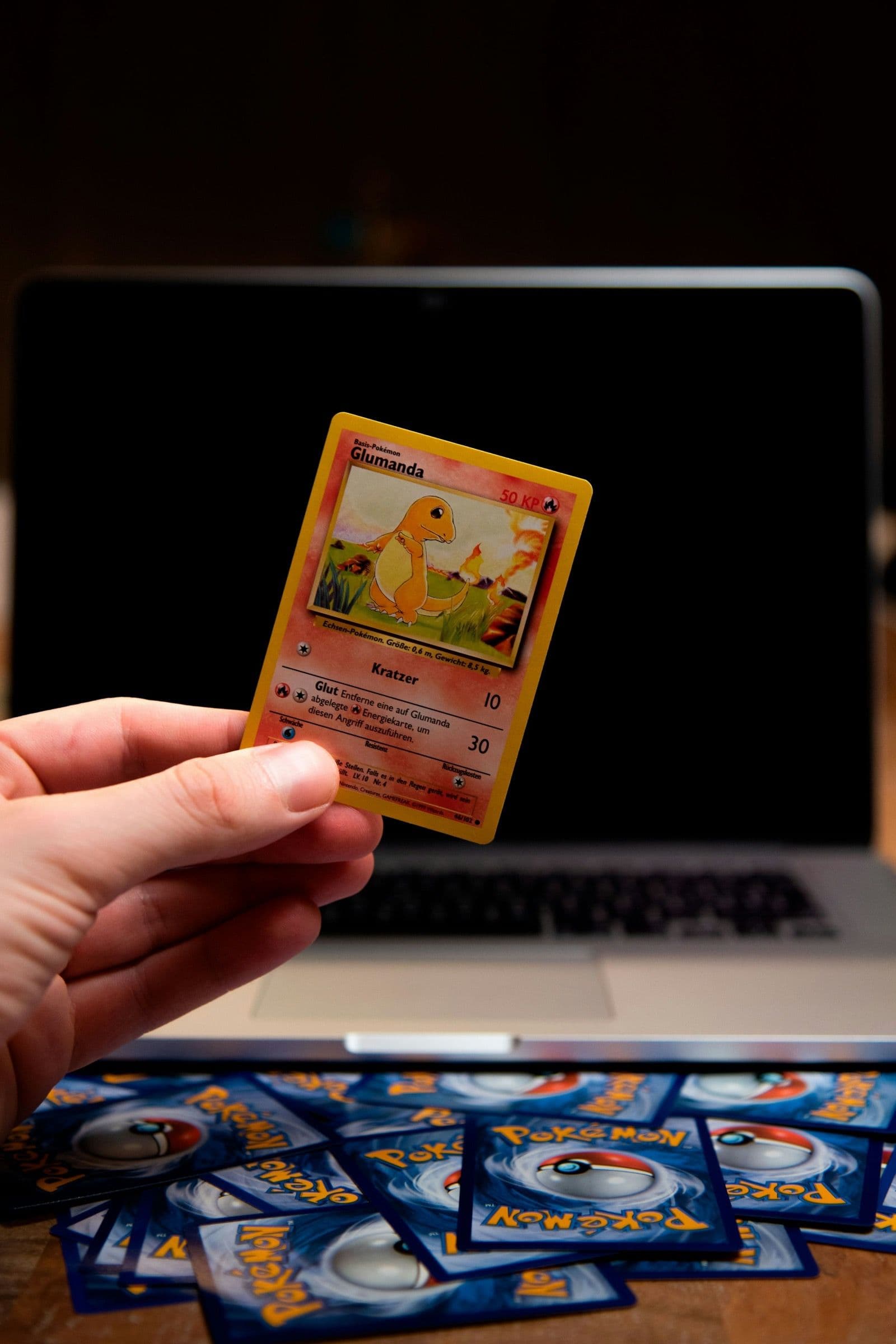
Then search the name and number in the official Pokémon TCG card database or on a marketplace, and match the picture. If your search turns up several cards with the same name, the number is what tells them apart.
For cards from 1999–2000, check two more things. A small black "Edition 1" stamp below the left side of the artwork marks a 1st Edition card. Base Set cards without the stamp and without a drop shadow along the art box are "Shadowless", an early print; later Unlimited prints have the shadow (Loose Packs, Jul 9, 2026). These versions sell for very different prices, so don't skip this.
Step 2: Judge the condition honestly
Condition decides which price you should be looking at. Most price guides and market prices default to Near Mint, so if your card isn't Near Mint, the number you find will be too high.
TCGplayer, one of the largest US card marketplaces, sorts cards into five conditions (TCGplayer):
- Near Mint (NM): looks nearly unplayed, with at most slight edge wear or a couple of minor scratches.
- Lightly Played (LP): minor edge wear, scuffs or scratches, nothing severe.
- Moderately Played (MP): clear edge and surface wear, scratching, or a bend or crease that doesn't damage the card's structure.
- Heavily Played (HP): a lot of wear, creasing and whitening, but still in one piece.
- Damaged: tears, splits, water damage or wear beyond the levels above.
Check under a bright lamp. Look at the back corners and edges for white spots (whitening), tilt the front to catch scratches on the foil, and look along the card for bends. A childhood card that lived in a shoebox is usually Lightly Played at best, even if it looks fine at first glance.
Step 3: Look up sold prices, not asking prices
What a card is worth is what people have recently paid for it, in your condition and version. Asking prices only tell you what sellers would like to get.
TCGplayer's help center makes the point with its own example: a card whose sellers' Listed Median was nearly double its Market Price, because cards listed near the real price sell quickly and the overpriced ones are left behind (TCGplayer).
Where to look:
- TCGplayer: the Market Price is built from recent completed sales on TCGplayer and updates as sales happen. The Most Recent Sale shows the last sale for the condition and printing you've selected. Set the filters to your card's printing (holo, reverse holo) and condition before reading anything.
- eBay sold listings: search the card name and number, then tick Sold items in the filters. Ignore the active listings. One trap: when a seller accepted a Best Offer, eBay shows the original listing price, not what the buyer actually paid (HobbyDB).
- 130point: a free search of recent sales that shows the accepted Best Offer price for US eBay sales, which fills that gap.
- PriceCharting: price history for a card, with ungraded and graded copies shown separately. Handy for seeing whether a price has been steady or jumping around.
Step 4: Sanity-check the number
A single sale can mislead you, so look for a range. Collect five or so recent sales of the same version in roughly your condition, drop the highest and lowest, and the middle of what's left is a fair value.
Watch for these traps:
- Graded sales mixed in. A graded copy, especially a PSA 10, can sell for far more than a raw one. Make sure you're comparing raw with raw.
- Wrong version. A reverse holo, a Japanese copy or a different card number with the same name will all have different prices.
- Old sales. Prices move. Weight the last few weeks over sales from months ago.
- Very few sales. If a card sold only once or twice recently, treat any figure as a rough guide.
- What you'd actually get. Selling costs money: marketplace fees, shipping and supplies come out of the sale price, and a shop buying your card will pay less than its own selling price.
If a card that looks ordinary shows a surprisingly high price, double-check the version before getting excited. If one looks too valuable to be real, our guide on how to spot fake cards may help.
Step 5: Decide whether grading changes the answer
For most cards, the raw sold price from step 3 is your answer. Grading costs money per card and takes time, so it only changes the picture for cards that are both valuable and very clean.
Grading is worth a closer look when:
- recent sales of a graded copy (for example PSA 10) are far above raw sales and
- your card is sharp: centered borders, clean corners and edges, no scratches in the foil.
Before paying for grading, check your card the way a grader would with our guide on how to pre-grade cards at home, and compare fees and turnaround in PSA vs CGC vs TAG vs BGS. If your card is already in a slab, look up sales for that exact grader and grade only: a PSA 9 and a PSA 10 of the same card can sell for very different amounts.
Which details change a Pokémon card's value?
Small details on the card often matter more than the Pokémon on it. These are the ones to check before you trust any price:
Detail | Why it matters |
|---|---|
Card number | Separates different cards of the same Pokémon, and marks secret rares |
Rarity | Higher rarities are scarcer in packs, though rarity alone doesn't set the price |
Holo vs reverse holo vs non-holo | Each finish is priced separately |
1st Edition stamp or Shadowless (1999–2000) | Early prints of the same card sell for much more than later ones |
Language | English and Japanese versions have separate markets and prices |
Promo stamps | Set logos, prerelease or event stamps make a different card from the regular one |
Condition | Moves the price from one tier to the next |
Grade (if slabbed) | Each grader and grade is its own price |
If you have Japanese cards, look them up on Japanese-card listings, not English ones. Our guide to Japanese vs English Pokémon cards explains how the two differ.
Common mistakes when pricing a Pokémon card
- Using the first number you see. Search results often show the most expensive version first, or an asking price.
- Pricing a played card at Near Mint. Most childhood cards aren't Near Mint.
- Assuming old means valuable. Plenty of 1999 cards sell for very little; age helps only for certain cards and early prints.
- Mixing up languages and finishes. Always check the card number, language and finish match.
- Ignoring selling costs. The sale price isn't what lands in your pocket.
If you're sorting a whole collection, check the holos, secret rares and anything with a special stamp first. Commons and uncommons sell for very little on their own, so price them as a group rather than one by one. And if you're thinking of finishing the set instead of selling, our master set guide shows how to track it.
Where to go next
- Pokémon Card Rarities Explained (read the symbol on your card)
- How to Pre-Grade Your Cards at Home (is your card clean enough to grade?)
- How to Start Collecting Trading Cards
Price your cards with CollectorDream
With CollectorDream you can scan a card, confirm the exact version and see recent sold prices for it in one place, then add it to your collection. The app is out now on iOS: download CollectorDream on the App Store, and follow my daily openings on YouTube, TikTok and Instagram.
FAQ
Are my old Pokémon cards worth anything?
Some are. Most commons and uncommons from any era sell for very little, but holo rares, 1st Edition and Shadowless prints from 1999–2000, and popular Pokémon in good condition can be worth much more. Identify each card and check its sold prices to be sure.
Is TCGplayer or eBay more accurate for Pokémon card prices?
Both use real sales. TCGplayer's Market Price is a quick read for common, often-sold cards; eBay sold listings (with 130point for accepted offers) are better for rare, vintage and graded cards. Checking both is best.
How do I know if my Pokémon card is rare?
Look at the rarity symbol next to the card number, and check whether the number is higher than the set total. A number above the total means a secret rare.
Should I get my Pokémon card graded before selling it?
Only if graded copies sell for much more than raw ones and your card is in excellent condition. Grading costs money and time, so for most cards selling raw makes more sense.
Why does my price app show a different value than eBay?
Apps and price guides use different data, time windows and conditions. Many show a Near Mint market figure, while eBay sold listings show individual sales in every condition. Always compare the same version, condition and time period.
Alec Nguyen
Founder, CollectorDream
Scan a card, see its rarity and value
The CollectorDream app reads the card for you. Now on the App Store.
Download on iOS (opens the App Store)