On this page · 10 sections
- Binder, toploader or slab: the short answer
- Binders: best for sets and browsing
- Toploaders and magnetic holders: best for single favorites
- Graded slabs: best for your few top cards
- How to choose for each card
- Mix all three
- How to display cards without damaging them
- Where to go next
- See your whole collection with CollectorDream
- FAQ
Updated: October 29, 2026
Sooner or later every collection outgrows the shoebox, and the question becomes how to show your cards off without putting them at risk. This guide compares the three main ways to display trading cards, binders, toploaders (and their magnetic cousins) and graded slabs, so you can pick the right home for each card. It works the same for Pokémon, One Piece, Yu-Gi-Oh!, Dragon Ball and Lorcana.
| Binder (side-loading pages) | Toploader | Magnetic holder | Graded slab |
|---|---|---|---|---|
What it is | A book of 9-pocket pages | A rigid plastic sleeve, open at the top | A two-piece hard case that snaps shut | A sealed case from a grading company, with a label |
Protection | Good against dust and handling; soft against bends | Good against bends | Very good: rigid on all sides | Highest: sealed and tamper-evident |
Display | Whole pages at a glance | Stands in a box or on a stand | Stands on its own or on a stand | Stands, frames, wall racks |
Cost per card | Lowest | Low | Higher | Highest (a grading fee per card) |
Easy to take the card out? | Yes | Yes | Yes | No, the case has to be broken |
Best for | Sets, master sets, binder collections of a favorite character | Chase cards, trades, cards you carry | A favorite card on a desk or shelf | Your most important cards |
Binder capacity example: Vault X. Toploader size: BCW. Slab security: PSA. Checked Oct 29, 2026.
Binder, toploader or slab: the short answer
Put most of your cards in binders, your favorite few in toploaders or magnetic holders, and only your most important cards in slabs. Each option trades protection against cost and convenience, and no single one is right for a whole collection.
The rest of this guide explains where each one shines, then gives you a three-question way to choose for any card.
Binders: best for sets and browsing
A binder is the best way to display a set or a big collection. You see dozens of cards at once, paging through it is half the fun, and the cost per card is the lowest of any option.
- Use side-loading pages. Pockets that open at the side are much harder for a card to slip out of than top-loading ones.
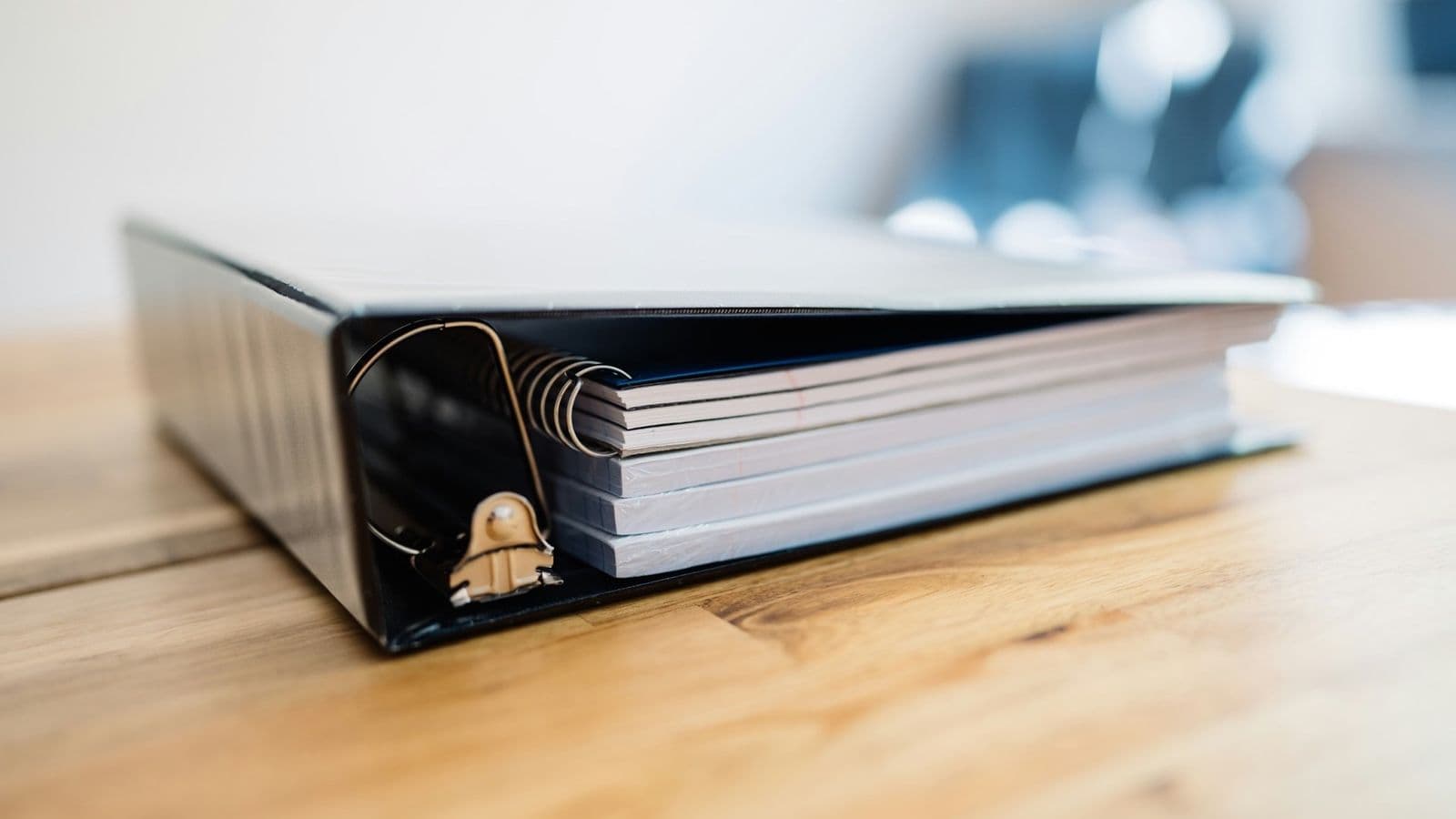
- Prefer zip or sewn-in binders over O-rings. The rings on O-ring binders can press into the cards nearest the spine.
- Know the capacity. A typical 9-pocket binder holds 18 cards per page, front and back. Vault X's 9-pocket zip binder, for example, holds 360 cards on 20 double-sided pages, with pockets about 68 × 97 mm (Vault X).
- Sleeve first if you like. Pockets that size take a card in a penny or deck sleeve. Our card sleeve sizes by game guide covers which sleeves fit which game; Yu-Gi-Oh! cards sit loose in standard pockets.
- Check the plastic. The Library of Congress says plastic storage should be polyester, polyethylene, polypropylene or acrylic without additives, and that an "archival" label alone doesn't guarantee it (Library of Congress). Pages that say "PVC-free" and name polypropylene are the safe pick; it also warns against PVC enclosures for photographs (Library of Congress).
Watch out for: binders are soft. A heavy binder stored flat under other things, or a page bent while you turn it, can bend the cards inside. Store binders upright on a shelf, like books. Binders are also how most collectors track a full set; our master set guide explains what counts.
Toploaders and magnetic holders: best for single favorites
A toploader is a rigid plastic sleeve that keeps a single card flat. It's the standard way to protect a chase card, ship a card or keep a card you take to trades.
- Penny sleeve first. Slide the card into a penny sleeve, then into the toploader. A standard 3 × 4 in toploader has an opening of about 2¾ × 3⅞ in and takes cards up to 35pt thick (BCW).
- Display: toploaders stand upright in a storage box or in a small stand. They don't look like much on their own, so many collectors use them for protection and something else for display.
A magnetic holder (often called a one-touch) is a two-piece hard case with a magnetic closure. It looks cleaner on a shelf than a toploader, protects every edge and opens easily if you want the card back. Holders are sold by card thickness, so match the holder to the card, or the card will rattle or the case won't close.
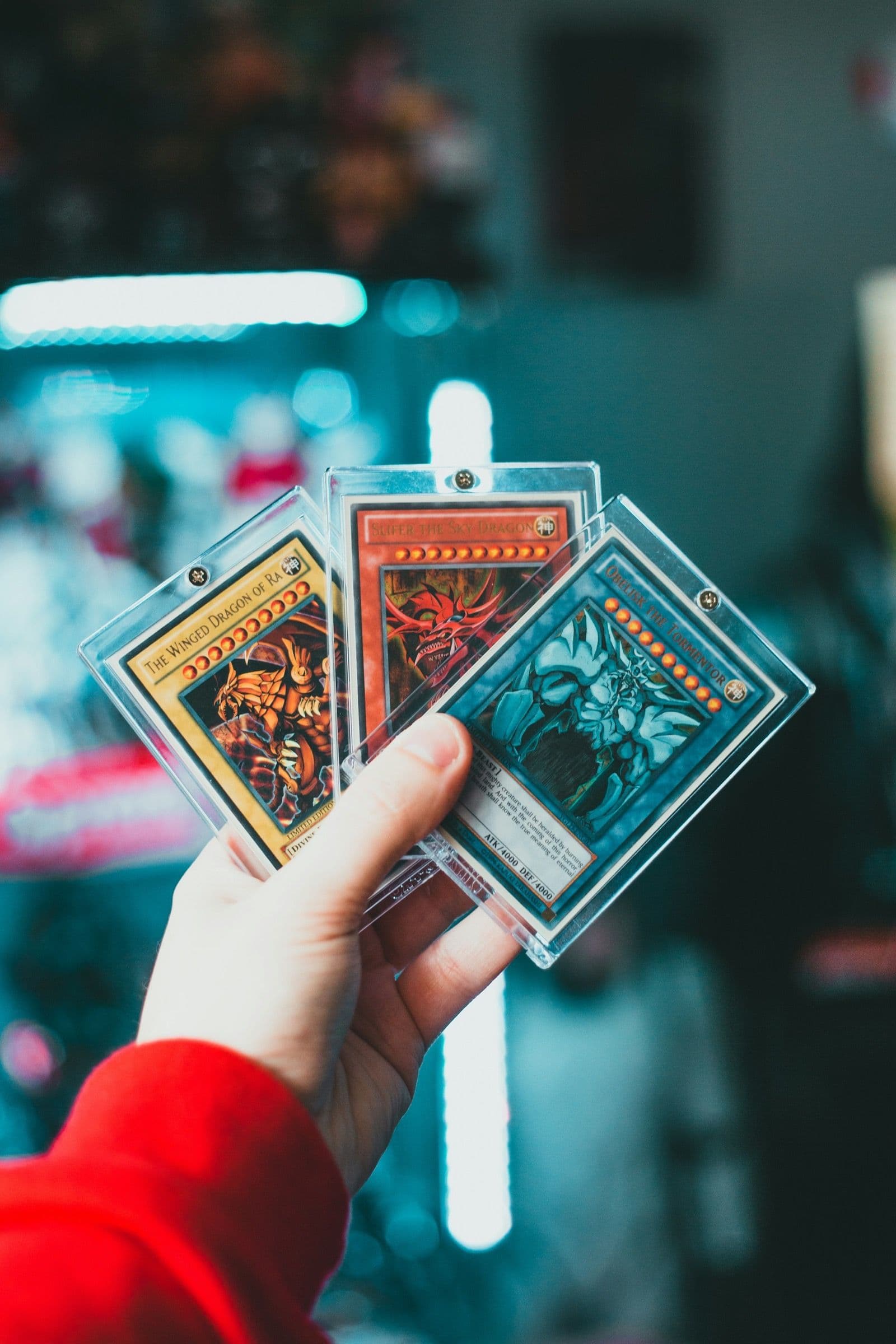
Toploader binders are a middle path: binders with pockets sized for toploaded cards. You get the rigidity of a toploader and the browsing of a binder, at the cost of bulk.
Watch out for: don't send cards to a grader in toploaders. PSA asks for a clear penny sleeve inside a semi-rigid holder instead (PSA shipping guide).
Graded slabs: best for your few top cards
A graded slab is a card that a grading company has authenticated, graded and sealed in a hard plastic case with a label. It's the most protective way to display a card, and the label tells anyone who sees it exactly what the card is and what grade it got.
- Tamper-evident, not tamper-proof. PSA's case is sonically welded shut, so opening it usually leaves chips, scratches or a cloudy "frosting" along the seam (PSA). That's a big part of why slabs are trusted, and why buyers check them closely. Our guide to fake PSA slab red flags shows what to look for.
- Cost: every slab costs a grading fee plus shipping, so it only makes sense for a small number of cards. Our PSA vs CGC vs TAG vs BGS comparison covers fees and turnaround, and how to pre-grade your cards at home helps you pick which cards are worth sending.
- Display: slabs stand on their own in a stand, line up in a slab box, or hang in a wall frame. A slab can still scratch, so a fitted slab sleeve helps if you handle it often.
Watch out for: once a card is slabbed, you can't touch it or move it to a binder without breaking the case. That's the point, but it means slabbing is a one-way door for that copy.
How to choose for each card
Three questions sort almost any card:
- Is this one of the few cards you'd want authenticated and protected for good? If yes, and it's in great condition, consider a slab.
- Do you want to see it on its own, on a desk or shelf, or carry it to trades? If yes, use a toploader or a magnetic holder.
- Otherwise, it goes in a binder, with the rest of its set or your favorite-character pages.
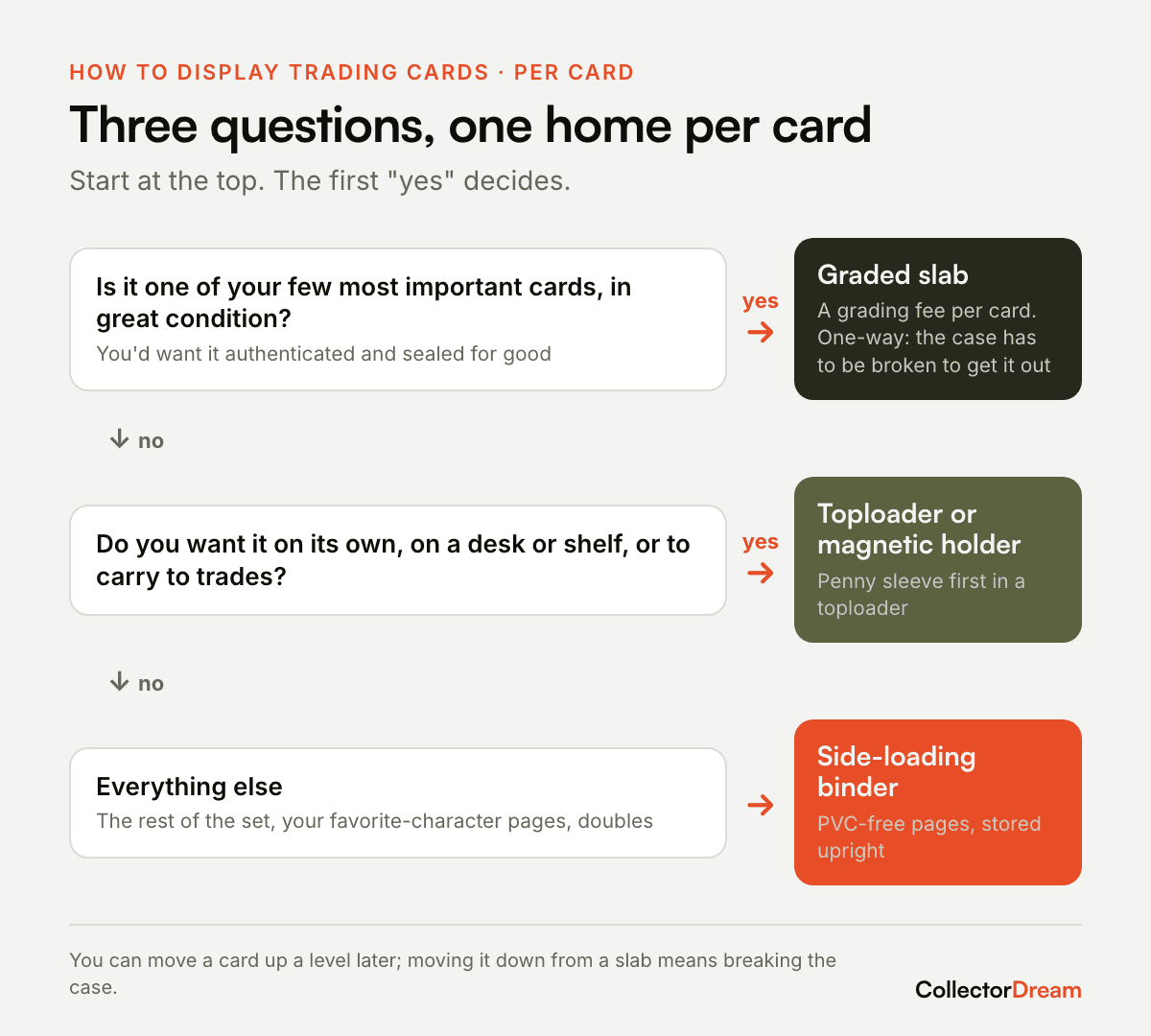
You can always move a card up a level later. Moving one down from a slab means breaking the case, so it's the only choice worth sleeping on.
Mix all three
The most practical setup for most collectors is a pyramid: lots of cards in binders, a handful in holders, and a very few in slabs.
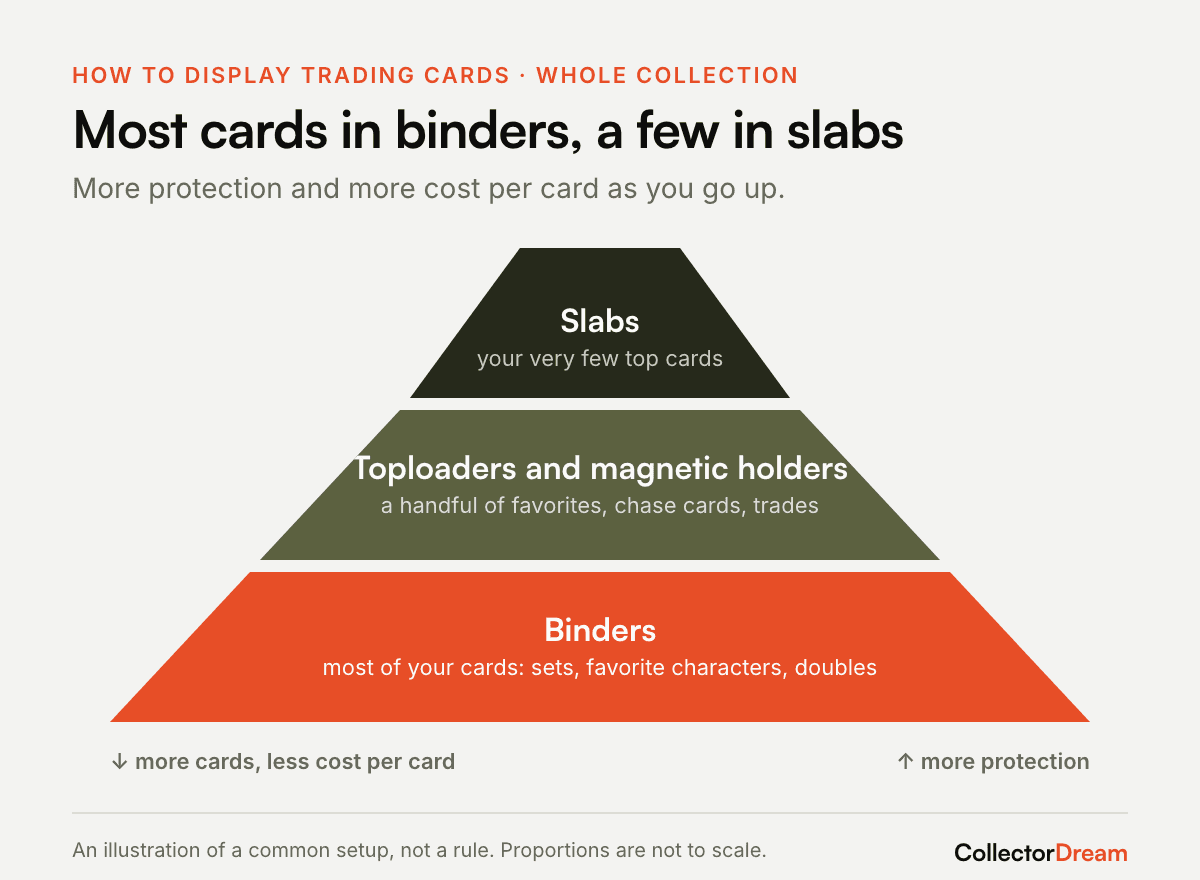
A common pattern looks like this:
- Binders for each set or each favorite character, sleeved or not.
- A box of toploaders for chase cards, trade bait and cards waiting to be graded or sold.
- One shelf or stand for magnetic holders and slabs, the cards you actually want to look at every day.
How to display cards without damaging them
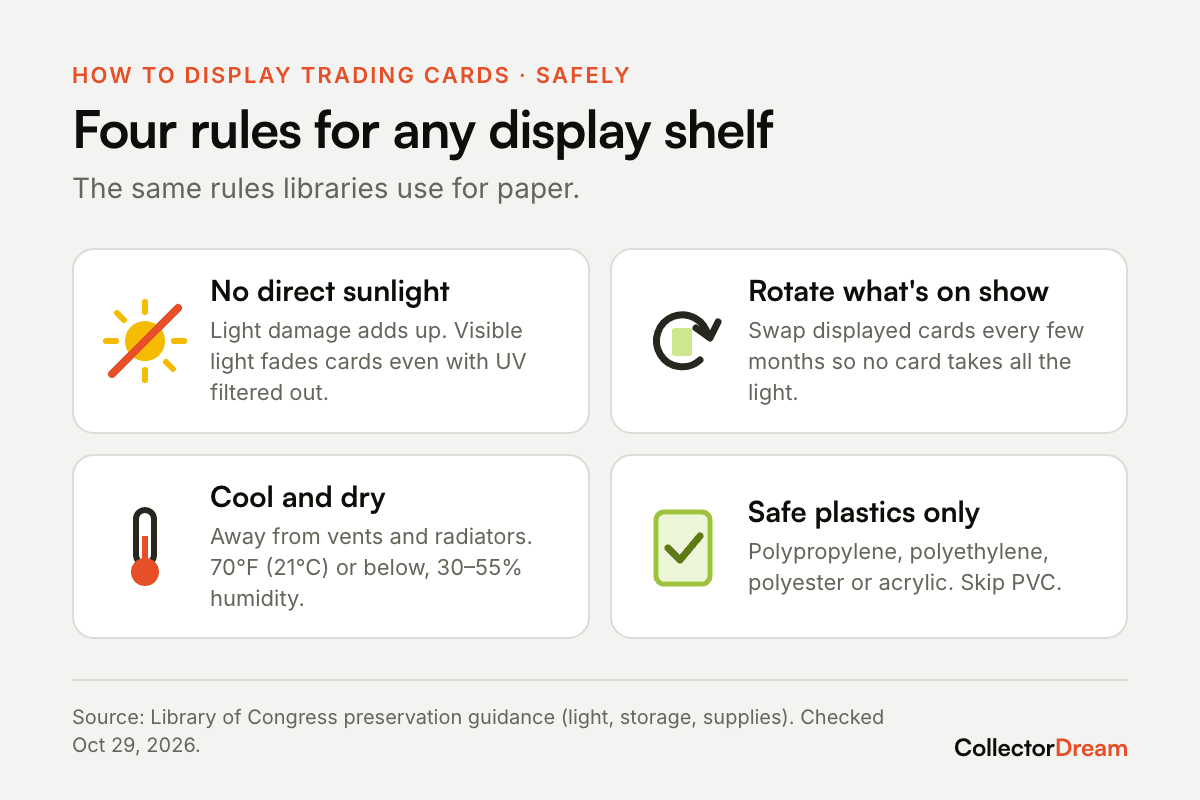
Whichever option you choose, the display spot matters as much as the holder. The rules are the same ones libraries use for paper:
- Keep cards out of direct sunlight. Light damage is cumulative, and the Library of Congress notes that visible light still causes damage even with all UV removed (Library of Congress). UV-filtering holders and cases help, but a dim spot helps more.
- Rotate what's on show. Swap your displayed cards every few months so no single card takes all the light.
- Avoid heat and damp. Keep displays away from vents, radiators and sunny windows, ideally at 70°F (21°C) or below and 30–55% relative humidity (Library of Congress).
- Use safe plastics. Polyester, polyethylene, polypropylene and acrylic are the plastics the Library of Congress lists as suitable; skip PVC (Library of Congress).
If you're also keeping sealed product on the same shelves, our guide on how to store sealed booster boxes covers the same light, humidity and pest rules in more detail.
Where to go next
- How to Start Collecting Trading Cards in 2026
- Card Sleeve Sizes by Game
- PSA vs CGC vs TAG vs BGS
- How to Store Sealed Booster Boxes for Years
See your whole collection with CollectorDream
Binders, boxes and slabs end up in different places, which makes it easy to lose track. CollectorDream lets you scan your cards from all five games, note whether each one is in a binder, a holder or a slab, and see recent sold prices, raw and graded, in one place. The app is out now on iOS: download CollectorDream on the App Store, and follow Alec's daily openings on YouTube, TikTok and Instagram.
FAQ
Is it better to keep cards in a binder or in toploaders?
Use binders for most cards and toploaders for the special few. Binders show many cards at once and cost little per card; toploaders protect single cards better against bending.
Do binders damage cards?
Good side-loading binders with PVC-free pages don't. Damage usually comes from O-ring binders pressing on cards near the spine, cheap PVC pages, or binders stored flat under weight.
Should I put toploaders in a binder?
You can, in a toploader binder made for them. It combines rigid protection with browsing, but it's bulkier and holds fewer cards than a regular binder.
Do graded slabs protect cards from UV light?
A slab protects the card physically, but don't rely on it to stop fading. Visible light damages paper and ink even with UV filtered out, so display slabs away from direct sunlight.
How should I display graded cards?
In a slab stand, a slab box or a wall frame, out of direct sunlight and away from heat. A fitted slab sleeve helps if you handle a slab often.
Alec Nguyen
Founder, CollectorDream
Scan a card, see its rarity and value
The CollectorDream app reads the card for you. Now on the App Store.
Download on iOS (opens the App Store)