On this page · 11 sections
Updated: October 29, 2026
Maybe you're saving a booster box for a birthday, for an opening with friends, or just because you like how it looks on the shelf. Whatever the reason, a sealed box has to survive years of light, damp, heat, bugs and the weight of whatever sits on top of it. This guide covers how to store booster boxes so they come out of the closet looking the way they went in, using the same rules libraries use for paper.
Threat | What it does | What to do | Target |
|---|---|---|---|
Light | Fades box art and wrappers; damage adds up over time | Keep boxes in the dark: a closet, a closed bin or an opaque cover | No direct sun; as little light as possible |
Humidity | Damp brings mold, warping and pests | Store in the living space; check with a hygrometer | 30–55% relative humidity |
Heat and swings | Speeds up aging; swings stress paper and card | Avoid attics, garages, vents and radiators | 70°F (21°C) or below, steady |
Pests | Silverfish eat paper, starch and glue | Keep the area dry and clean; check boxes regularly | No damp corners |
Weight | Crushes corners and dents the box | Rigid cases, shelves, short stacks | No box carries a heavy load |
Wrap damage | A torn wrap can't be proven untouched | Handle by the sides; keep proof of purchase | Factory wrap intact |
Targets: Library of Congress, Storing Your Books and Limiting Light Damage; mold timing: Canadian Conservation Institute. Checked Oct 29, 2026.
How do you store booster boxes long term?
Store sealed booster boxes somewhere dark, cool, dry and steady, inside the part of your home you heat and cool, off the floor and with nothing heavy on top. A booster box is cardboard, paper, ink, glue and plastic film, so the advice that protects books protects it too.
The Library of Congress recommends keeping books at 70°F or below and 30–55% relative humidity, away from big swings in either, and warns against storing anything of value in basements, attics or garages, which are often poorly insulated and prone to leaks (Library of Congress). It also says to keep things away from vents and radiators.
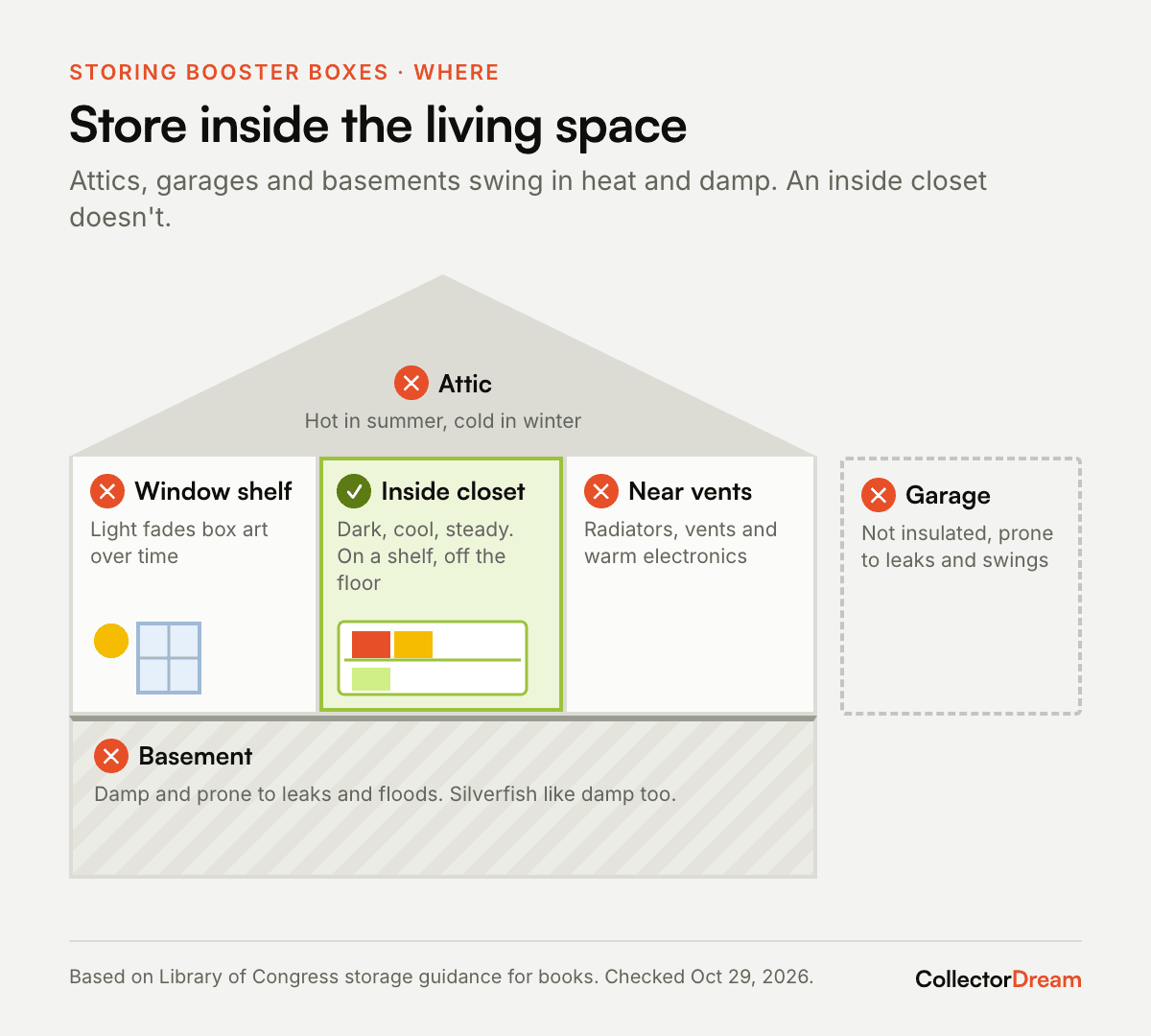
In practice, that's a closet in a bedroom or hallway, ideally on an inside wall, on a shelf rather than the floor. If you'd put a stack of old photo albums there without worrying, it's a good place for booster boxes.
Keep them out of the light
Light damage is cumulative: a little light for a long time does as much harm as a lot of light briefly (Library of Congress). On a booster box, that shows up as faded art and printing, usually on the side that faced the window.
- Never in direct sun. Not on a windowsill, and not on a shelf a window shines on for part of the day.
- UV-filtering cases help, but don't solve it. The Library of Congress notes that visible light still causes damage even with all the UV removed. A UV-filtering acrylic case cuts one part of the problem; darkness cuts all of it.
- Display, then rotate. If you want boxes on show, display one or two in a dim spot and keep the rest in a closet or a closed, opaque bin, swapping now and then.
Control humidity
Humidity is the threat that does the most damage the fastest. Damp air lets mold grow, makes paper and card swell and warp, and brings in the pests that like wet places.
How fast is "fast"? The Canadian Conservation Institute gives rough times before visible mold appears on vulnerable surfaces, ones rich in starch, sugar or protein: about 100 days at 70% relative humidity, 10 days at 80%, and 2 days at 90–100% (CCI). Clean paper holds out longer, typically needing 80–85% before mold is likely at all, but a booster box has glue, coatings and dust on it, so don't count on that.
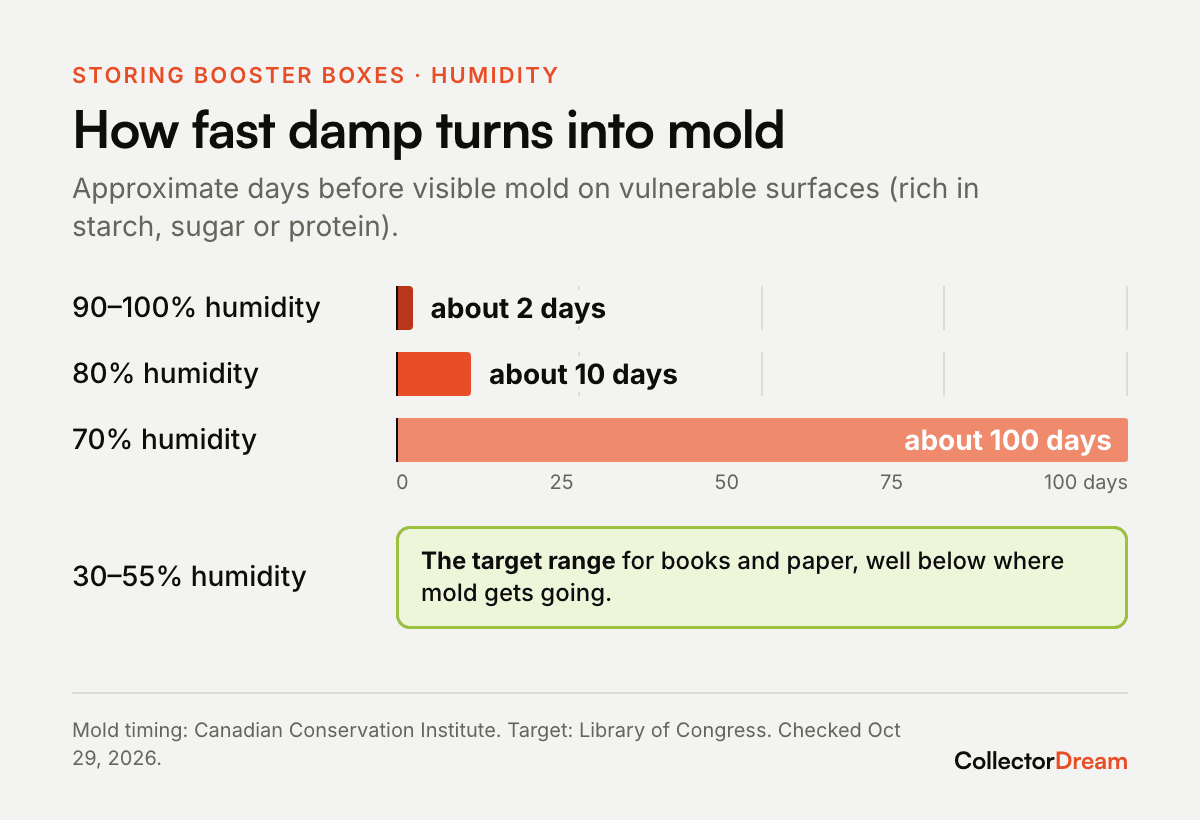
What to do:
- Measure it. A cheap digital hygrometer on the same shelf tells you more than any guess. Aim for 30–55% (Library of Congress).
- Fix the room, not the box. If the closet reads high, a dehumidifier in the room or a different closet will do more than anything you put in the bin.
- Be careful with airtight bins. A sealed tote keeps out dust and bugs, but it also traps whatever moisture went in with the boxes. If you use one, pack it on a dry day and put the hygrometer inside.
- Desiccant packs are a backup, not a plan. They help in a closed bin, but they fill up, and they can't keep up with a damp room. Check and replace them on a schedule.
Keep temperature cool and steady
Cool is good, and steady matters as much as cool. Heat speeds up the chemistry that ages paper and plastic, and big swings between day and night or summer and winter make materials expand and shrink over and over. Swings also push the humidity up and down with them.
Keep boxes at 70°F (21°C) or below, away from vents, radiators, sunny outside walls and anything that warms up, like a gaming PC or a fridge (Library of Congress). That's another reason attics and garages fail: they're hot in summer, cold in winter and damp in between.
If you move boxes from a cold car into a warm house, let them sit in their bag or bin for a while before you unpack them, so moisture doesn't condense on the cold wrap.
Keep pests out
Silverfish are the pest to worry about. They eat starch, glue and paper products, prefer damp spots around 75–95% relative humidity, and travel from room to room in cardboard cartons (Health Canada). Paper pasted with starch glue is exactly what they go for (Canadian Conservation Institute).
- Dry beats everything. Keeping humidity in range makes the spot unattractive to silverfish in the first place.
- Don't store in old shipping cartons you brought up from the basement or garage. Use a clean bin or a shelf.
- Look for signs. Small irregular holes or scraped patches on the box, or tiny droppings, mean it's time to move everything and deal with the damp.
Stack and shelve without crushing
Booster boxes are thin cardboard. One box is sturdy; five boxes stacked on top of it are a slow crush, and the bottom box gets dented corners and a bowed lid.
- Use a rigid case. A fitted acrylic or hard plastic booster box protector takes the weight instead of the box.
- Short stacks only. Without cases, keep stacks low and put the heaviest product, like cases or larger boxes, on the bottom shelf, never on top of a booster box.
- Off the floor. A shelf protects against spills, mopping and the odd leak.
- Handle by the sides. Lift from the sides of the box, not by pinching the top edges, which is where wrap tears and dents start.
Leave the shrink wrap alone
Keep the factory shrink wrap on and intact. It keeps out dust, and it's the main sign to anyone else, including future you, that the packs inside haven't been touched.
That's also why you should never re-wrap a box yourself, even one whose wrap tore by accident. Home shrink wrap is exactly what people who search or reseal packs use, so a re-wrapped box looks like a reseal no matter what really happened. If a wrap tears, leave it, take a photo, and be upfront about it if the box ever changes hands. Our guide to spotting fake cards and resealed packs shows what buyers check for.
Two more habits help:
- Keep proof of where it came from. A receipt or order confirmation and a dated photo of the box when it arrived take a minute to save.
- Buy boxes you plan to keep from a source you trust. A box that was resealed before it reached you won't get better in your closet. If you're still deciding between a booster box, a bundle and an Elite Trainer Box, our booster box vs bundle vs ETB comparison walks through what's inside each.
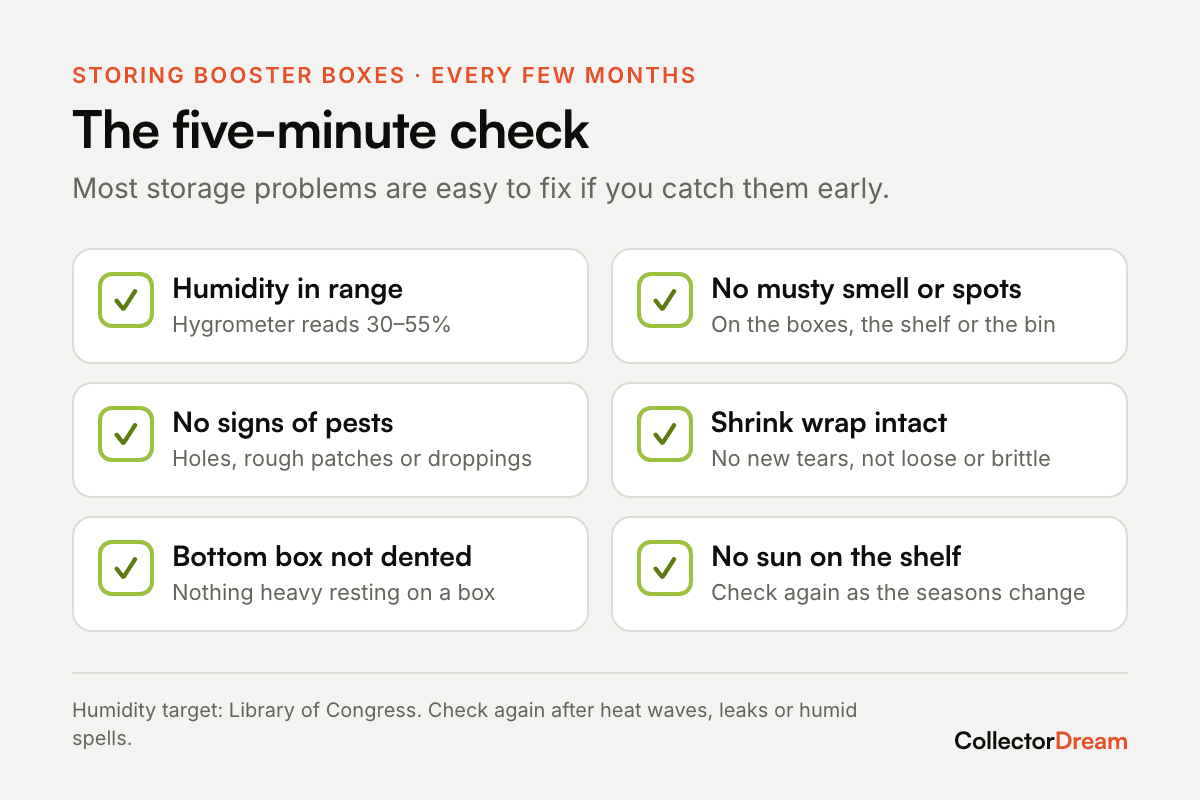
A five-minute check every few months
Stored boxes don't need much, but they do need someone to look at them now and then. Every few months:
- Read the hygrometer. Is it still in the 30–55% range?
- Sniff and look. Any musty smell, spots or fuzz on boxes or the bin?
- Check for pests. Holes, scraped patches or droppings?
- Check the wrap. New tears, or wrap that has gone loose or brittle?
- Check the bottom box. Any dents or bowing from weight?
- Check the light. Has the sun found the shelf since you last looked?
If the time comes to open a box you've kept, have your supplies ready first. Our card sleeve sizes by game guide tells you which sleeves to buy for each game.
Where to go next
- How to Start Collecting Trading Cards in 2026
- How to Spot Fake Cards & Resealed Packs
- Booster Box vs Bundle vs ETB
- Card Sleeve Sizes by Game
Keep track of what's on the shelf with CollectorDream
CollectorDream lets you log sealed product alongside your cards, so you can see every box you're keeping, where it came from and when you got it, in one place. The app is out now on iOS: download CollectorDream on the App Store, and follow Alec's daily openings on YouTube, TikTok and Instagram.
FAQ
Can I keep booster boxes in the garage?
It's best not to. Garages, attics and basements swing in temperature and humidity and are prone to leaks, and the Library of Congress advises against storing anything of value in them. An inside closet is much safer.
Do acrylic cases block UV light?
Cases sold as UV-filtering cut down ultraviolet light, but visible light still fades print over time. Use a case for protection from dust and weight, and keep the boxes somewhere dim as well.
Should I put silica gel in with my booster boxes?
Desiccant packs can help inside a closed bin, but they fill up and need replacing, and they can't fix a damp room. A hygrometer tells you whether you need them at all.
Can I re-shrink a box whose wrap tore?
No. Re-wrapping at home looks exactly like a reseal to anyone who sees the box later. Leave the torn wrap, take a dated photo and be honest about it.
How often should I check stored booster boxes?
Every few months is enough for most homes, plus after any heat wave, leak or very humid spell. Check humidity, smell, pests, wrap, the bottom box and light.
Alec Nguyen
Founder, CollectorDream
Scan a card, see its rarity and value
The CollectorDream app reads the card for you. Now on the App Store.
Download on iOS (opens the App Store)