On this page · 9 sections
Updated: October 29, 2026
A fake PSA slab can pass a quick glance: the label looks right, and the cert number may even be real. This guide shows you how to check a PSA cert number properly, why a matching cert isn't enough on its own, and how to test the label and the holder using the security features PSA itself describes. It works for any graded card, whether it's Pokémon, One Piece, Yu-Gi-Oh!, Dragon Ball or Lorcana.
Check | What a genuine slab shows | Red flag |
|---|---|---|
Cert lookup | A record with the same card, set, number and grade | No record, or a record for a different card or grade |
Cert photos | Recent certs usually have front and back images that match the card | Centering, print marks or edges that don't match the photos |
QR code (back of label) | Opens the cert record on psacard.com | Doesn't scan, or opens a different site |
LightHouse logo (current labels) | Switches on and off as you tilt the slab | A flat, printed-looking logo that never changes |
Light test | You can make out the text on the other side of the label | Too thick to see through, or a second label showing underneath |
UV light (optional) | Small PSA logos light up in the logo area on the back | No UV pattern |
Holder edges | Clear, rigid, firmly sealed | Cloudy "frosting", cracks, glue, flex or creaking |
The card itself | Condition fits the grade | Obvious wear in a high-grade slab |
Security features from PSA's security page, its label announcement (Jun 14, 2017) and its buyer's guide, read Oct 29, 2026. PSA also uses covert features it doesn't publish.
How do you check a PSA cert number?
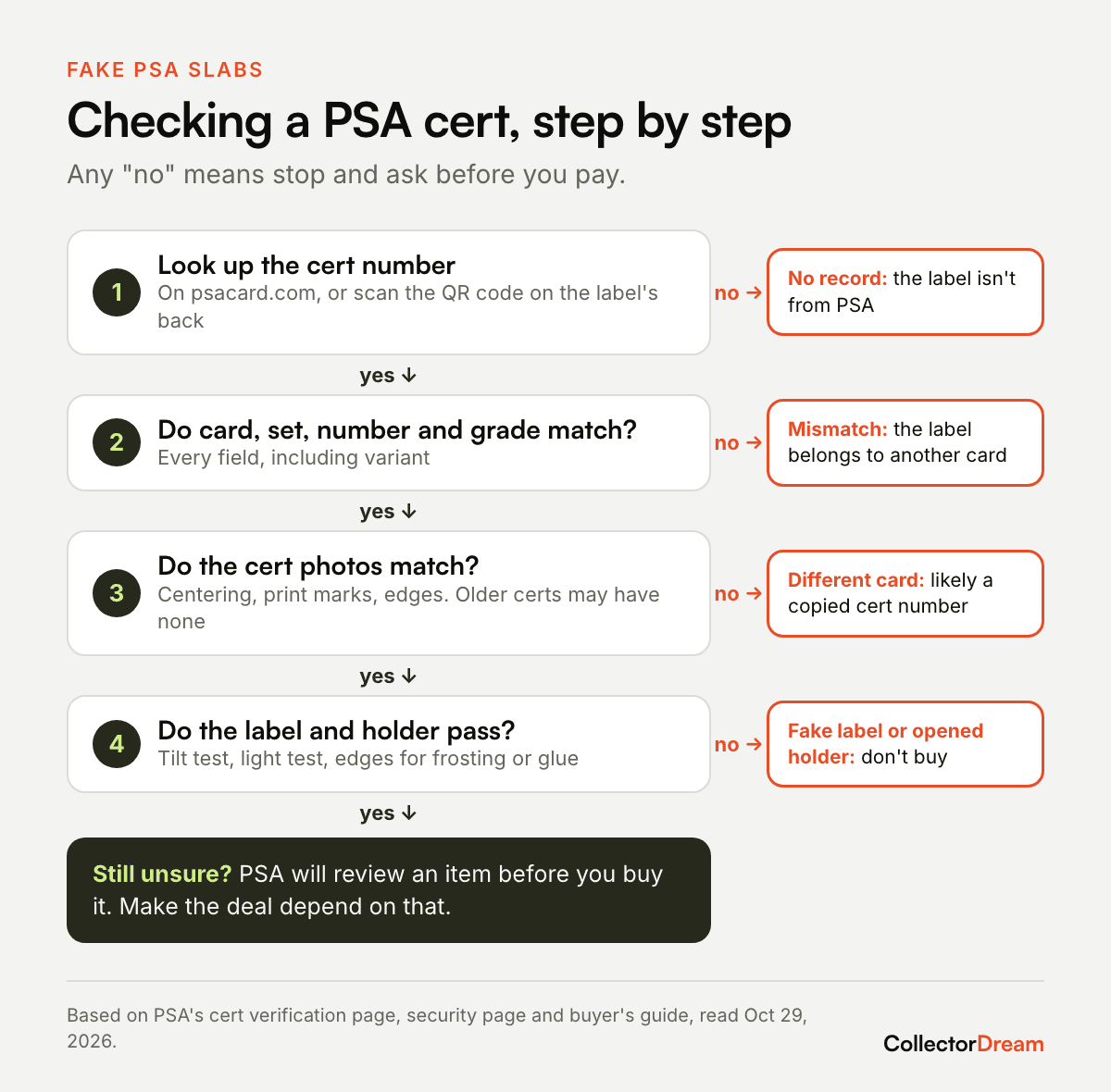
Type the certification number from the label into PSA's cert verification page at psacard.com/cert, then compare the result with the slab line by line. The record should show the same card name, year and set, card number and grade.
- Read the cert number from the front of the label. Use the number on the slab you'll actually receive, not one typed into a listing.
- Look it up on psacard.com, or scan the QR code on the back of the label, which PSA added so collectors can reach the cert record instantly (PSA). Check that the scan opens psacard.com and not a lookalike site.
- Compare every field. A different card, set, variant or grade means the label doesn't belong to that card.
- Compare the photos, if the record has them. PSA's current Standard through Premier tiers all include front and back imaging (PSA), so recently graded cards usually have pictures. Look at the centering, any print marks and the edges: they should match the card in the slab exactly. Older certs may have no photos at all.
- If anything is off, stop and ask the seller, or PSA, before you pay.
Which fake slabs can a cert check miss?
A cert lookup proves that a number exists and what PSA recorded for it. It doesn't prove the slab in front of you is the one PSA made. PSA says plainly that verifying a cert number doesn't remove the risk, and that criminals do sometimes put real cert numbers, taken from public sources, on counterfeit labels (PSA cert verification).
That leaves two kinds of fake a lookup can miss:
- A counterfeit slab with a copied cert number. The record matches perfectly because it belongs to a real card somewhere else. Photos on the record are your best check here, and the label and holder tests below.
- A genuine PSA holder that's been opened and refilled with a different or lower-grade card. The label is real, so the holder's seal is what gives it away.
How do you check a PSA label?
Use three of the features PSA has built into its labels since 2017 (PSA, Jun 14, 2017):
- The LightHouse logo. On current labels, the PSA logo on the front has an on/off effect: tilt the slab left and right and it appears and disappears (PSA security). A logo that looks printed flat and never changes is a red flag.
- The light test. Hold the slab close to a lamp and look through the label from the back, then from the front. PSA says you should be able to make out the text on the other side, even if you can't read it word for word. A forger who glues a fake front onto a real label makes it too thick to see through, and parts of the original label may show underneath (PSA buyer's guide).
- The UV pattern. Under a UV flashlight, the PSA logo on the lower left of the label's back lights up to show smaller PSA logos (PSA, 2017).
The label background is also printed with fugitive ink, the same kind used on checks, which dissolves if someone tries to wash the label with chemicals. Don't test that one yourself.
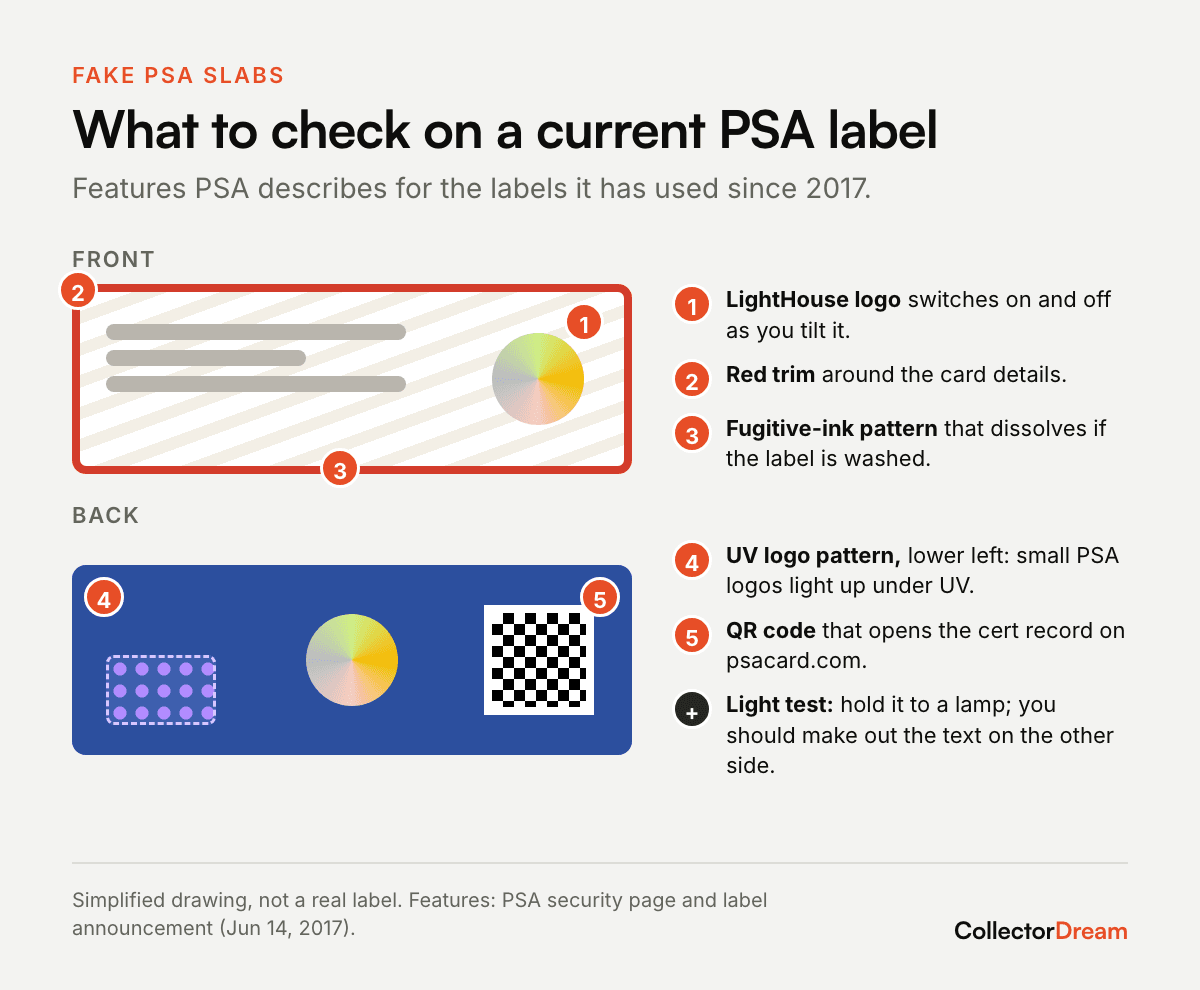
What about older labels? Slabs graded before the 2017 label change don't have the LightHouse logo, so an older label isn't a red flag by itself. Take extra care with them, though: PSA notes that some forgers copy the older label style precisely because it lacks the newer features (PSA buyer's guide).
How do you check the holder?
PSA's holder is tamper-evident, not tamper-proof: its two halves are sealed with a sonic weld that leaves marks if someone breaks it (PSA buyer's guide). Look and feel for three things:
- Frosting. A cloudy, whitish look along the edges where the plastic was forced apart, sometimes with small cracks.
- Flex. A welded holder feels very firm. Once the weld is broken, the plastic becomes noticeably more flexible again.
- Glue and gaps. Glue doesn't restore the weld. PSA says light pressure along the edge, even from a fingernail, can make a re-glued holder creak or pop open, and sometimes an edge is already open.
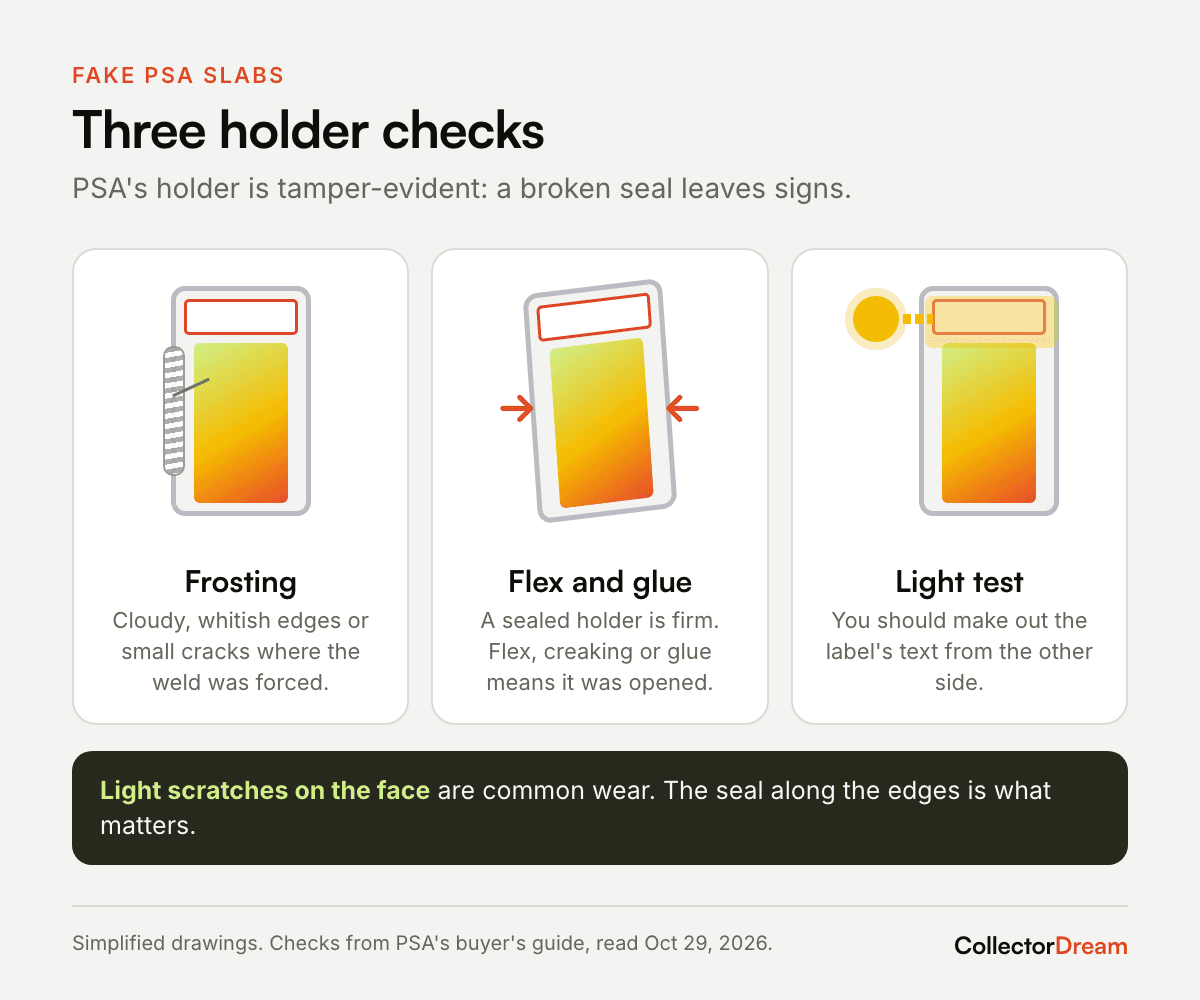
Light scratches on the face of a slab are common wear and, on their own, don't point to a fake. What matters is the seal along the edges.
Does the card match the grade?
Look at the card through the plastic as if you were pre-grading it. A PSA 10 should have sharp corners, clean edges and centering within about 55/45 on the front (PSA grading standards). If the card in a 10 slab is clearly off-center or has visible whitening, something is wrong, however good the label looks.
Our guide to pre-grading cards at home covers what to look for, and the PSA vs CGC vs TAG vs BGS comparison explains what each grade means at each company.
How do you buy graded cards safely?
The best time to catch a fake slab is before you pay. PSA's own advice comes down to a few habits (PSA buyer's guide):
- Know the seller. Buy from a dealer, shop or auction house with a track record, and ask for references on bigger purchases.
- Be wary of unsolicited offers, especially ones that seem too good to be true.
- Ask PSA to review it. PSA says you can contact it to arrange a review of an item before you buy, and suggests making the deal contingent on PSA's confirmation. A seller who hesitates has given you an answer.
- Choose where you buy. PSA says marketplaces such as Craigslist, Mercari and OfferUp aren't recommended for PSA-graded items (PSA).
- Take your time. If anything feels off, wait a day and ask someone you trust.
The same habits protect you with raw cards too. Our guides to spotting fake cards and resealed packs and fake One Piece manga rares cover the cards before they're slabbed.
Where to go next
- How to Pre-Grade Your Cards at Home (judge the card inside the slab)
- PSA vs CGC vs TAG vs BGS (how the four graders compare)
- How to Spot Fake Cards & Resealed Packs
- How Much Is My Pokémon Card Worth? (check sold prices before you buy a slab)
Know what you're buying with CollectorDream
With CollectorDream you can log every card you own, raw or graded, with its cert number and recent sold prices in one place. The app is out now on iOS: download CollectorDream on the App Store, and follow my daily openings on YouTube, TikTok and Instagram.
FAQ
How can you tell if a PSA slab is fake?
Start with the cert lookup on psacard.com and compare every detail and any photos. Then tilt the label to check the LightHouse logo, hold it to a light to make sure you can see through it, and check the holder's edges for frosting, cracks or glue.
Does a valid cert number mean the slab is real?
No. PSA warns that counterfeiters sometimes put real cert numbers, copied from public sources, on fake labels. A matching record is the first check, not proof.
What is the PSA LightHouse label?
It's the label PSA introduced in 2017. Its security features include a logo that switches on and off when you tilt it, fugitive ink that dissolves if the label is washed, a UV logo pattern on the back and a QR code that links to the cert record.
Can PSA check a slab before I buy it?
Yes. PSA says you can contact it to arrange a review of an item before purchase, and it suggests making the deal depend on PSA's confirmation.
Can a real PSA slab be opened and resealed?
It can be opened, but PSA designs its holder to show it. A broken sonic weld leaves frosting or cracks along the edges and makes the plastic more flexible, and glue doesn't restore the seal.
Are older PSA labels fake?
Not by default. Labels from before 2017 don't have the LightHouse logo. PSA notes that some forgers imitate the older style, so check older slabs especially carefully.
Alec Nguyen
Founder, CollectorDream
Scan a card, see its rarity and value
The CollectorDream app reads the card for you. Now on the App Store.
Download on iOS (opens the App Store)