On this page · 11 sections
- What does a real One Piece manga rare look like?
- Front checks: texture, text and the stamp
- Back and feel: color, thickness and stock
- Check the card against Bandai's card list
- Red flags before you buy
- Graded manga rares: check the slab too
- Think you bought a fake?
- Buy from a verified source
- Where to go next
- Check cards with CollectorDream
- FAQ
Updated: October 29, 2026
A fake One Piece manga rare can look right at arm's length and still fall apart under a light and a loupe. Manga rares are among the cards counterfeiters target most, because they're the chase of most sets. This guide walks you through the checks graders use, front and back, how to compare a card against Bandai's own card list, and the red flags to catch before you send any money.
Check | What a genuine card shows | What fakes have shown | Source |
|---|---|---|---|
Art texture | Defined texture that follows the drawing | More uniform texture, softer detail | CGC |
Card text | Crisp, even font | Larger, bolder text | CGC |
Copyright line (bottom right) | Sharp | Noticeably less sharp | CGC |
Authenticity stamp (bottom left) | Small, nearly transparent "One Piece Card Game" | Printed harshly, not transparent | CGC |
Card back | Strong blue | Duller, more purplish | CGC |
Illustration details | Matches the official image | Small drawing differences | SNKRDUNK |
Thickness | Same as your other cards | Often thicker, from an added layer | SNKRDUNK |
Corner markings | Base code, star, number and block icon match Bandai's list | Anything that doesn't match | Bandai card list |
CGC: counterfeit alert on a Luffy manga rare, Aug 9, 2024. SNKRDUNK: counterfeit guide, Aug 8, 2025. Bandai: official card list.
What does a real One Piece manga rare look like?
A manga rare is a parallel print of a card with artwork built from One Piece manga panels. It isn't a separate rarity code: the card prints its base rarity, usually SR or SEC, with a small star above the rarity box that marks it as a parallel. Our One Piece card rarities guide explains the codes, the star and the other special prints.
That matters for spotting fakes in two ways. First, you know exactly what the corner should show. Second, every English manga rare has an official image on Bandai's card list, so you always have a genuine reference to compare against, even if you don't own one.
Front checks: texture, text and the stamp
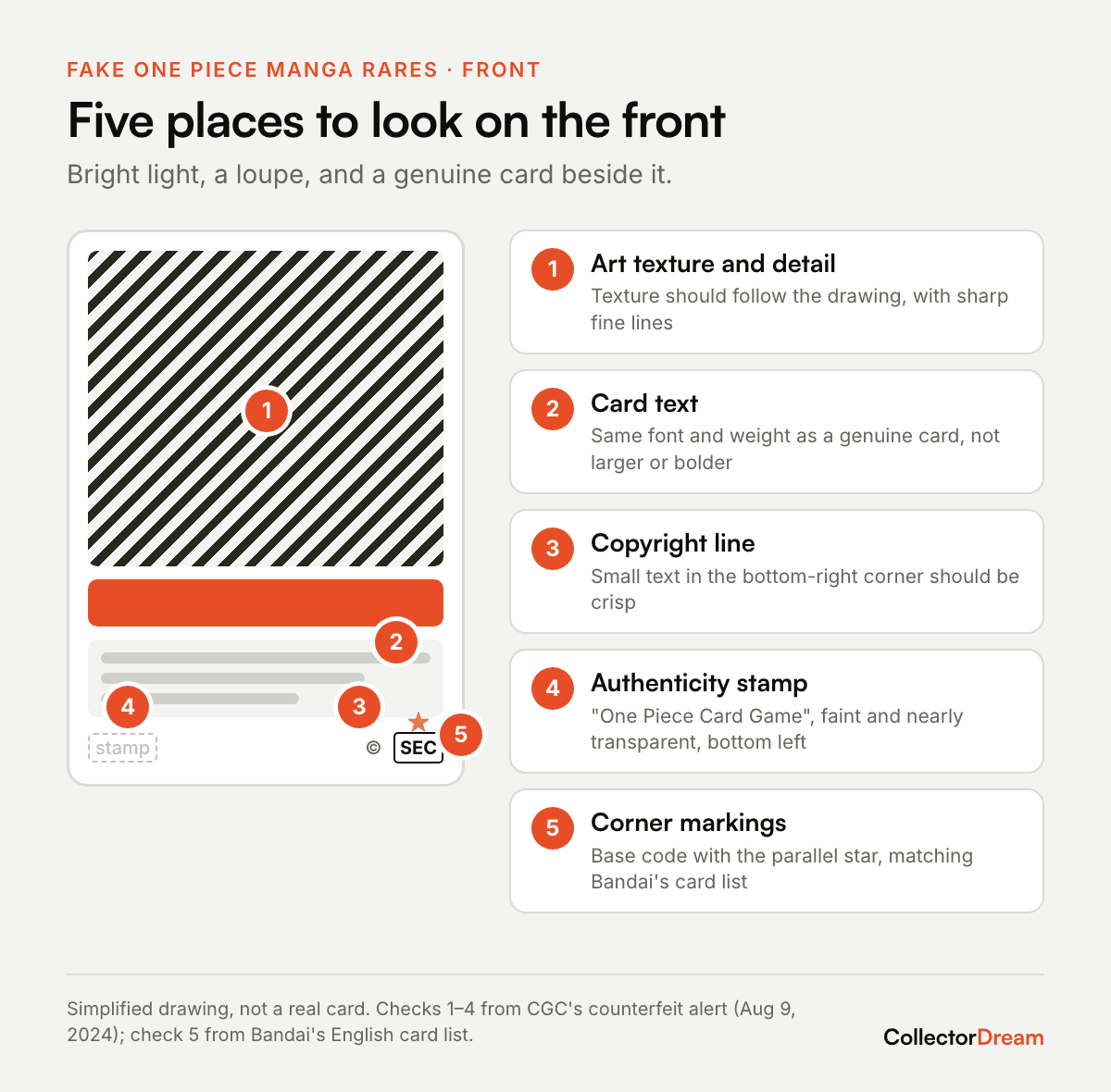
Start with the front, under a bright light, with a loupe or your phone's camera zoomed in. These are the differences CGC's graders found when a fake Luffy manga rare (OP05-119) was submitted to them (CGC, Aug 9, 2024):
- Texture. Tilt the card. On the genuine card, the texture follows the drawing and the details are sharp. On the fake, the texture was more uniform and the fine lines in the portrait and the background panels were softer.
- Card text. Compare the font with a genuine card. The fake's text was larger and bolder.
- Copyright line. The small copyright text in the bottom-right corner was noticeably less sharp on the fake.
- Authenticity stamp. Genuine One Piece cards carry a small, nearly transparent "One Piece Card Game" stamp in the bottom-left corner, near the color symbol. On the fake it was printed harshly and wasn't transparent.
SNKRDUNK's guide adds one more: compare the drawing itself. On a fake gold Luffy SP card it examined, the character's mouth was drawn differently and a ring around a number was the wrong color (SNKRDUNK, Aug 8, 2025).
Back and feel: color, thickness and stock
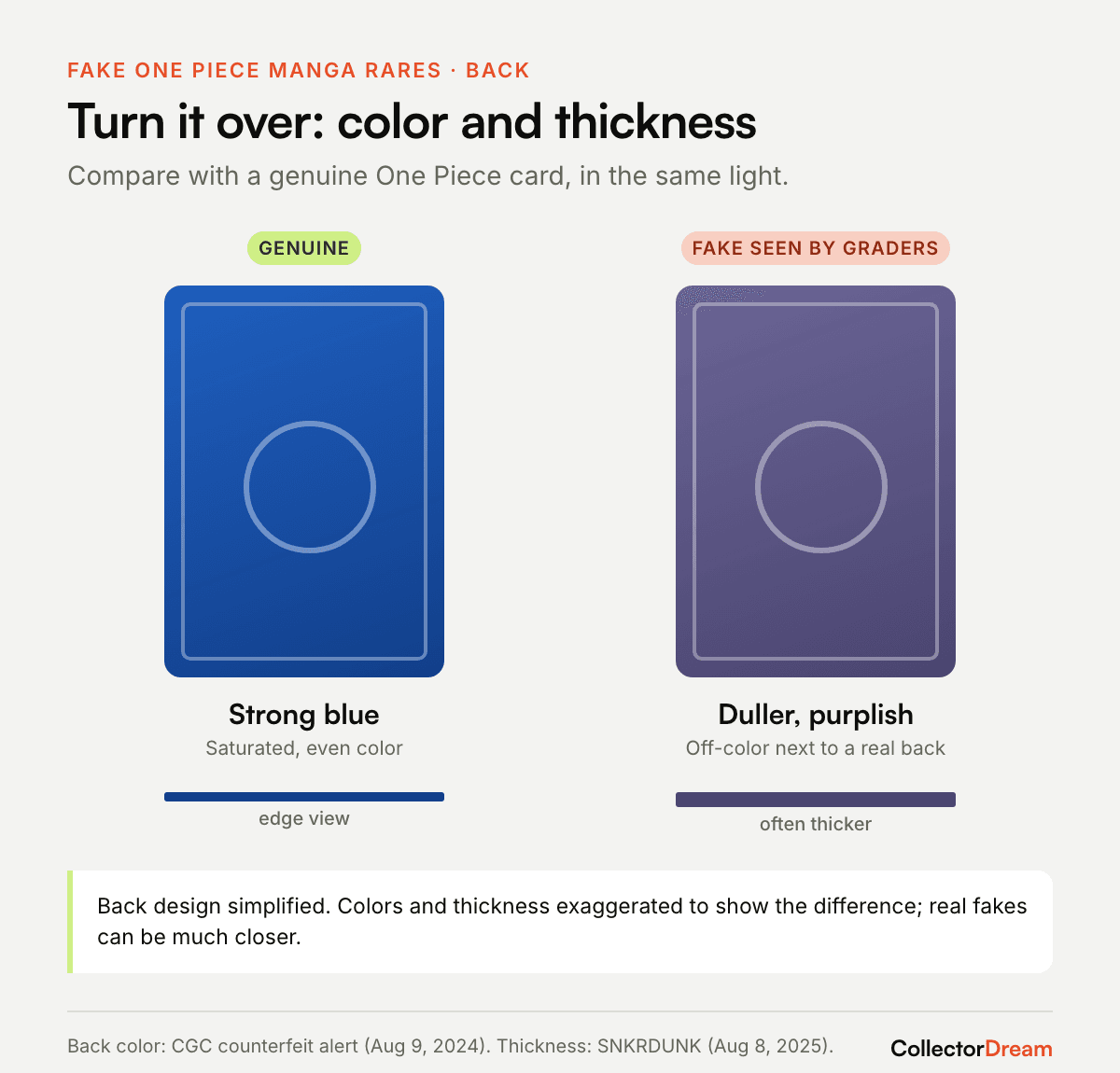
Turn the card over next to a genuine One Piece card. The back of the fake CGC examined was duller and more purplish, while the genuine back was a strong blue (CGC). Misprint calls the blue-versus-purple back one of the fastest checks (Misprint, May 30, 2026).
Then compare how the two cards feel:
- Thickness. SNKRDUNK found fakes are often thicker than genuine cards, because counterfeiters add an extra layer (SNKRDUNK). Stack the card with a genuine one and look at the edges.
- Stock. A fake may flex or feel different in the hand. Do this gently, and never bend a card you might want to grade.
- Light. SNKRDUNK's lab uses infrared light, under which it says a real card takes on a white tint and a fake a black one. Most of us don't have that kit at home, so treat it as a check for a professional.
Check the card against Bandai's card list
Bandai's official card list is your free reference copy. Search it for the card number and open the parallel versions, which are listed next to the regular card (Bandai card list). Then check:
- The card number matches, including the set code (for example, OP05-119).
- The rarity code is the base code of that card (SR or SEC for most manga rares), with the parallel star above it.
- Any block icon in the corner matches the official image.
- The art lines up panel for panel. Fakes made from a scan often have small drawing differences or blurred fine lines.
If a card shows a rarity or marking that doesn't exist on Bandai's list for that number, it isn't a real print, however good it looks.
Red flags before you buy
Most fakes are caught before the card ever reaches you, by looking hard at the listing. Watch for:
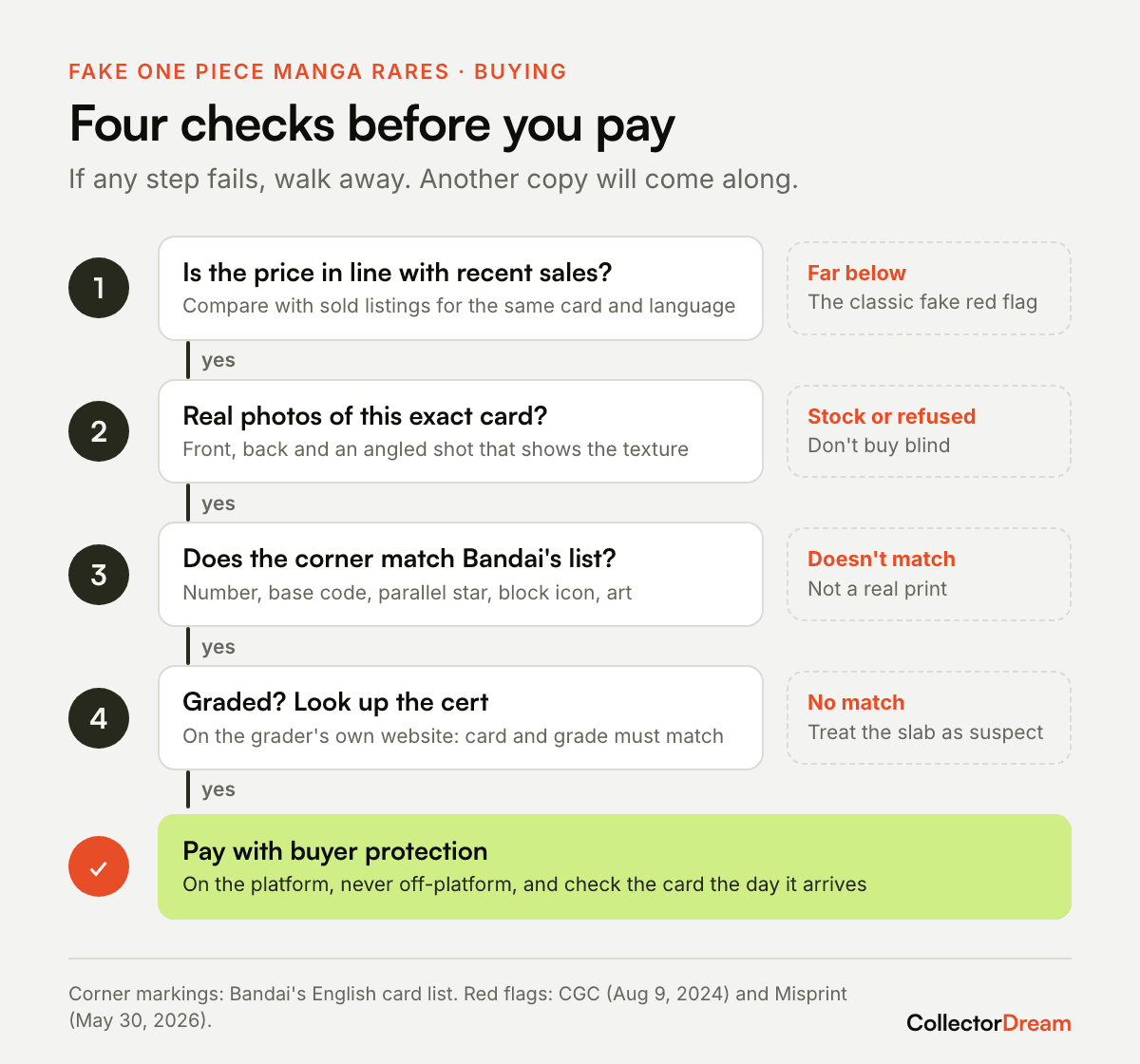
- A price far below recent sold prices. A marquee manga rare listed for much less than it usually sells for is the classic warning sign.
- Stock or borrowed photos. Ask for clear photos of the exact card: front, back, and an angled shot that shows the texture.
- A seller who won't send more photos, or pushes you to pay off-platform.
- Unvetted channels. Misprint ranks peer-to-peer groups and unvetted overseas listings as the riskiest places to buy high-value raw cards (Misprint).
- Replicas sold openly. Bandai says unauthorized replicas of its card designs are sold online and at events, and that they won't be allowed at official tournaments (Bandai, Jul 10, 2026). A replica that changes hands a few times can turn up later listed as genuine.
Bandai has also warned about fake versions of a championship prize card being sold online, and it advises checking product details on the official site before you buy (Bandai, Nov 1, 2024).
Graded manga rares: check the slab too
Buying a manga rare already graded by PSA, CGC, TAG or BGS removes most of the risk, because the grader has authenticated the card. Look up the certification number on the grader's own website and make sure the card, grade and photos match the listing. Fake slabs exist too; our upcoming guide to fake PSA slabs covers what to look for.
If you're weighing whether to grade a raw manga rare you already own, our guide to whether it's worth grading One Piece cards runs the numbers, and PSA vs CGC vs TAG vs BGS compares the graders.
Think you bought a fake?
Act quickly and keep everything:
- Stop handling the card and put it in a fresh sleeve and toploader.
- Photograph it front and back, next to a genuine card, in good light.
- Open a case with the platform or payment service you used, with your photos and the listing.
- Get a second opinion. A grading company will flag a counterfeit, and a local card shop can often compare it against stock.
Don't resell a card you believe is fake, even as a "replica". Once it leaves your hands, the next buyer may not know.
Buy from a verified source
The simplest way to avoid fakes is to buy high-value cards graded, or from sellers and stores with a track record and buyer protection. For sealed product, buy from stores you trust; our guide to spotting fake cards and resealed packs covers resealed boxes and packs.
Where to go next
- One Piece Card Rarities Explained (codes, the parallel star and every special print)
- Most Valuable One Piece Cards 2026 (the cards most worth checking twice)
- How to Pre-Grade Your Cards at Home (the same loupe-and-light routine, for condition)
Check cards with CollectorDream
With CollectorDream you can scan a One Piece card, see its set, number and print, and compare it with recent sold prices before you buy, so a suspiciously cheap manga rare stands out. The app is out now on iOS: download CollectorDream on the App Store, and follow Alec's daily openings on YouTube, TikTok and Instagram.
FAQ
How can you tell if a One Piece card is fake?
Compare it with a genuine card and with its image on Bandai's card list. Fakes found by graders had softer, more uniform texture, bolder text, a blurry copyright line, a harshly printed authenticity stamp and a duller, more purple back.
What color is the back of a real One Piece card?
A strong, saturated blue. CGC described the back of a fake manga rare as duller and more purplish next to a genuine card.
Do real One Piece cards have an authenticity stamp?
Yes. CGC says every One Piece card has a small, nearly transparent "One Piece Card Game" stamp in the bottom-left corner, near the color symbol. On the fake it examined, the stamp was printed boldly and wasn't transparent.
Is a graded manga rare safe to buy?
Much safer than a raw one, as long as the slab is real. Look up the cert number on the grader's website and check that the card and grade match the listing.
Are proxy cards the same as fakes?
Proxies and replicas aren't official cards. Bandai says unauthorized replicas of its card designs won't be allowed at official tournaments, and once they're resold as genuine, they're fakes.
Can a light test spot a fake One Piece card?
Not reliably at home. SNKRDUNK's lab uses infrared light, but the simplest home checks are the back color, the texture and the corner markings, side by side with a genuine card.
Alec Nguyen
Founder, CollectorDream
Scan a card, see its rarity and value
The CollectorDream app reads the card for you. Now on the App Store.
Download on iOS (opens the App Store)